Country:

 City:
City:


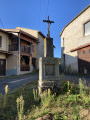
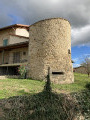
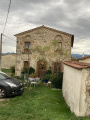
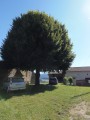
Park on the communal land at the southernmost end of the hamlet of Château, on the site of the commandery demolished on Couthon’s orders during the French Revolution.
(S/E) Take the tarmac road leading to the entrance of the hamlet. Opposite the tetramorphic cross, take the dirt track on the left, which joins the D7.
(1) At the junction just before this, turn left onto the tarmac-surfaced local road leading to the hamlet of Les Bâtisses.
(2) At the entrance to the hamlet, take the dirt track on the right. After about 400 m, turn left, heading south-west, to follow the path that climbs towards La Constancias. You leave the commune of Courpière and head along the edge of Trézioux. At the first junction, on the uphill stretch, take the path climbing to the right to reach La Constancias, where you rejoin the municipality of Courpière and the D7.
(3) Carefully follow the road to the right for about 200 m, then take the path on the left as you leave the hamlet. You’ll reach a three-way junction in the road; take the path opposite, heading north-east, which descends (6% gradient) to a place called La Bouchisse.
(4) At the crossroads, take the track on the left and, almost directly opposite, the second path, heading north-east, which leads to the hamlet of Laudant.
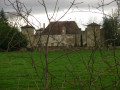
(5) Walk round the hamlet in a clockwise direction and take the opportunity to admire the former fortified house of the Lords of Laudant, whose coat of arms was“azure, a band of gold, a border of gules”: a private property not open to visitors, situated at the northernmost end of the hamlet, overlooking the ravine and its gun tower. The lords of Laudant are said to have contributed financially, alongside the d'Aurelle de Villeneuve family, to the construction of the village church and have a chapel to the south, to the right of the transept.
As you leave, on your right you will find the chapel dedicated to Saint Fiacre, the patron saint of gardeners, which has been converted into a private residence: private property, not open to visitors. After 100 m, take the road on the left at the stone cross (name and origin unknown), then left again at the junction with the tarmac road leading to Vaure.
(6) Turn left, without entering the hamlet, and head down to the hamlet of Charmelat.
(7) Walk round the hamlet and, at the wayside cross with the stone base bearing a coat of arms likely originating from the commandery, head back up the street below the path.
(7) Turn left and head back to the Vaure crossroads.
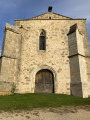
(6) Opposite, head due south along the tarmac road which will take you to the entrance to the village of Courtesserre. At the start of the climb, note the view to the right of the Puy-de-Dôme. Then, at the highest point, note the view to the left of the Forez ridge line and its highest point: Pierre sur Haute. Rejoin the D7 at the entrance to the village, then take the first street on the left, Rue des Granges, which leads to Saint-Martin Church. Take a moment to admire the old parish church, which has been listed in the supplementary inventory of Historic Monuments since 1926: the interior is not open to visitors, which is a great pity, as it features capitals magnificently carved with motifs and thirteen lamp bases, twelve of which depict figurines (13th century?). The original bell tower, a square turret housing four bells, was demolished during the Revolution. Nothing remains of the porch that stood at the church entrance.
(8) Take Rue du Champ de l’Église back to the D7. Turn left and, on leaving the village, follow the first tarmac road on the left, towards Le Château and La Côte. Continue straight on to the hamlet of Le Château, and return to where you parked (S/E).

 Visorando Member
 Easy
Easy 
 Association / Club / Walk leader
 Difficult