Hambleden to Mill End and Hambleden Lock

A short circular walk from the village of Hambleden to the River Thames at Mill End. The walk starts from the village car park adjacent to the Stag and Huntsman Inn, and follows mainly good paths, tracks, and rural lanes. The walk offers a fine view of Hambleden village across the meadows and is packed with interest, including the exhilarating walk across the weir to Hambleden Lock. The Stag and Huntsman Inn at the end of the walk is perfect for refreshment.

Details

94149095
Creation:
Last update:
Last review:
  • Walking
    Activity: Walking
  • ↔
    Distance: 4.92 km
  • ◔
    Average duration: 1h 30 
  • ▲
    Difficulty: Easy

  • ⚐
    Back to start: Yes
  • ↗
    Ascent: + 25 m
  • ↘
    Descent: - 32 m

  • ▲
    Highest point: 71 m
  • ▼
    Lowest point: 30 m

Description of the walk

Start: Hambleden Village car park (pay-and-display) adjacent to the Stag and Huntsman Inn. Postcode: RG9 6RP. Grid ref: SU785865.

(S/E) From the rear of the car park (away from the road entrance), take the footpath signposted (Chiltern Way) by the gate that leads to the cricket ground. Turn left along the edge of the field towards a gap in the hedge in front of Kenricks (A), the large house overlooking the cricket ground.

(1) Go through the gap in the hedge and turn right (south) along the track. After approximately 350 m, turn left at the track junction. Follow the public footpath sign uphill for 110 m to the field entrance (do not go through the main field gate). Turn right through a small gate and continue on the path alongside the hedge to reach North Cot Wood.

(2) Enter the wood through a kissing gate. After a few metres, take the footpath to the right and leave the wood through another kissing gate. Continue across the field, keeping parallel to the wood and enjoying the views. At the end of the field, the path dips left to an old stile - walk around the stile and down 4 steps to reach the lane.

(3) Turn right and follow the lane downhill to the road junction (take care!). Turn left and walk along the footway. Cross the road and continue along the opposite footway past the historic Yewden Manor to reach the main Henley to Marlow Road by Millend Farm (approximately 350 m).

(4) Cross the road (take care!) and take the footpath (signposted) to the right of the Marina entrance. Continue past Hambleden Mill (B) to cross over the River Thames on the weir bridges to Hambleden Lock (C).
Enjoy some time gongoozling (idly watching the boats on the river) before returning to Hambleden.

(5) Retrace your steps to the main road. Take care crossing the road and follow the footway/road towards Hambleden. At the junction on the right to Rotten Row enter the field through the kissing gate (NB: There are toilets in the car park 50m further along the Hambleden road).
The field you have now entered was once part of the extensive Yewden Roman Villa site (D).

(6) Follow the path (north) for about 1.1km across the water meadows towards Hambleden - you will see the village ahead of you. The meadows here are often used for grazing sheep or cattle – keep dogs on short lead! Approximately halfway, you will cross a track and pass through two kissing gates. Here is a good place to view the Hambleden Brook (E).

(7) On reaching the edge of Hambleden village (F), go through the kissing gate just to the left of Hambleden Brook. Turn right, over the bridge, following the road through the village (take care!). Pass the village shop and cafe (on the left) and old pump to the war memorial outside St Mary the Virgin Church (G).

(8) Continue past the old garage (on the right) and, at the road junction, continue ahead passing the old Wheeler’s Butcher’s shop, to return to the Stag & Huntsman Inn and car park (S/E).

We hope you enjoyed your walk. If you experienced any issues with the route description or the paths on this walk, please do let us know.


Waypoints

  1. S/E : km 0 - alt. 48 m - Hambleden village car park - Hambleden village
  2. 1 : km 0.16 - alt. 56 m - Gap in hedge (opposite Kenricks House)
  3. 2 : km 0.88 - alt. 62 m - Kissing gate at wood boundary
  4. 3 : km 1.23 - alt. 70 m - Country lane
  5. 4 : km 2.14 - alt. 35 m - Road junction - Henley to Marlow road
  6. 5 : km 2.58 - alt. 30 m - Hambleden Lock
  7. 6 : km 3.58 - alt. 37 m - Kissing gate
  8. 7 : km 4.66 - alt. 47 m - Kissing gate into village
  9. 8 : km 4.76 - alt. 50 m - Church lychgate
  10. S/E : km 4.92 - alt. 48 m - Hambleden village car park - Hambleden village

Notes

Start: Hambleden Village car park. Postcode: RG9 6RP. OS Grid ref: SU785865.

Parking: Village car park adjacent to the Stag and Huntsman Inn. The car park is pay-and-display (if you choose to park elsewhere in the village, please do so responsibly).

Need to Know!

  • This easy route follows rural paths, tracks, and lanes. They may be rough, wet or muddy in part.
  • Some of the rural lanes/tracks that feature in the walk do not have footways. They are regularly used by walkers and horse riders, but please do take care!
  • Take extra care crossing the main Henley to Marlow road (waypoint 4)
  • You may encounter sheep or cattle in the meadows between waypoints (6) and (7) - keep dogs on short lead!

Refreshments :

Worth a visit

(A) Kenricks House - Kenricks, a Grade II-listed building, was the birthplace of Saint Thomas Cantilupe in 1218. Cantilupe was appointed Bishop of Hereford and Lord Chancellor of England, and was a trusted adviser of King Edward I. He was canonised in 1320. Another notable resident was Philadelphia Carey, Baroness Scrope of Bolton, a cousin and Lady-in-Waiting to Queen Elizabeth I and to Queen Anne of Denmark. In 1938, the house was acquired by William Henry Smith, 3rd Viscount Hambleden, descendant of the founder of newsagent and stationery group WH Smith.

(B) Hambleden Mill - A mill at Hambleden is mentioned in the Domesday Book of 1086. The mill was powered by the River Thames and was once an important site for milling flour. In the 19th century, it was providing flour to the Huntley & Palmers biscuit factory in Reading. The site continued operating as a flour mill until 1955. The magnificent building is Grade II Listed and has since been preserved and repurposed as flats.

(C) Hambleden Lock - There has been a lock at Hambleden since at least 1338, possibly earlier associated with the Mill. The pound lock was built in 1773 and rebuilt in 1870 and 1994. The great weir with its walkways is an impressive site and an ancient right of way across the river. In 1777, the eccentric Caleb Gould became keeper and remained in post at the lock for 59 years (he was succeeded by his son). He wore a long coat, baked bread for bargemen, and ate a dish of onion porridge every night!

Hambleden Lock and Mill feature in Charles Dickens' short ghost story "The Phantom of Regatta Island" (1869). The Lock also features in Jerome K. Jerome’s novel, Three Men in a Boat (1889). Hamble Lock is approximately 2 miles downstream from Henley Bridge. The lock and weir are a popular place to gongoozle - idly watch the boots on the river and passing up and down through the lock. There are often people kayaking and canoeing on the rough water just below the weir.

(D) Yewden Roman Villa - The Yewden roman villa site was discovered to the south of Hambleden in 1912. It comprises a large villa and associated buildings including kilns, temples and trackways. The site featured in the TV archaeology series, Digging for Britain presented by Dr Alice Roberts. The skeletal remains of 97 newborn babies were discovered here! Roman villa north of Yewden Lodge, Hambleden - 1014606 | Historic England

(E) Hambleden Valley and Hamble Brook- The Hambleden Valley and surrounding hills are in the Chilterns National Landscape. The valley cuts north to south through the chalk hills to the River Thames, sculpted by meltwaters during the Ice Age. The valley has long been occupied: flint tools evidence Neolithic occupation, remains of Roman settlement to the north and south of Hambleden village, and the village is recorded in the Doomsday Book of 1086. Today, the valley has a secluded, tranquil feel to it, characterised by rolling farmland and water meadows framed by the surrounding wooded hills.

The clear chalk Hamble Brook meanders along the valley bottom towards the River Thames. It is one of 9 major chalk streams in the Chilterns. Chalk streams are globally rare and a special quality of the Chilterns National Landscape. The stream is fed from groundwater stored in the chalk aquifer, which emerges as a spring near Skirmett. The Hamble Brook is a winterbourne (a stream which usually only flows in winter) relying on heavy rainfall to top up the aquifer and maintain the flow. It often dries up along parts of its course.

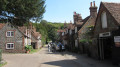
(F) Hambleden village- The village name, Hambleden, is Anglo-Saxon in origin and means crooked or irregularly shaped hill. The village, with many flint and red brick buildings clustered around the church, is one of the prettiest in the Chilterns. As you stroll through the village, it is easy to see why it has become a popular location for filming. Films which feature the village include: The Captive Heart, Chitty Chitty Bang Bang, The Witches, The Legacy, Dance with a Stranger, Sleepy Hollow, the remake of The Avengers starring Ralph Fiennes, 101 Dalmatians, and Three Bags Full, a sheepish murder mystery starring Hugh Jackman and Emma Thompson. The village has also been a regular location for various TV series, including Band of Brothers, the Two Ronnies, Agatha Christie's Poirot, A Village Affair, Rosemary & Thyme, Endeavour, and Midsomer Murders.

During the build-up to D-Day in 1944, the village was a base for US troops.

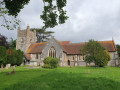
(G) St Mary the Virgin Church- The church dates from the 12th century. It originally had a central tower, but this was replaced by the current tower in 1721 (modified in the early 1880’s). The tower holds eight bells, the oldest of which predates the Reformation. There is much of interest within the church, including:

  • The monument of Sir Cope D'Oyley (died 1633), his wife Martha and her ten children (note the children holding skulls who died before their parents);
  • The 12th century stone font and blocked ‘Devil’s’ doorway;
  • A carved wooden panel in the Wolsey Alter, said to be the remnants of Cardinal Wolsey’s bedstead; and
  • The munitions chest that belonged to Lord Cardigan (former Hambleden resident), infamous for leading the ill-fated charge of the Light Brigade.

In the churchyard is the domed Kenrick Mausoleum, and the grave of WH Smith (newspaper/bookseller), who became Lord Hambleden. His former house, ‘Greenlands’, is situated by the Thames near Mill End.

Other walks in the area

For more walks, use our search engine .

The GPS track and description are the property of this route's author. Please do not copy them without permission.