(A) Kenricks House - Kenricks, a Grade II-listed building, was the birthplace of Saint Thomas Cantilupe in 1218. Cantilupe was appointed Bishop of Hereford and Lord Chancellor of England, and was a trusted adviser of King Edward I. He was canonised in 1320. Another notable resident was Philadelphia Carey, Baroness Scrope of Bolton, a cousin and Lady-in-Waiting to Queen Elizabeth I and to Queen Anne of Denmark. In 1938, the house was acquired by William Henry Smith, 3rd Viscount Hambleden, descendant of the founder of newsagent and stationery group WH Smith.
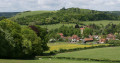
(B) Hambleden Valley and Hamble Brook - The Hambleden Valley and surrounding hills are in the Chilterns National Landscape. The valley cuts north to south through the chalk hills to the River Thames, sculpted by meltwaters during the Ice Age. The valley has long been occupied: flint tools evidence Neolithic occupation, remains of Roman settlement to the north and south of Hambleden village, and the village is recorded in the Doomsday Book of 1086. Today, the valley has a secluded, tranquil feel to it, characterised by rolling farmland and water meadows framed by the surrounding wooded hills.
The clear chalk Hamble Brook meanders along the valley bottom towards the River Thames. It is one of 9 major chalk streams in the Chilterns. Chalk streams are globally rare and a special quality of the Chilterns National Landscape. The stream is fed from groundwater stored in the chalk aquifer, which emerges as a spring near Skirmett. The Hamble Brook is a winterbourne (a stream which usually only flows in winter) relying on heavy rainfall to top up the aquifer and maintain the flow. It often dries up along parts of its course.
(C) Hambleden village - The village name, Hambleden, is Anglo-Saxon in origin and means crooked or irregularly shaped hill. The village, with many flint and red brick buildings clustered around the church, is one of the prettiest in the Chilterns. As you stroll through the village, it is easy to see why it has become a popular location for filming. Films which feature the village include: The Captive Heart, Chitty Chitty Bang Bang, The Witches, The Legacy, Dance with a Stranger, Sleepy Hollow, the remake of The Avengers starring Ralph Fiennes, 101 Dalmatians, and Three Bags Full, a sheepish murder mystery starring Hugh Jackman and Emma Thompson. The village has also been a regular location for various TV series, including Band of Brothers, the Two Ronnies, Agatha Christie's Poirot, A Village Affair, Rosemary & Thyme, Endeavour, and Midsomer Murders.
During the build-up to D-Day in 1944, the village was a base for US troops.
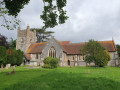
(D) St Mary the Virgin Church - The church dates from the 12th century. It originally had a central tower, but this was replaced by the current tower in 1721 (modified in the early 1880’s). The tower holds eight bells, the oldest of which predates the Reformation. There is much of interest within the church, including:
- The monument of Sir Cope D'Oyley (died 1633), his wife Martha and her ten children (note the children holding skulls who died before their parents);
- The 12th century stone font and blocked ‘Devil’s’ doorway;
- A carved wooden panel in the Wolsey Alter, said to be the remnants of Cardinal Wolsey’s bedstead; and
- The munitions chest that belonged to Lord Cardigan (former Hambleden resident), infamous for leading the ill-fated charge of the Light Brigade.
In the churchyard is the domed Kenrick Mausoleum, and the grave of WH Smith (newspaper/bookseller), who became Lord Hambleden. His former house, ‘Greenlands’, is situated by the Thames near Mill End.
(E) Elizabethan manor house - The Elizabethan manor house was built in 1603 for Emanuel, the 11th Baron Scrope, who became Earl of Sunderland. Charles I took refuge here o nenight in 1646 while fleeing from Oxford. The old manor house is also the former home of Lord Cardigan (born here in 1779), who led the ill-fated charge of the Light Brigade during the Battle of Balaclava on 25 October 1854, during the Crimean War.



 Pays:
Pays:

 Commune:


 Association / Club / AMM
 Moyenne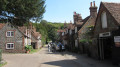
 Visorandonneur
 Professionnel du tourisme
