Great Kimble, Pulpit Hill and Ellesborough

This walk explores the diverse archaeology visible in just one square mile of the Chiltern Hills, visiting Pulpit Hill (an Iron Age Hillfort), the villages of Ellesborough, Great Kimble and Little Kimble, all with interesting churches and a deserted medieval village.

Details

97673306
Creation:
Last update:
Last review:
  • Walking
    Activity: Walking
  • ↔
    Distance: 3.84 mi
  • ◔
    Average duration: 2h 10 
  • ▲
    Difficulty: Easy

  • ⚐
    Back to start: Yes
  • ↗
    Ascent: + 486 ft
  • ↘
    Descent: - 486 ft

  • ▲
    Highest point: 837 ft
  • ▼
    Lowest point: 367 ft

Photos

Description of the walk

START & FINISH: Lay-by in Great Kimble (A4010) HP17 0XS. Grid ref: SP 825 058

(S/E) Go to the Great Kimble end of the lay-by and turn right up the bridleway on the North Bucks Way towards Pulpit Hill fort. Ascend for 700m as far as a path coming from the right (the Ridgeway National Trail). Go down this path for 20m to look at ‘The Butts’, a rifle range from WWII. If you’re lucky, you will find edible snails (protected), a relic from the Roman occupation, in the vegetation. Turn round, return to the bridleway and turn right to continue climbing as it becomes a narrower ‘hollow-way’ created by years of foot and animal traffic. In 350m, shortly after entering woodland, the bridleway meets a waymark post, 20m on from a disused metal gate on the right.

(1) Take an unmarked but well-used path ascending to the right, passing a National Trust sign after 75m. Keep to the path running at the top of the steep slope - the views from the summit are worth the effort. This eventually leads to (A) Pulpit Hill hillfort. After 120m, look for a faded painted waymark on a large beech tree. You are now inside the rampart of the hillfort on the northeast corner. Turn left and walk across the hillfort.

After exploring the hillfort, return by the same route, descending to the bridleway by the metal gate. Cross to the footpath opposite and go through woods to a kissing gate. Descend across a wooded pasture, taking the lower path to a wire fence on the right-hand side and a gate in the corner of the field.

(2) Turn right through the gate to rejoin the Ridgeway. Ignore the path to the left and continue straight across the field to the next gate in the corner. Do not go through it, but stand and admire the magnificent views towards Chequers, the Prime Minister’s country residence. Turn left in front of the gate and follow the field edge for 350m to a kissing gate (B).

Go through and continue straight ahead over a crossing track and along a wide woodland track. Follow it round to the right, then to the left and, after leaving the woodland, pass through a kissing gate and head straight across the field to a gap in the fence and hedgerow ahead.

(3) Descend the steep steps and on through a large area of box trees to a gate. Go through the gate and follow the path round (C) Beacon Hill.

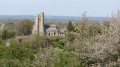
Drop down through a wooden kissing gate and across a field towards the church ahead. On the right are the Lady Dodd's Cottages, originally built in 1746 as eight almshouses for the poor people of the parish. Go through the kissing gate and turn right along a short path parallel to the road. Cross the road and climb up to (D) Ellesborough Church. Pass with the church on your right-hand side and descend by steps through the modern graveyard to a kissing gate. Continue in the same direction for 200m to a gap in the fence line.

(4) Go through and turn left along the Aylesbury Ring path, through two fields to a stile and between gardens to reach the Ellesborough Road. Turn right along the verge and then along the pavement opposite to visit (E) Little Kimble Church after 300m. Turn left out of the churchyard and left again to the A4010. Cross with care to the pavement opposite and walk up the hill for 400m to reach (F) St Nicholas Church, Great Kimble.

(5) Turn right down Church Lane past Great Kimble School. Note the flint cottages, with interesting re-use of wine bottles in Moss Cottage on the left. After 150m, by the 30mph sign, take the raised path to the left and enter a field by a gate donated by Ealing Outdoor Club.

Cross the stile and continue ahead past a large (G) medieval fish pond on the right. Pass to the right of a stile at the edge of a field to follow the overhead power lines across the field to a kissing gate.

(6) Do not go through the gate, but instead turn left diagonally back across the field in the direction of the church. Pass through the earthworks of a (H) deserted medieval village to an iron kissing gate at the top left-hand corner. Go through it and along the short path to the road. Cross the A4010 with care to return to the start.(S/E)

"We hope you have enjoyed your walk. Please remember to rate the walk and add comments. We are interested in how we could improve the instructions or the route and would like to hear about any issues with paths on the walk."

Waypoints

  1. S/E : mi 0 - alt. 413 ft - Start
  2. 1 : mi 0.7 - alt. 797 ft - Turn to Pulpit Hill
  3. 2 : mi 1.11 - alt. 686 ft - Right through gate
  4. 3 : mi 1.71 - alt. 640 ft - Down steps
  5. 4 : mi 2.36 - alt. 400 ft - Left on Aylesbury Ring
  6. 5 : mi 3.32 - alt. 436 ft - Right down Church Lane
  7. 6 : mi 3.64 - alt. 397 ft - Back towards church
  8. S/E : mi 3.84 - alt. 413 ft - Finish

Notes

TERRAIN: An easy walk on good paths with one long climb at the start.

START & FINISH: Lay-by in Great Kimble (A4010) HP17 0XS. Grid ref: SP 825 058

FOOD & DRINK: None on the walk, but nearby pubs include The Swan in Grove Lane, Great Kimble, The Three Crowns in Askett and The Russell Arms at Butlers Cross

PARKING: Lay-by just off the A4010 Risborough Road in Great Kimble

LOCAL TRANSPORT: Bus 300 runs between High Wycombe and Aylesbury all week. Bus 321 runs between High Wycombe and Aylesbury on Mondays to Fridays. Princes Risborough Community Bus runs to Great Kimble on Mondays and Thursdays

This walk was created for the book "50 Great Walks in the Chilterns".

Worth a visit

(A) PULPIT HILL is a well-fortified Iron Age hillfort dating back some 2,400 years and is one of several along this edge of the Chilterns. There are others nearby at Ivinghoe, Wendover and Cholesbury. They served a variety of possible purposes, from status symbols to places of refuge in times of strife.
(B) GREAT KIMBLE WARREN: Warrens were created for breeding rabbits as a valuable source of food and fur. In the woods, but not accessible, are cross dykes, land boundaries dating back to the Bronze Age. Nearby are two further warrens, Little Kimble and Ellesborough.

Great Kimble Warren is also noted for its ancient box woodland, the largest in the UK. Box was regarded as the best wood for woodcarving. It was also used for musical instruments and bobbins. In 2013, the Chilterns Conservation Board launched the Chilterns Box Woodland Project to research, conserve and celebrate the area’s box heritage.
(C) BEACON HILL has a prehistoric round barrow and has been used as a beacon and Second World War gun emplacement.

Down the hill, towards the road there is a motte and bailey castle known as 'CYMBELINE'S CASTLE' (a Victorian name) to the left amongst the trees, built by the Normans in the 11th Century as protection from a hostile local population.
(D) ELLESBOROUGH CHURCH is a 15th century flint-faced building. It’s where the then Prime Minister, Mrs. Thatcher, famously announced ‘We are a grandmother’. To the right of the path leading to the south door is a gravestone with an interesting and moralising inscription about a John Bradley, who died in his 97th year.
(E) LITTLE KIMBLE CHURCH dates from the 13th century and has amazing 14th century wall paintings and medieval floor tiles. From the churchyard at the rear can be seen the remains of a motte and bailey castle and a moat, built either as a subsidiary fort to 'Cymbeline's Castle' for its protection or when King Stephen and Queen Matilda were fighting for the throne and probably used in conjunction with the one above for better protection.
(F) ST NICHOLAS CHURCH, Great Kimble is a 13th century church much restored in the Victorian period. A roadside sign depicts the 1635 protest of local MP, John Hampden, against the attempt of King Charles I to raise Ship Money without reference to Parliament. Near the churchyard, according to the Ordnance Survey Map, is a ‘tumulus’. But this is no ordinary Neolithic or Bronze Age tumulus. Twenty metres wide by 3m high, it revealed Romano-British pottery when excavated in 1887 and 1950, and is believed to be contemporaneous with a neighbouring minor Roman villa. Such Roman tumuli are extremely rare. There are only 150 in Britain, mainly in East Anglia.
(G) MEDIEVAL FISH PONDS AND MOATS: Ponds would have been for breeding fish, an important part of the medieval diet. They were considered pure and therefore acceptable for fasting not just on Fridays, but also on Wednesdays, Saturdays and Holy Days. Moats were not generally defensive but were status symbols constructed between 1150 and 1325 for the newly-rich lesser-gentry. They also provided protection for stored crops and water for domestic purposes.
(H) MEDIEVAL VILLAGE: The earthworks are the remains of a medieval village. It was abandoned due to a number of factors: sheep-raising, greater mobility of peasants, the growth of woollen-industries in towns and deteriorating weather. Also visible in this area are ridges and furrows associated with medieval agriculture. In the left corner of the field is a spring which the village depended on for its water supplies.

Other walks in the area

For more walks, use our search engine .

The GPS track and description are the property of this route's author. Please do not copy them without permission.