Little Hampden, Dunsmore and Coombe Hill

A beautiful ridge walk through Chiltern woodlands with some magnificent views as you pass over Coombe Hill.

Details

59288450
Creation:
Last update:
Last review:
  • Walking
    Activity: Walking
  • ↔
    Distance: 8.52 km
  • ◔
    Average duration: 2h 50 
  • ▲
    Difficulty: Moderate

  • ⚐
    Back to start: Yes
  • ↗
    Ascent: + 134 m
  • ↘
    Descent: - 134 m

  • ▲
    Highest point: 262 m
  • ▼
    Lowest point: 163 m

Photos

Description of the walk

Start & Finish Little Hampden (HP16 9PS). Grid ref: SP 857 040. In the lay-by opposite the red brick houses (formerly the site of the Rising Sun pub) just before the road ends.

(S/E) Go back down the lane to (A) Little Hampden Church. Turn left down the bridleway opposite, ignoring the right fork into a field. Keeping the hedge on your left, follow the bridleway through the valley, bearing right and then left up into the woods on the far side. Climb steeply to reach two wooden kissing gates.

Go through the left-hand kissing gate and ahead through the woods ignoring all crossing paths for 1 Km. Where the woods start to thin out, giving views of the valley to your left, ignore the right turn indicated by arrows on a tree and continue ahead for 120m to turn right on a path soon after a large clearing. Follow it uphill all the way to the top.

(1) Turn left along the bridleway with a wire fence on your left. Where a wide track joins from the right (opposite ‘Hampdenleaf’) continue ahead, soon leaving the woods and passing between high hedges.

On reaching an uneven tarmac track, continue ahead past cottages and a small church to the crossroads by the pond in Dunsmore. Go straight on along the lane opposite, signposted ‘Dunsmore Village Only’. After the last house (‘The Beeches’) continue ahead on the bridleway, ignoring the track with barriers on the left to a fork.

(2) Where the bridleway forks, bear left into the wood and stay in the same direction, ignoring all paths to the left and right, for 1 Km. Continue past where the fence on the right peters out and walk between two old metal gates that face each other. Stay straight ahead on the footpath for a further 200m to meet a line of trees on a bank. Go over the bank past old metal fence posts either side of the path to a crossing bridleway.

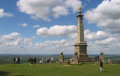
(3) Great care is needed to ensure the correct path is taken. Do not turn right along the bridleway, instead, stay straight ahead to follow the sometimes indistinct path through the wood. Pay attention to the map and occasional arrows marked on the trees. Stay in the same general direction for 300m to meet a wide bridleway. Cross, go through a gate in the fence ahead and turn right to a gate which is the entrance to Coombe Hill. Go through the gate and turn left keeping to the left-hand side of the open space to meet a gravelled track. Turn right and follow it to reach the monument (B).

(4) Just past the monument turn left and take the path to the right of the hedge along the edge of the escarpment, following The Ridgeway National Trail (note the acorn symbol). The rear of (C) Chequers can be seen in the valley to the right. At the edge of the woods turn left uphill to a metal kissing gate. Turn right through the kissing gate to follow The Ridgeway through the woods.

At a road turn right down the hill and after 150m turn left just past Lodge Hill Farm. Continue to follow the well-signposted Ridgeway path through the wood.  After 750m it turns right and drops steeply downhill for a further 200m to meet a crossing track.

(5) At the crossing track turn left onto the South Bucks Way, then take the left-hand path uphill. Follow it as it meanders through the woods for 600m, keeping left at a minor fork to reach a major path junction with a wide field entrance directly ahead. Walk towards the field entrance and take the second path on the left (signposted South Bucks Way). Follow this sometimes quite narrow path through the woods. On meeting a bridleway continue straight ahead into Little Hampden.(S/E)

"We hope you have enjoyed your walk. Please remember to rate the walk and add comments. We are interested in how we could improve the instructions or the route and would like to hear about any issues with paths on the walk."

Waypoints

  1. S/E : km 0 - alt. 224 m - Little Hampden
  2. 1 : km 1.25 - alt. 212 m - Bridleway left
  3. 2 : km 3.14 - alt. 231 m - Fork left
  4. 3 : km 4.67 - alt. 259 m - Crossing bridleway - Take Care
  5. 4 : km 5.24 - alt. 253 m - Monument
  6. 5 : km 7.17 - alt. 219 m - Waypoint 10
  7. S/E : km 8.52 - alt. 224 m - Little Hampden

Notes

Start & Finish: Little Hampden (HP16 9PS). Grid ref: SP 857 040

Terrain: Fairly level, but one short, steep ascent near the beginning.

Food & Drink: Buckmoorend Farm Shop is near Waypoint 5 - continue downhill for 200m and the Farm Shop is signed to the left. The kitchen, open Fri, Sat, Sun 10-4, serves hot snacks and drinks.

Parking: In the lay-by opposite the red brick houses (formerly the site of the Rising Sun pub) just before the road ends

Local Transport: No public transport to the start. At nearby Butlers Cross, Bus 321 runs between Aylesbury and High Wycombe and there is also the Princes Risborough Circular bus.

This walk was created for the book "50 Great Walks in the Chilterns" available from the Chiltern Society or from Amazon.

Worth a visit

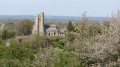
(A) Little Hamden Village and Church: The villages of Great and Little Hampden appear in the Domesday Book, when they were jointly called ‘Hamdena’, after the owners of the local manor. By the 14th century there were two distinct villages, each on a separate hill with arable land in the valley between them.

The little church has no dedication of its own because it was originally linked with the church at Hartwell. Its most interesting feature is its wall paintings. These include the remains of a 14th century Weighing of the Souls (Doom), with the Virgin Mary at one end of the scales and the Devil at the other; what is reputed to be the oldest representation of St Christopher (13th century); two 13th century figures, probably St Peter holding a book and key and St Paul holding a sword; and a much defaced 12th century figure of a bishop, found during the Victorian restoration. The ancient altar stone was buried in the floor, presumably during the Reformation, and was placed in its present position in 1942.

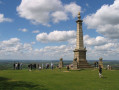
(B) Coombe Hill and the monument : Coombe Hill, which has been owned by the National Trust since 1918, is the highest viewpoint in the Chilterns at 260m above sea level. It commands extensive views across the Vale of Aylesbury, as well as towards the Cotswolds in one direction and Ivinghoe Beacon in the other. There is a toposcope which points out some of the distinctive features visible on a clear day. Coombe Hill is a designated Site of Special Scientific Interest because of its chalk grassland and acid heathland, where over 30 species of wildflower and 28 species of butterfly can be found. The site is grazed by cattle during the summer so that the grass remains short and the wild flowers can thrive.

The monument dates from 1904. It was built in memory of the 148 men of Buckinghamshire who gave their lives in the Boer War (1899-1902). It had to be rebuilt after a lightning strike in 1938, and was later subject to further damage and vandalism, before being re-dedicated after restoration work in 2010.

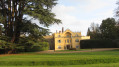
(C) Chequers is the country retreat of the Prime Minister. Although there has been a house on the site since the 12th century, little is known about its history before it was restored by William Hawtrey in the 16th century. Shortly afterwards Lady Mary Grey, younger sister of Lady Jane Grey, was confined there when she was banished from court by Queen Elizabeth I. The house eventually became linked by marriage to the family of Oliver Cromwell and still contains a large collection of Cromwell memorabilia.

In the 19th century Gothic-style alterations were made at the expense of the Tudor panelling and windows, but some Tudor features were subsequently reinstated by Mr and Mrs Arthur Lee (later Lord and Lady Lee of Fareham). During WWI it became a hospital, then a convalescent home for officers. After the war the Lees, who were childless, gave Chequers to the nation as a country retreat for serving Prime Ministers.

Reviews and comments

4 / 5
Based on 1 review

Reliability of the description
4 / 5
Ease of following the route
Non utilisé
Route interest
4 / 5
aardvarkkrill
aardvarkkrill

Overall rating : 4 / 5

Date of your route : Sep 22, 2025
Reliability of the description : ★★★★☆ Good
Ease of following the route : Not used / Not applicable
Route interest : ★★★★☆ Good
Very busy route : No

This is a lovely walk, with a lot of it in the woods amongst trees. The view from the monument is vast, and if it's not too windy it's a good place to sit. Some of the paths are a little hard to follow from the description alone, but the GPS makes it clear.

Other walks in the area

For more walks, use our search engine .

The GPS track and description are the property of this route's author. Please do not copy them without permission.