Grand Bargy and Petit Bargy from Saint Bruno

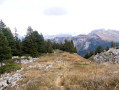
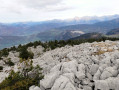
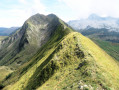
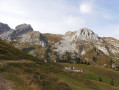
I suggest you climb the peaks of Grand Bargy and Petit Bargy in succession in a wild environment with some beautiful panoramic views. Please note that the route includes a few off-trail sections in a chaotic environment with fairly extensive sharp limestone pavement.
You will cross a ZSM (Zone of Major Sensitivity) for the protection of the bearded vulture: please read the practical information.

Details

86850309
Creation:
Last update:
Last review:
  • Walking
    Activity: Walking
  • ↔
    Distance: 12.65 km
  • ◔
    Average duration: 7h 05 
  • ▲
    Difficulty: Very difficult

  • ⚐
    Back to start: Yes
  • ↗
    Ascent: + 1,224 m
  • ↘
    Descent: - 1,218 m

  • ▲
    Highest point: 2,297 m
  • ▼
    Lowest point: 1,212 m

Photos

Description of the walk

The start is from the hamlet of Saint-Bruno along the Route de la Colombière (RD4), about 2 km from the village of Le Reposoir (there is a small car park near a stream).

(S/E) Follow the road uphill for about 300 metres.

(1) Heading north, continue right on Chemin de Malatrait. Further up, you will reach the Malatrait chalets.

(2) Continue straight ahead towards Petit Bargy, then after a steep climb, you will reach the Chalets de La Cha. Pass them on your right.

(3) At a nearby intersection, continue left towards Petit Bargy. You will return via the right.

(4) Not far away, at asecond intersection, turn left towards a cave (with a statue of the Virgin Mary), then take a short, slightly rough path. You will then reach another path to follow to the left uphill. Heading north-west, continue through grassy terrain, then rocky terrain as you cross a scree slope. After a few steep sections, you will reach the Col d'Encrenaz.

(5) Heading southwest, continue left on an unmarked path, staying on the ridge and tackling a difficult section that requires a little care. Then continue straight ahead for an ascent, following some orange markings and tackling two successive chimney sections. You will reach a gentler section and join a more marked path: try to note this location for the return journey.

(6) Continue straight ahead, heading west, then southwest, encountering a few unexpected difficulties and tackling two small passes in succession. The route then avoids a peak (elevation 2229), then turns slightly to the right at a large cairn. Reach an unnamed pass.

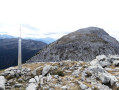
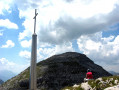
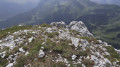
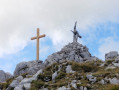
(7) Be careful, from this point onwards the route becomes significantly more difficult, winding to the right and left around crevasses and following the orange markings and cairns as best you can. A little higher up, continue on a much easier route where the slope gradually flattens out. Reach the summit of Grand Bargy, which is not very marked. Continue for about 100 metres and you will reach another summit marked by a cross.

(8) There are beautiful views from this spot. Retrace your steps with greater caution in this direction.

(6) Shortly before the descent to the Col d'Encrenaz, it is best to follow the less difficult route on the right. After passing through a chimney, bear left (avoid going straight ahead on a more difficult route) and you will soon rejoin the route you took on the way up. Bear right in the second chimney, then left to reach the pass further down.

(5) Continue straight ahead until you reach a short steep section. You will then reach the summit of Petit Bargy.

(9) There are beautiful views from this spot. Head towards the cross and follow another path to the left, heading north-east (blue markings, more or less clearly visible). You will reach an intersection where three paths meet.

(10) Follow the middle path, which is the least marked, heading towards the small, slightly overhanging ridge. Please note that from this point onwards, the route becomes more difficult with some steep sections near crevasses (follow the blue markings): in short, continue along a route that follows a ridge for a short while, then turn right onto a downhill section and continue slightly to the left at the bottom.

(11) Continue south-east, to the right. The path passes near the summit of Tête des Bécus: continue straight ahead, heading south-east on moderate slopes, then steeper slopes with a few rocky sections. Further down, you will reach an intersection.

(12) Continue to the right towards Sur la Cha.

(3) Follow the route back in reverse on the left, taking the carriage road to return to the car park (S/E).

Waypoints

  1. S/E : km 0 - alt. 1,213 m - Route de la Colombière RD4 - Saint-Bruno
  2. 1 : km 0.29 - alt. 1,235 m - Saint Bruno
  3. 2 : km 1.16 - alt. 1,329 m - Malatrait
  4. 3 : km 2.36 - alt. 1,547 m - On La Cha
  5. 4 : km 2.59 - alt. 1,624 m - The Cave
  6. 5 : km 3.63 - alt. 1,998 m - Col d'Encrenaz
  7. 6 : km 3.93 - alt. 2,120 m - Intersection
  8. 7 : km 4.68 - alt. 2,198 m - Unnamed pass - Elevation 2,200 metres
  9. 8 : km 5.36 - alt. 2,285 m - Croix du Grand Bargy
  10. 9 : km 7.38 - alt. 2,097 m - Petit Bargy
  11. 10 : km 8.08 - alt. 1,996 m - Intersection
  12. 11 : km 8.41 - alt. 1,930 m - Tête des Bécus
  13. 12 : km 9.7 - alt. 1,611 m - La Fléchière
  14. S/E : km 12.65 - alt. 1,212 m - Route de la Colombière RD4 - Saint-Bruno

Notes

The starting point is on the Route de la Colombière near Saint Bruno, more precisely on the banks of a stream in an area that was devastated by a mudslide in 2023 (read more). It can be viewed on Google Maps.
Good hiking boots and walking sticks are recommended.
Take your rubbish with you; nature will thank you.

Vehicles are not permitted on Chemin de Malatrait (except for residents).

This hike is best done when there is no fog and the ground is dry and free of snow (normally from June to October). It is not recommended for people who are not sure-footed.

Between points (5) and (8), the route crosses a ZSM (Zone of Major Sensitivity) for the protection of the bearded vulture, where all activities are prohibited from 1 November to 31 August, with the exception of the route as described ( see map - marked in yellow). Nevertheless, this is an area where you should remain as discreet as possible. For more information, see the website https://www.gypaete-barbu.com

I suggest you do a circular loop with an alternative route that is longer but also more difficult and exposed (see the route here). Avoid this if you are not used to this type of terrain.

Below is a detailed breakdown of the difficulty level for each section (the route is not uniform):
- Green: fairly easy terrain with no significant elevation changes or difficulties.
- Blue: steeper slopes and/or elevation changes on a well-marked route.
- Orange: route presenting some technical difficulties and/or poor route viability (markings or visibility of the path).
- Red: difficult route due to significant elevation changes that may require some climbing, in an environment with some hazards.
- Black: fairly difficult route and/or involving contiguous hazards.
- White: route in very difficult technical environments requiring certain equipment.

From (S/E) to (1): Green difficulty
The route is easy to follow (at most, be careful of vehicle traffic).
Unmarked area.

From (1) to (2): Green difficulty
Follow a road suitable for vehicles, where the only difficulty is the steeper slope before reaching the Chalets de Malatrait.
Marked with yellow arrows + signposts.

From (2) to (3): Blue difficulty
Continue along the carriage road for a short while on steep slopes.
Markings: yellow arrows + signposts.

From (3) to (4): Blue difficulty
The path is relatively easy to follow at first, but then becomes less clear as you approach the cave. The route then continues along a small, uneven section where you will need to use your hands (you can also retrace your steps and then continue left on the path on the left, following the markings).
Yellow arrow markings + signposts. Unmarked section after the intersection towards the cave.

From (4) to (5): Orange difficulty
Follow a path without any notable difficulties, then tackle a few challenges crossing a scree slope where you need to keep your bearings. Before reaching the Col d'Encrenaz, there are a few steep and uneven sections to negotiate.
Yellow arrow markings + signposts.

From (5) to (6): Orange difficulty
The route is off-trail and presents a small difficulty where you will need to use your hands, then continues upwards opposite, following a few tracks in a rocky environment. Two chimneys are tackled in succession with some difficulty, before reaching easier terrain.
Some orange markings.

From (6) to (7): Blue difficulty
The rest of the route follows a series of paths with a few unexpected difficulties, the main challenge being orientation at times.
Some orange markings + cairns.

From (7) to (8): Red difficulty
Be careful, as there are a few difficulties to be encountered when crossing an imposing formation of sharp limestone pavement: the route involves navigating numerous crevasses where missteps are not an option; you will need to use your hands on a few short passages. The route winds to the right and left, where it is best to follow the markings (orange dots and cairns) while remaining observant in order to determine the best route. Note: despite my best efforts, I cannot guarantee the accuracy of the GPS track in this area.
The route then gradually becomes easier until you reach the summit of Grand Bargy, then tackles some slightly rough passages before reaching the cross located on another peak (about 10 metres lower).
Some orange markings + cairns.

From to (8): Blue difficulty
You can quickly reach the cross without any major difficulties by following a few tracks.
Some orange markings + cairns.

From (8) to (7): Red difficulty
You retrace your steps with a few slight variations (as shown on the map). For the rest of the route, be a little more careful on the descent, particularly in the rugged sharp limestone pavement area.
Some orange markings + cairns.

From (7) to (6): Blue difficulty
The same route as before can be followed without any additional difficulties.
Some orange markings + cairns

From (6) to (5): Orange difficulty
You return to the poorly marked intersection seen on the way up, where I recommend continuing straight ahead: after passing a relatively easy chimney, I recommend continuing to the left for a few metres (the route opposite continues down a difficult chimney), then rejoin the route from the outward journey, following the orange markings to tackle asecond chimney (less difficult than the one described above). You then reach the Col d'Encrenaz with the same difficulties as on the outward phase.
A few orange markings

From (5) to (9): Blue difficulty
After the pass, follow a path with a short steep section.
Yellow arrow markings + signposts.

From (9) to (10): Blue difficulty
After the summit of Petit Bargy, another trail is followed without much difficulty.
Blue markings (moderately marked in places)

From (10 to (11): Orange difficulty
Please note that there are some difficulties to be encountered when crossing a section of sharp limestone pavement: at the intersection, head towards the nearby ridge, then follow it for a short while on a route that is mainly off-trail. Then head right for a short descent, then veer slightly left, following the blue markings as best you can.
Blue markings (moderately marked in places)

From (11) to (12): Blue difficulty
Around the Tête des Bécus, the route then follows a clearly visible path. After turning left and a short climb, the path continues on steep slopes, approaching a rocky section.
Yellow arrow markings + signposts.

From (12) to (3): Green difficulty
The trail is relatively easy to follow.
Marked with yellow arrows + signposts.

From (3) to (S/E): Blue difficulty
The route follows the same itinerary as the outward journey.
Marked with yellow arrows + signposts.

Worth a visit

  • Bargy mountain range: read the Wikipedia article.
  • Lac Bénit: read the Wikipedia article.
  • Chartreuse du Reposoir: this is a former Carthusian monastery founded in the 12th century. For more information, see the Wikipedia article .
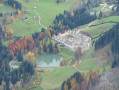
  • Grotte de La Cha: there is a statue of the Virgin Mary with two plaques (thefirst reads "Notre Dame de Lourdes, pray for us" and the second reads "Depoisier Baron François II").

Other walks in the area

For more walks, use our search engine .

The GPS track and description are the property of this route's author. Please do not copy them without permission.