


Refine your search for walks in Gare de Les Ardoines
Gare de Les Ardoines walks


 The painted walls of Vitry-sur-Seine
 Visorando Member
 5.12 mi
 +36 ft
 -39 ft
 2h 25
2h 25
 Easy
Easy
 Departure from Vitry-sur-Seine (Val-de-Marne)
Sometimes described as the French capital of street art, Vitry-sur-Seine boasts an impressive density and diversity of street art! This urban route from station to station allows you to discover a good number of these works, though it makes no claim to be exhaustive. A walk to be undertaken with your eyes wide open and your head turning in all directions!
Walks near Gare de Les Ardoines
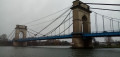
Along the Seine from Choisy-le-Roi to Alfort
 4.68 mi
+23 ft
-20 ft
2h 10
Easy
Departure from Choisy-le-Roi (Val-de-Marne)
4.68 mi
+23 ft
-20 ft
2h 10
Easy
Departure from Choisy-le-Roi (Val-de-Marne)
An urban walk that starts on the elevated quays and continues along the towpath, right by the river. After the confluence, the walk ends by following the Marne upstream for the final kilometre.
Adjust your route according to flood levels on the Seine or the Marne: see the practical information section.
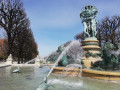
From Villejuif to Pont Neuf
 6.32 mi
+69 ft
-338 ft
3h 00
6.32 mi
+69 ft
-338 ft
3h 00
 Moderate
Departure from Villejuif (Val-de-Marne)
Moderate
Departure from Villejuif (Val-de-Marne)
This urban route will allow you to discover a small corner of the suburbs, cross the Bicêtre Hospital and end up at the Seine after passing through Parc Montsouris and the Jardin du Luxembourg, then a few old districts of Paris.
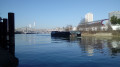
At the confluence of the Seine and the Marne
 3.88 mi
+20 ft
-52 ft
1h 50
Easy
Departure from Maisons-Alfort (Val-de-Marne)
3.88 mi
+20 ft
-52 ft
1h 50
Easy
Departure from Maisons-Alfort (Val-de-Marne)
A short walk that takes us to the point where the two main rivers of the Île-de-France region meet, two kilometres east of Paris. Numerous bridges, a dam and a lock on the Marne, a towpath and industrial heritage form the backdrop to this urban route.
Street Art Trail in Alfortville
 Local authority
 5.46 mi
+10 ft
-13 ft
2h 30
Easy
Departure from Maisons-Alfort (Val-de-Marne)
5.46 mi
+10 ft
-13 ft
2h 30
Easy
Departure from Maisons-Alfort (Val-de-Marne)
Discover or rediscover the Grand Paris Sud Est Avenir area by exploring its various walking routes, which showcase the main points of interest and the sometimes little-known treasures of our 16 municipalities, each with their own unique and distinctive histories.
The painted walls of Ivry and the Rive Gauche neighbourhood of the 13th arrondissement
 4.98 mi
+92 ft
-85 ft
2h 20
Easy
Departure from Ivry-sur-Seine (Val-de-Marne)
4.98 mi
+92 ft
-85 ft
2h 20
Easy
Departure from Ivry-sur-Seine (Val-de-Marne)
Discovering street art on both sides of the Boulevard Périphérique! First, you’ll pass through Ivry-sur-Seine, where painted or graffitied walls alternate with much older heritage. Next, you’ll meander through the Rive Gauche neighbourhood of Paris’s 13th arrondissement, which is currently undergoing extensive renovation, and where murals and modern architecture sit alongside an interesting industrial heritage.
From Alfort to the Pont d’Austerlitz via Lac de Daumesnil
 4.53 mi
+62 ft
-66 ft
2h 10
Easy
Departure from Maisons-Alfort (Val-de-Marne)
4.53 mi
+62 ft
-66 ft
2h 10
Easy
Departure from Maisons-Alfort (Val-de-Marne)
Starting from the Marne just before it joins the Seine, the route takes you through Charenton-le-Pont. The large park around Lac de Daumesnil offers a bucolic transition before entering Paris. After strolling through Parc de Bercy, you cross the Seine via a footbridge before reaching Austerlitz station near the bridge of the same name.
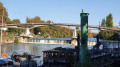
A thousand and one activities by the water: from Créteil to Alfortville
 9.30 mi
+20 ft
-23 ft
4h 20
Moderate
Departure from Créteil (Val-de-Marne)
9.30 mi
+20 ft
-23 ft
4h 20
Moderate
Departure from Créteil (Val-de-Marne)
Discover or rediscover the Grand Paris Sud-Est Avenir area by exploring its various walking routes, which showcase the main points of interest and the sometimes little-known treasures of our 16 municipalities, each with their own unique and distinctive histories.
From Ivry to Arcueil via Fort de Bicêtre
 5.05 mi
+367 ft
-259 ft
2h 40
Easy
Departure from Ivry-sur-Seine (Val-de-Marne)
5.05 mi
+367 ft
-259 ft
2h 40
Easy
Departure from Ivry-sur-Seine (Val-de-Marne)
A route through a highly urbanised area that is still evolving, where old workshops, residential estates and post-war buildings stand alongside more recent architecture. The route is punctuated by a few spacious parks, a fort from the old walls of Paris, and the superimposed aqueducts of Arcueil and Cachan.
From Créteil to Maisons-Alfort via the lake and the Juliottes neighbourhood
 4.56 mi
+46 ft
-16 ft
2h 10
Easy
Departure from Créteil (Val-de-Marne)
4.56 mi
+46 ft
-16 ft
2h 10
Easy
Departure from Créteil (Val-de-Marne)
An urban route starting along Lake Créteil from its southern tip to its northern tip, set amongst lawns and reed beds. You then cross, via footpaths, the ‘Du Chou et des Épis’ neighbourhood, with its cylindrical tower blocks featuring original designs, and the University district. The end of the route takes you to Maisons-Alfort via the Juliottes neighbourhood.
Marne loop from Saint-Maur to Joinville
 8.41 mi
+72 ft
-26 ft
3h 55
Moderate
Departure from Saint-Maur-des-Fossés (Val-de-Marne)
8.41 mi
+72 ft
-26 ft
3h 55
Moderate
Departure from Saint-Maur-des-Fossés (Val-de-Marne)
The commune of Saint-Maur-des-Fossés lies entirely within a bend in the Marne. This walk, from station to station, follows almost the entire length of this bend. It can be enjoyed in all seasons and showcases the river and its islands, the residential neighbourhoods along its banks and Charles Trénet, who lived here for part of his life.