


Refine your search for walks in Étang d'Ouroux (Ouroux-en-Morvan)
Étang d'Ouroux (Ouroux-en-Morvan) walks


 A short tour of the mills of Ouroux-en-Morvan
 Association / Club / Walk leader
 10.16 mi
 +1,129 ft
 -1,158 ft
 5h 40
5h 40
 Moderate
 Departure from Ouroux-en-Morvan (Nièvre)
This circular allows you to see some of the region's mills that are no longer in operation, in the commune of Ouroux-en-Morvan. It will also allow you to discover some of the commune's hamlets.
Ouroux loop via Le Plessis and the Voie du Tacot
 5.30 mi
+965 ft
-955 ft
3h 15
5.30 mi
+965 ft
-955 ft
3h 15
 Easy
Departure from Ouroux-en-Morvan (Nièvre)
Easy
Departure from Ouroux-en-Morvan (Nièvre)
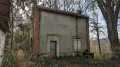
The first part of this route allows you to discover part of the commune of Ouroux-en-Morvan, passing through the hamlet of Le Plessis, then Savelot. The second part of the route takes you along the Chemin du Tacot, a single track road that ran from Corbigny to Seaulieu. You will pass the old Cœuzon station and the bridge-tunnel over the Chalaux river. You will also have the opportunity to see an almost identical full-size replica of the old Tacot locomotive. You will continue under arches covered in vegetation and finish by walking alongside the Étang d'Ouroux lake. In front of the village hall, you can also admire the blue carriage, which is unique in that it has the same metre gauge as the Tacot.

Euro 2008 zone starting from Ouroux-en-Morvan
 5.13 mi
+413 ft
-417 ft
2h 45
Easy
Departure from Ouroux-en-Morvan (Nièvre)
5.13 mi
+413 ft
-417 ft
2h 45
Easy
Departure from Ouroux-en-Morvan (Nièvre)
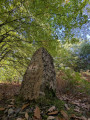
Let's go back in time to 2008, when the commune of Ouroux-en-Morvan was the geographical centre of the Eurozone. This distinction was calculated by the Institut Géographique National (IGN). The exact point was located in the Bondy forest. However, the centre of the Eurozone changes with the accession of new member countries. Each new accession to the euro zone shifts this central point. Thus, in 2009, with the entry of Slovakia, the centre moved to Liernais, in Côte-d'Or. This "European point" is represented by a piece of granite, and along the route you will find signs explaining the role of the Eurozone.
Walks near Étang d'Ouroux (Ouroux-en-Morvan)
Athez - Châtelet
 Local authority11.20 mi
+1,263 ft
-1,145 ft
6h 15
Moderate
Departure from Anost (Saône-et-Loire)
Local authority11.20 mi
+1,263 ft
-1,145 ft
6h 15
Moderate
Departure from Anost (Saône-et-Loire)
The second stage of this three-day hike, which is shorter and less steep. It leads from Athez to the Étang du Châtelet via the old Voie du Tacot railway line. The hike passes through Arleuf and the Théâtre des Bardiaux. From pond to pond, you’ll walk in the footsteps of the timber rafters.
Le Châtelet - Bibracte
13.08 mi
+2,306 ft
-1,909 ft
8h 00
 Difficult
Departure from Arleuf (Nièvre)
Difficult
Departure from Arleuf (Nièvre)
Third stage of the hike Towards the sources of the timber-floating trade, this fairly challenging section takes you upstream along the rivers, to where the timber was stored at the ‘ports’ of the timber-floating trade, so far from the sea... While waiting for the great flood (caused by the release of water from the ponds), the timber was then set adrift and continued its journey, not without difficulties, to Clamecy where it was tied together into rafts. It then continued its journey unhurriedly towards Paris where it was sold.