Country:

 City:
City:


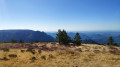
(S) Take the Rd180 towards the Espinouse information point (north-west). From there, you have several options: either join theGR®71north of the summit by turning right, or follow theGR® on your left towards St Martin du Froid. It all depends on the weather at that time of morning, as the mountains can be very foggy. Personally, due to poor visibility, I opted for the second option to reach Mazade des Huttes in the south as quickly as possible.
(1) Continue through the Peyre-Taillade woods to the west. You will reach a T-junction. Leave theGR® and follow the signposted path to the left towards Saint-Martin-du-Froid. You will reach a Y-junction.
(2) Take the path on the right, then rejoin a wider track. Turn left onto it. Then join theGRP® de la Traversée du Languedoc. Turn left onto it and follow it to the crossroads at the small chapel of Saint-Martin-du-Froid.
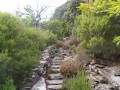
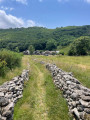
(3) Turn right at the chapel and return to the intersection. Take the GRP® on the right. Be careful to follow the path that runs along the edge of the beech trees with the stone border, but not the path with a barrier just to the left. The path quickly becomes a trail that descends into the moors. It is not very difficult, and often well stoned, with many long switchbacks. You will soon reach the first houses with slate roofs, then enter the forest, and finally arrive at the Col de Bardou.
(4) Rejoin theGR®7that you left at Douch. Follow the signs for Héric through the chestnut woods and continue downhill (about 600m).
At the end of the descent, you will arrive at a very pretty bridge over the Héric stream.
Climb up opposite to reach the hamlet of Héric, where you will find a refreshment bar and a refuge.
(5) There are no difficulties here either. Once you have crossed the hamlet of small houses, cross the stream via the bridge and take the concrete road that runs alongside the stream. Continue downhill to the Passerelle des Soupirs.
(6) Take this path and cross the stream. Take the path on the right, which runs alongside the stream for a while before entering the undergrowth and reaching the village of La Coste.
(7) Follow the yellow markings along a concrete road that passes through old abandoned vineyards. At the end of this wine-growing road, you will see the village of Saint-Martin-de-l'Arçon. Head to the upper part of the village and take a stone path at the entrance. Follow it to the main street.
(8) Important note: Only take this path if you are not too tired and have enough time. Some sections are particularly difficult and dangerous, and the descent is very poorly marked and difficult to find.
If not, take the road via La Pomarède.
Alternatively, opposite the old post office, take the path directly opposite, which heads off to the right towards Caroux. Go up the flower-lined lane until you reach the last houses overlooking the village. Leave the path and take the road on your right towards the pumping station. Just before taking the dirt track that leads to the pumping station, take the stony path that climbs up to your left (it looks like a ditch at first) and is marked with blue paint. The path is narrow and lined with walls and broom.
The signs are clear. Go uphill until you reach some old chestnut groves. The Col de la Pomarède is fairly easy to reach.
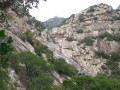
(9). You then need to leave the well-marked path and walk over stones on the mountainside. Take care and watch your step. The blue markings are clear and it is fairly easy to reach the Albine stream waterfall.
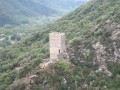
(10). From there, the path is more unpredictable, as there are no longer any markings. You have to climb a little and then follow the small cairns. However, it is not easy to find the path. It is easy to find the path that continues uphill, but not the one that goes downhill. However, if you go down the chestnut grove, you will eventually find it. All that remains is to go down the stony path and return to the village of Colombières le Haut and the church (E) (beautiful view of the recently restored square tower).

 , magnificent landscapes
 Visorando Member
 Moderate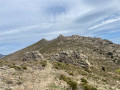
 Difficult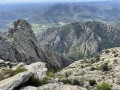
 Easy
Easy