Green spaces in Paris’s 6th arrondissement

The sixth arrondissement of Paris is emblematic of Parisian elegance. A chic neighbourhood with legendary cafés, it has historical links to writers, philosophers and artists. It is as renowned for its intellectual heritage as it is for its architectural heritage, with its museums, art galleries and prestigious cultural institutions.

It boasts a dozen public squares and municipal gardens, including the famous Jardin du Luxembourg, which is managed by the state and will not be discussed here.

Details

38645400
Creation:
Last update:
Last review:
  • Walking
    Activity: Walking
  • ↔
    Distance: 8.10 km
  • ◔
    Average duration: 2h 30 
  • ▲
    Difficulty: Easy

  • ⚐
    Back to start: No
  • ↗
    Ascent: + 52 m
  • ↘
    Descent: - 61 m

  • ▲
    Highest point: 65 m
  • ▼
    Lowest point: 28 m
  • ⚐ Country: France
  • ⚐ City: Paris (75000)
  • ⚑
    Start: N 48.860916° / E 2.34086°
  • ⚑
    End: N 48.848763° / E 2.321224°
  • ❏
    IGN map(s): Ref. 2314OT
  • Hour-by-hour weather

Photos

Description of the walk

Starting point: Louvre-Rivoli metro station – Line 1.

(S) On leaving the elegant metro station, turn around and continue along Rue de l’Amiral de Coligny, passing the Louvre Palace on your right and the Church of Saint-Germain-l’Auxerrois on your left. When you reach the Seine, turn right onto Quai François Mitterrand.

(1) Turn left onto the Pont des Arts, which offers an unobstructed view of the Île de la Cité. Turn right onto Quai de Conti, cross the quay at the pedestrian crossing with the traffic lights, walk for about thirty metres, passing a small triangular square on your right, and turn left onto Rue de Seine. Walk along the right-hand side of Square Honoré Champion. A few dozen metres further on, turn left into Square Gabriel Pierné. Walk around it and continue along Rue de Seine. Take thesecond right, the narrow Rue Visconti, and turn right at No. 10 into the Jardin Alice Saunier Seité.

(2) Walk around the garden and continue along Rue Visconti. At the end of the street, turn left onto Rue Bonaparte, then right onto Rue Jacob. Pass Rue Saint Benoît on your left, and at the next junction turn left onto Rue des Saints-Pères. At the end of the street, you will reach the Ukrainian Greek Catholic Cathedral of Saint Volodymyr the Great.

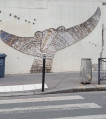
(3) Turn left onto Boulevard Saint-Germain, then immediately left into Square Taras Shevchenko. Note a mural on the side façade of the Société de Géographie, located at 184 Boulevard Saint-Germain. Walk around the square and, on exiting, head left back onto Boulevard Saint-Germain. Turn left onto Rue Saint-Benoît, then right onto Rue Guillaume Apollinaire, arriving at Place Saint-Germain-des-Prés.

(4) Turn right at the foot of the church into Square Laurent Prache.

(4) On leaving the square, turn left, walk past the Church of Saint-Germain-des-Prés, the oldest church in Paris, turn left onto Boulevard Saint-Germain, walk past the Saint-Germain-des-Prés metro station and immediately turn left into Square Félix Desruelles.

(5) On leaving the square, head left back onto Boulevard Saint-Germain, continue to the traffic lights, cross at the pedestrian crossing and turn right into Rue du Four. After a few dozen metres, cross Rue du Four at the pedestrian crossing and continue on the left-hand pavement. Turn left into Rue Princesse, right into Rue Guisarde, and left into Rue des Cannettes. At the end of the street, pass Place Saint-Sulpice and its monumental fountain on your right, and turn left onto Rue Saint-Sulpice, walking alongside the church on your right. Cross Rue Garancière and Rue de Tournon on your right and arrive at Rue de Condé.

(6) Turn right; at the fork, keep right and, at the end of the street, turn right, passing Square Francis Poulenc on your right . Cross Rue de Tournon and continue along Rue de Vaugirard. Take thethird right, Rue Servandoni. At the end of the street, turn left onto Rue Palatine. Cross Place Saint-Sulpice, keeping to the left and once again leaving the majestic fountain on your right. Turn left onto Rue Bonaparte, taking the side lane on the left, the Promenade de l’Allée du Séminaire Jean-Jacques Olier.

(7) At the end of the promenade, cross Rue de Vaugirard, turn left, and enter the Jardin du Luxembourg on the right. Take thefirst major path on the left to go round the Orangerie du Sénat on the right. Walk past the Eugène Delacroix Fountain on your left. At the end of the path, turn right to go round the Palais du Luxembourg (you can continue for a few dozen metres along the fence on the left to see the famous Medici Fountain on your right).

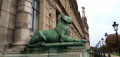
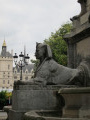
(8) Then take the path on the right to cross the garden. Pass the octagonal pond on your right and, at the end of the path, climb four steps, leaving a lion sculpture on your left, and continue straight ahead. When you reach the gate, turn right and take the exit.

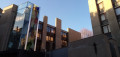
(9) Cross Rue Auguste Comte and head straight ahead onto EsplanadeGaston Monnerville. Cross Rue Michelet. Note, on the right, the impressive, colourful building of the Institute of Art and Archaeology. Continue straight ahead into the Garden of the Great Explorers Marco Polo and Cavelier de la Salle.

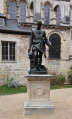
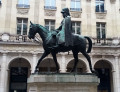
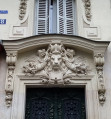
(10) Exit at the far end of the garden behind the Fountain of the Four Parts of the World. Cross at the pedestrian crossing opposite, then continue along a central reservation. Cross to the right at the pedestrian crossing to cross Rue d’Assas, take another central reservation and, in front of a statue of Marshal Ney on the left, turn right into Rue Notre-Dame des Champs. Note the richly decorated façade of the building at No. 82, and opposite, on the wall of the women’s hall of residence, a stylised bird in what appears to be ceramic. Cross Rue Vavin and continue straight on until you reach a small tree-lined square with a statue of Captain Dreyfus in the centre. Then turn left, cross Boulevard Raspail in two stages and continue straight ahead onto Rue Stanislas. Turn right into Square Ozanam.

(11) Cross the square and exit onto Boulevard du Montparnasse. Turn right, pass the entrance to the Church of Notre-Dame des Champs, cross Rue du Montparnasse, pass Impasse Robiquet on your right and turn right onto Rue de Rennes. Cross immediately at the traffic lights to take the left-hand pavement. Turn left onto Rue Littré and, at the end of the street, turn right again onto Rue de Vaugirard and head towards Rue Jean Ferrandi on the left.

(12) Follow this street and, at the end, cross at the pedestrian crossing on the left and enter the Jardin du Père Armand David opposite by pushing open a heavy door.

(13) On leaving the garden, turn right onto Rue du Cherche Midi, then right onto Rue Saint Romain; at the end of the street, cross Rue de Sèvres and turn right. Pass Rue Vanneau on your left, go past No. 42 in front of the Egyptian fountain known as the Fellah Fountain, and just after that, reach the Vanneau metro station – Line 10 (E).

Waypoints

  1. S : km 0 - alt. 46 m - Louve Rivoli metro station
  2. 1 : km 0.37 - alt. 38 m - Pont des Arts - Seine [la]
  3. 2 : km 0.99 - alt. 45 m - Alice Saunier Seité Garden
  4. 3 : km 1.6 - alt. 52 m - Boulevard Saint-Germain - Église Saint-Volodymyr (Paris)
  5. 4 : km 2.02 - alt. 45 m - Église Saint-Germain-des-Prés (Paris)
  6. 5 : km 2.36 - alt. 46 m - Félix Desruelles Square
  7. 6 : km 3.17 - alt. 37 m - Rue de Condé
  8. 7 : km 3.95 - alt. 48 m - Promenade de l'Allée du Séminaire J.J. Olier - Église Saint-Sulpice (Paris)
  9. 8 : km 4.67 - alt. 43 m - Palais du Luxembourg - Jardin du Luxembourg
  10. 9 : km 5.17 - alt. 51 m - Gaston Monnerville Esplanade
  11. 10 : km 5.56 - alt. 61 m - Fountain of the Four Corners of the World
  12. 11 : km 6.79 - alt. 58 m - Ozanam Square
  13. 12 : km 7.43 - alt. 54 m - Rue Jean Ferrandi
  14. 13 : km 7.74 - alt. 51 m - Father Armand David Garden
  15. E : km 8.1 - alt. 37 m - Vanneau metro station

Worth a visit

Square Honoré Champion
7, Quai Malaquais and Rue de Seine.
Created in 1947 (374 m²).
A small square featuring an oval lawn with trees and flowers, at the centre of which stands a statue of Voltaire. Although visible from the street, this garden is not open to the public. It is named in honour of the publisher Honoré Champion (1846–1913).

Square Gabriel Pierné
5 Rue de la Seine
Opened in 1938 (844 m²)
A small square where you can see the Marché aux Carmes fountain (1830) and ‘Carolina’, a bronze statue. This space, with its partially paved ground and stone benches, is named after the French musician Gabriel Pierné (1863–1937).

Alice Saunier Seïté Garden
10 Rue Visconti
Created in 2000 (80 m²)
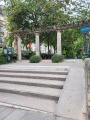
This is one of the smallest gardens in Paris. Featuring pergolas and stone benches, it is named in memory of the politician Alice Saunier-Seïté (1925–2003), the first female rector of an academy.

Taras Shevchenko Square
186 Boulevard Germain
Created in 1937 (436 m²).
Play area, drinking fountain.
The garden’s name, which pays tribute to the Ukrainian poet Taras Shevchenko (1814–1861), is explained by its proximity to the Ukrainian church; a bronze bust of Shevchenko stands alongside a stone bust of Laennec (1781–1826), the French doctor who invented the stethoscope.

Square Laurent Prache
1 Place Juliette Gréco
Opened in 1901 (590 m²)
Drinking fountain.
Here you can see elements of the former Abbey of Saint-Germain-des-Prés, and fragments of its cloister, which no longer exists. The square is named in memory of the MP Laurent Prache (1856–1919), a French politician.

Félix Desruelles Square
168 bis, Boulevard Saint-Germain
Created in 1901 (1,515 m²)
Playground, drinking fountain.
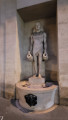
The square is situated on the site of the former garden of the Church of Saint-Germain-des-Prés. It features a bronze monument depicting Bernard Palissy, the famous 16th-century scholar who discovered the secret of enamel composition. The garden also features a glazed sandstone portico, created to showcase the products of the Manufacture Nationale de Sèvres at the 1900 World’s Fair. This square pays tribute to Félix Desruelles (1865–1943), a sculptor.

Square Francis Poulenc
Place Pierre Dux
Opened in 1940 (184 m²)
A small enclosed square commemorating the composer Francis Poulenc (1899–1963), who died in the 6th arrondissement.

Promenade de l’Allée du Séminaire Jean-Jacques Olier
Rue Bonaparte Rue de Vaugirard
Opened in 1936 (990 m²)
An elegant promenade, partly raised, featuring the “Fontaine de la Paix”, built in the early 1800s in a neoclassical style. It consists of a square basin topped with triangular pediments. The four sides are adorned with bas-reliefs symbolising Agriculture, Commerce, Science and the Arts. Its name pays tribute to the priest Jean-Jacques Olier (1608–1657).

Esplanade Gaston Monnerville
7, Place André-Honnorat
Created in 1864 (11,154 m²)
Playground, table tennis tables, drinking fountains.
The central section of Avenue de l’Observatoire is occupied by a series of gardens, including this esplanade named after Gaston Monnerville (1897–1991), a 20th-century French politician and President of the Senate, whose chamber is located near the esplanade. A bust in his honour has been erected there. In the centre, vast lawns feature two sculptural groups: ‘La Nuit’ and ‘Le Crépuscule’.

Garden of the Great Explorers: Marco Polo and Cavelier de la Salle
Avenue de l'Observatoire
Created in 1867 (10,903 m²)
Play equipment, playground, drinking fountains, table tennis tables.
In the centre of Avenue de l'Observatoire, this garden follows on from the Esplanade Gaston Monnerville. It pays tribute to two explorers: Marco Polo (1254–1324) and Robert Cavelier de la Salle (1643–1687). Its lawns are adorned with two statues: "Dawn" and "Day". At the far end of the gardens, an imposing bronze fountain dating from 1875 depicts “The Four Parts of the World”.

Square Ozanam
18 Rue Stanislas
Created in 1934 (1,640 m²)
Play area, drinking fountains.
This small square is situated at the foot of the Church of Notre Dame des Champs. It is named after Frédéric Ozanam (1813–1853), one of the founders in 1833 of the Society of Saint Vincent de Paul, and a former teacher at the nearby Stanislas College.

Père Armand David Garden
90, Rue du Cherche-Midi
Created in 2018 (500 m²)
This garden consists of square beds, adorned with medicinal and aromatic plants inspired by religious gardens. It is named after the French missionary botanist, Father Armand David (1826–1900).

Other walks in the area

For more walks, use our search engine .

The GPS track and description are the property of this route's author. Please do not copy them without permission.