


Refine your search for walks in Église Saint-Sulpice (Paris)
Église Saint-Sulpice (Paris) walks


 Sundials and astronomical curiosities in Paris
 Visorando Member
 8.94 mi
 +144 ft
 -23 ft
 4h 15
4h 15
 Moderate
 Departure from Paris
A long urban trail on the theme of sundials and sites related to astronomy scattered throughout Paris: the Paris meridian, observatories, gnomons, etc. Best done on a sunny day so you can read the time along the way! The sundials are often high up, sometimes hidden by trees that have grown... you may have to search hard to find them.
Green spaces in Paris’s 6th arrondissement
 5.04 mi
+171 ft
-200 ft
2h 30
5.04 mi
+171 ft
-200 ft
2h 30
 Easy
Departure from Paris
Easy
Departure from Paris
The sixth arrondissement of Paris is emblematic of Parisian elegance. A chic neighbourhood with legendary cafés, it has historical links to writers, philosophers and artists. It is as renowned for its intellectual heritage as it is for its architectural heritage, with its museums, art galleries and prestigious cultural institutions.
It boasts a dozen public squares and municipal gardens, including the famous Jardin du Luxembourg, which is managed by the state and will not be discussed here.
Walks near Église Saint-Sulpice (Paris)
Symbols of Franco-American relations in Paris
 7.00 mi
+108 ft
-49 ft
3h 20
Moderate
Departure from Paris
7.00 mi
+108 ft
-49 ft
3h 20
Moderate
Departure from Paris
A walk through Paris taking in the iconic sites associated with Americans in Paris, whilst also passing by some of the city’s famous landmarks.
The route can be followed in either direction.
Saint-Germain-des-Prés and Montagne Sainte-Geneviève
 3.84 mi
+79 ft
-105 ft
1h 50
Easy
Departure from Paris
3.84 mi
+79 ft
-105 ft
1h 50
Easy
Departure from Paris
A journey into the medieval and even Gallo-Roman past of Paris, following in the footsteps of Sainte-Geneviève, whose namesake hill we climb, whose ancient sarcophagus can be seen in the church of Saint-Étienne-du-Mont, and whose statue can be seen in the Jardin du Luxembourg and on the Pont de la Tournelle. Among other sights, the itinerary follows a section of the old city wall built by Philippe Auguste and crosses the Arènes de Lutèce.
The Passages of Paris
7.51 mi
+75 ft
-16 ft
3h 30
Moderate
Departure from Paris
In Paris, the term ‘passages’ refers to covered walkways through which one goes from one street to another by passing through one or more buildings, and which are intended solely for pedestrians. The shops there are splendid, well-stocked, but somewhat expensive. In bad weather, like the Palais-Royal, they serve as promenades and meeting places. They are generally lit by gas.
From the Île de la Cité to the Porte de Versailles
 3.65 mi
+43 ft
-30 ft
1h 45
Easy
Departure from Paris
3.65 mi
+43 ft
-30 ft
1h 45
Easy
Departure from Paris
From the heart of the capital to its outskirts, this urban walk takes you through the Latin Quarter before following the entire length of Paris’s longest street, Rue de Vaugirard. Along the way, you’ll come across Notre-Dame Cathedral (currently undergoing restoration), the Palais du Luxembourg and several churches dating from various periods.
From Île de la Cité to Porte de Pantin
 6.26 mi
+79 ft
-23 ft
2h 55
Moderate
Departure from Paris
6.26 mi
+79 ft
-23 ft
2h 55
Moderate
Departure from Paris
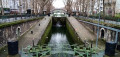
From the heart to the outskirts of the capital, this urban route first takes you through the Marais district, dotted with mansions. Then, under the sign of water, you walk along the Canal Saint-Martin and then the Bassin de la Villette. The route ends at the entrance to the Parc de La Villette.
From Île de la Cité to Porte de Montreuil
 5.38 mi
+118 ft
-39 ft
2h 35
Easy
Departure from Paris
5.38 mi
+118 ft
-39 ft
2h 35
Easy
Departure from Paris
From the heart to the outskirts of the capital, this urban route starts on the banks of the Seine and then follows the Port de l'Arsenal on the Canal Saint-Martin. It then crosses the Roquette and Charonne districts and takes a few narrow streets and passages bordering the Père Lachaise Cemetery.
From Île de la Cité to Porte de Courcelles
 5.46 mi
+43 ft
-39 ft
2h 35
Easy
Departure from Paris
5.46 mi
+43 ft
-39 ft
2h 35
Easy
Departure from Paris
From the heart to the outskirts of the capital, an urban route that starts at the Pont Neuf (the oldest bridge in Paris), the Cour Carrée and the Louvre Pyramid, and the Tuileries Garden. We then reach the luxurious Opéra district. Finally, we cross Haussmannian Paris, with a few twists and turns in Parc Monceau along the way.
From Île de la Cité to Porte de Clignancourt
 4.98 mi
+299 ft
-246 ft
2h 35
Easy
Departure from Paris
4.98 mi
+299 ft
-246 ft
2h 35
Easy
Departure from Paris
From the heart to the outskirts of the capital, an urban route that crosses the Les Halles and Beaubourg districts, climbs the Butte Montmartre and descends to Clignancourt. Shopping streets, alleys, passageways and stairways await you.
From Île de la Cité to Porte d'Auteuil
 6.73 mi
+49 ft
-33 ft
3h 10
Moderate
Departure from Paris
6.73 mi
+49 ft
-33 ft
3h 10
Moderate
Departure from Paris
From the heart to the outskirts of the capital, an urban route that winds through the narrow streets of the 6th arrondissement before reaching the Church of Saint-Germain-des-Prés and its Romanesque bell tower. We then cross the 7th arrondissement and its wide avenues, as well as the Seine, after passing through Île des Cygnes, at the end of which stands a replica of the Statue of Liberty. The route ends in the 16th arrondissement with a few mansions and Art Nouveau buildings.
From Île de la Cité to Porte de Gentilly
 3.78 mi
+151 ft
-102 ft
1h 50
Easy
Departure from Paris
3.78 mi
+151 ft
-102 ft
1h 50
Easy
Departure from Paris
From the heart to the outskirts of the capital, this urban route crosses the 5th arrondissement, passing through ancient streets and past several churches. It then climbs the Butte aux Cailles and its streets decorated with murals. At the end of the hike, you can stroll through the picturesque Cité Florale.