Country:
 City:
City:


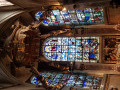
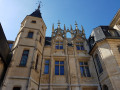
Departure from Place de la Cathédrale Notre-Dame in front of the Tourist Office.
(S/E) Take Rue des Carmes in front of the "Le Printemps" store, then turn left at the second street, Rue Saint-Lô, so named because it runs alongside the site of the former Saint-Lô church and priory, the remains of which can be seen on the right just before the next intersection with Rue Socrate.
The Saint-Lô church is probably one of the oldest churches in Rouen, proclaimed cathedral of Rouen and Coutances around 915. Later, in 1144, when the bishops of Coutances returned home, it became a priory that served as both a collegiate church and a parish church. Sold for demolition during the Revolution in 1793, only the porch remains today.
(1) Take the first street on the left, Rue Eugène Boudin, which then becomes Rue du Bec, to reach the very touristy Rue du Gros Horloge. Turn left and then immediately right under the archway (Passage Gravier), which leads to Rue de la Champmeslé.
(2) At the corner of Rue de la Champmeslé and Rue aux Ours is the Fontaine Saint-Candé residence, where the beautiful tower of the former Saint-Candé le Jeune Church stands in the middle of the courtyard, visible through the gate just after the Bouchara store. Take Rue aux Ours on the right, then Rue Camille Saint-Saëns on the left.
(3) You will arrive at what remains of the Saint-Pierre du Châtel Church, bombed by Allied aircraft in 1944 and left in its current state. Return to Rue aux Ours, continue on your way to Rue Jeanne d'Arc and turn left.
(4) On the right is the Tour Saint-André, currently undergoing restoration, a remnant of the old church of the same name, which was dismantled in 1861 to make way for Rue Jeanne d'Arc. Closed for worship during the Revolution, the tower was used as a workshop for melting lead shot: drops of molten lead were dropped from the top of the tower and solidified into round balls as they fell.
Walk down Rue Jeanne d'Arc to the next street on the right, Rue du Général Giraud, which you take after observing the ruins of the old Saint-Vincent Church on the left-hand side. Take the second street on the right, Rue Saint-Éloi, named after the church on the left, which became a Protestant temple after the Concordat of 1802. Turn left to walk along the building, then turn right to go around the tree-lined Place Martin Luther King.
As you pass, admire the remarkable Hôtel de Bourgtheroulde on your left, then enter the courtyard to see the bas-reliefs depicting the meeting between François I and Henry VIII of England at the Field of the Cloth of Gold.
Then take the pedestrian crossing that connects Place Martin Luther King to Place de la Pucelle on the left. Walk along the left side of the square to reach Place du Vieux Marché.
This square is home to the remains of the old Saint-Sauveur Church, which were uncovered during the construction of the new Sainte-Jeanne d'Arc Church in the 1970s.
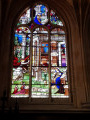
The Church of Sainte-Jeanne d'Arc, whose construction was completed in 1979, is part of a complex that serves as a memorial to the martyrdom of Joan of Arc, a church and a covered market. An ancient bell saved from the Church of Saint Vincent hangs between the market halls and the church. If the church is open, go inside to see the superb stained-glass windows saved from the Church of Saint Vincent, which were made around 1520-1530.
Diagonally opposite the entrance on Place du Vieux Marché, take Rue Cauchoise on the left, then the first street on the right, Rue des Béguines.
(5) At No. 16 Rue des Béguines, in a courtyard, you can see a few Gothic arches, which are all that remain of the old Saint-Vigor Church.
At the end of the street, turn right onto Rue des Bons Enfants, then take the second right onto Rue Sainte-Croix des Pelletiers, named after the old church that borders it on the left.
This church has been deconsecrated since the Revolution and was used as a shop, warehouse and wine cellar until around 1940, when it was converted into a conference and concert hall. Now closed due to dilapidation, it is awaiting further restoration.
Turn around at the church and head to Rue des Bons Enfants, continuing on the right
Then take the first street on the left, Rue Étoupée, cross Rue Jean Lecanuet and continue straight ahead to the end of the street.
Then take Rue Saint-Patrice on the right and Rue de l'Abbé Cochet on the left. At the corner of Rue Saint-Patrice and Rue Abbé Cochet is the Church of Saint-Patrice, which is still in use for worship. Its interior is well worth a visit, with remarkable 16th and 17th century stained glass windows and a baldachin altar.
After your visit, continue to the end of the street to reach Boulevard de la Marne. Cross the boulevard, turn right, then take the second street on the left, which leads to the SNCF railway station. Opposite the station, take the street on the right, Rue de la Rochefoucauld, which is bordered on the left by Saint Romain Church. The church may not look like much from the outside, but its interior is well worth a visit, having undergone extensive restoration work in the 19th century
At the end of the street, turn right onto Rue du Champ des Oiseaux and head down towards the boulevard. Cross the boulevard again and continue straight on along Rue Bouvreuil, then take the first street on the right, Rue du Donjon.
Then turn left onto Rue Philippe Auguste, then left again onto Rue Morand and finally right onto Rue Faucon. You will pass the Ceramics Museum before going down the stairs that lead to Rue du Baillage, which you take on the left towards Place Restout.
At the end of Place Restout, turn right onto Rue Jacques Villon and walk around the two adjoining churches via Rue Jean Lecanuet and Rue Charles Lenepveu.
The first is the Church of Saint-Godard, which is still in use for worship. The second is the Church of Saint-Laurent, which houses the Le Secq des Tournelles Ironwork Museum.
At the end of Rue Lenepveu, turn left onto Rue du Beffroy, then take Rue Bouvreuil on the right. Next, take the first street on the right onto Place du Dr Alfred Cerné, then the first on the left, Rue du Rempart Bouvreuil, to reach Rue d'Écosse, which you take on the right.
On the left, you will see the chapel of the Sisters of Compassion, converted into housing, in the middle of a courtyard.
Continue along Rue d'Écosse to the end of the street, then turn left onto Rue Beauvoisine.
After passing Rue Dulong on your right, you will find the entrance to the courtyard that leads to the Natural History and Antiquities Museums, which share the buildings of the former Couvent des Visitandines.
(6) Enter this courtyard, walk past the two museums to reach the small Square André Maurois, where you will find the authentic Fontaine de la Croix de Pierre fountain and a capital from the former Abbaye Sainte-Catherine du Mont abbey.
Leave the garden via the opposite entrance, passing under the gate of the former Clarisses Convent, which was moved here in 1908. Then take Rue Louis Ricard on the right downhill, then the first street on the right, Rue Dulong, then Rue du Vert Buisson on the left.
This street leads to Place de la Rougemare. As you walk along, admire the superb half-timbered house on the right-hand corner of Rue du Vert Buisson and the square. At the square, turn left to discover the Chapelle Saint-Louis, a former Benedictine chapel converted into a theatre.
Go to the end of the square and take the pedestrian walkway in front of the restaurant "Les petits parapluies"; this will take you to Rue Louis Ricard, which you cross to take Rue du Bourg l'Abbé just opposite and discover the chapel of the Lycée Corneille on your left.
Formerly the church of the Jesuit college, this chapel is thethird largest religious monument in the city. Marie de Médicis herself laid the first stone in 1615. Today, it has been converted into a concert hall.
Take the next street on the left, Rue des Minimes, which runs alongside the Benedictine Convent of the Holy Sacrament. Then take Rue Caron on the right, followed by Rue Coignebert, also on the right. Follow Rue Aimable Floquet on the left and Rue Saint-Nicaise on the right. You will then arrive at the Church of Saint-Nicaise, which was partially destroyed in 1934 and quickly rebuilt in reinforced concrete between 1935 and 1940. The church, which is now deconsecrated, is set to house a restaurant and brasserie in 2023.
Go around the church via Rue de l'Aître Saint-Nicaise and discover what remains of the old church that was not destroyed by the fire of 1934.
Take Rue des Requis on the right, then Rue Orbe on the left. Continue to the end of Rue Orbe to reach Place de la Croix de Pierre. Once you reach the square, take Rue des Capucins on the left.
On the left, stairs lead to the Maurice Nibelle nursery school: take them to discover the mini funeral chapel of the former Ursuline Convent just in front of the school. Returning to Rue des Capucins, on the left at the top of the stairs, you will find the Capucins Municipal Library, housed in the former convent church. If the doors are open, take a look inside.
Continue along Rue des Capucins, then take Passage du Bon Pasteur on the right. This passageway between the buildings leads to Rue Legouy, which you take on the left. Then turn right onto Rue de la Cigogne du Mont, after passing Rue Cantelles on the left. Go down the stairs on the right, which lead to Rue Sainte-Claire.
(7) At the bottom of Rue Sainte Claire, on the left, is the chapel of the former Clarisse Convent, which has been converted into a residence.
Continue to the end of Rue Sainte-Claire, then turn right onto Rue Saint-Hilaire, which will take you back to Croix de Pierre.
Continue along Rue Saint-Vivien, which is the continuation of Rue Saint-Hilaire. After passing the Church of Saint-Vivien and the square of the same name on your left, cross Avenue de la Porte des Champs to enter the gardens of the Town Hall, just opposite.
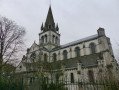
Leave the park on the left-hand side near the imposing Saint-Ouen Abbey Church, close to the Marmousets gate. If the doors are open, step inside the abbey church: its interior will surprise you with its slender architecture and magnificent rose windows.
Cross Rue des Faulx to reach Rue des Boucheries Saint-Ouen opposite, go to the end of the street and continue along Rue Damiette, which veers slightly to the left. Rue Damiette leads to Place Barthélémy and the magnificent Saint-Maclou Church, a masterpiece of flamboyant Gothic art.
Turn your back on the church to reach and cross Rue de la République, then take Rue Saint-Romain just opposite. Turn right at the first street, Rue des Chanoines, which must be the narrowest street in Rouen; with their corbelled upper floors, the houses lining the street are only a few centimetres apart.
This street leads to Rue Saint-Nicolas, which you take on the left just before turning right onto Rue Saint-Amand.
(8) Just before reaching the square of the same name, you will see a few sections of wall on the right, which are all that remain of the former Saint-Amand Abbey, destroyed in the mid-19th century.
Go around the square and take Rue de la Chaîne on the left, then take the first street on the left, Rue de la Croix de Fer.
(9) Embedded in the building on the left-hand side, you can see the remains of the former Saint-Nicolas Church, whose bell tower was dismantled and rebuilt in Cottévrard, a village north of Rouen.
Cross Rue Saint-Nicolas and continue along Rue de la Croix de Fer to the end to arrive at the Albane gardens at the foot of the cathedral.
Turn right and then left to finish this walk (S/E).



 Visorando Member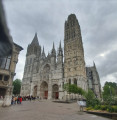

 Moderate