


Refine your search for walks in Église Notre-Dame-du-Rosaire (Saint-Ouen)
Église Notre-Dame-du-Rosaire (Saint-Ouen) walks


 Tours and detours in Saint-Ouen
 Visorando Member
 4.31 mi
 +36 ft
 -36 ft
 2h 00
2h 00
 Easy
Easy
 Departure from Saint-Ouen (Seine-Saint-Denis) (Seine-Saint-Denis)
This urban route offers a taste of what can be found in the inner suburbs of Paris: lively streets; markets; old townhouses; state schools; post-war buildings in varying states of repair; more recent tower blocks; old workshops and a few factories still in place; green spaces; rapidly changing neighbourhoods. Add to that a stroll through the famous flea market, a lovely view of the Seine, and a brief glimpse of the legendary Stade Bauer.
Walks near Église Notre-Dame-du-Rosaire (Saint-Ouen)
Les Grandes Carrières, Les Épinettes and Les Batignolles
 4.64 mi
+7 ft
-62 ft
2h 10
Easy
Departure from Paris
4.64 mi
+7 ft
-62 ft
2h 10
Easy
Departure from Paris
A journey through the northern districts of Paris in a new light, with the old Petite Ceinture railway line as a common thread. The many flower-filled passages, squares and gardens allow us to forget the hustle and bustle of the capital for a while.
The fish route in Paris
 4.43 mi
+108 ft
-144 ft
2h 10
Easy
Departure from Paris
4.43 mi
+108 ft
-144 ft
2h 10
Easy
Departure from Paris
Until the advent of the railway, fishmongers brought fish to Paris from the ports of the North Sea and the English Channel in horse-drawn convoys. Their route through Paris, as far as Les Halles, has left its mark in the names of a number of lanes that this urban itinerary more or less follows, with a few detours through streets and alleyways that deserve it.
Parks and cemeteries in the Hauts-de-Seine: art, anarchism and feminism
 5.27 mi
+13 ft
-20 ft
2h 25
Easy
Departure from Paris
5.27 mi
+13 ft
-20 ft
2h 25
Easy
Departure from Paris
This walk takes us in the footsteps of famous men and women, through the cemeteries of Clichy, Asnières and Levallois. The route is flat and is covered at a moderate pace to allow time to locate the graves, which can sometimes be difficult to find.
Green spaces in the east of Paris’s 17th arrondissement
 4.79 mi
+23 ft
-89 ft
2h 15
Easy
Departure from Paris
4.79 mi
+23 ft
-89 ft
2h 15
Easy
Departure from Paris
The 17th arrondissement of Paris is distinguished by its great urban and social diversity. The eastern part of the arrondissement combines working-class neighbourhoods with areas undergoing regeneration. Formerly a railway and industrial area, it has undergone significant recent transformation, notably with the Clichy-Batignolles eco-neighbourhood. Martin Luther King Park exemplifies this urban regeneration, designed according to ecological principles. But visitors also appreciate the charm of the Square des Batignolles or the Square des Épinettes, with their typical 19th-century landscape, or the tranquillity of the Square de la Villa Sainte-Croix.
Porte de la Chapelle – Porte de Montreuil
7.10 mi
+276 ft
-230 ft
3h 30
 Moderate
Departure from Paris
Moderate
Departure from Paris
A tour of north-east Paris today, taking in the Parc de la Villette, the Cité des Sciences and the Géode, the Philharmonie, the Butte du Chapeau Rouge, and ending with the charming Rue Saint-Blaise.
Green spaces in the west of Paris’s 17th arrondissement
 6.52 mi
+49 ft
-36 ft
3h 05
Moderate
Departure from Paris
6.52 mi
+49 ft
-36 ft
3h 05
Moderate
Departure from Paris
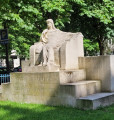
The 17th arrondissement of Paris is distinguished by its great urban and social diversity. The western part of the arrondissement is more residential and middle-class than the east, with the Ternes and Monceau neighbourhoods. It is characterised by varied architecture ranging from Haussmann-style buildings to contemporary blocks. Well-served by public transport, it combines Parisian traditions with modernity. The western part of the arrondissement offers two long walks and around twenty green spaces, including picturesque gardens such as the Square Saint-Odile and the undulating Jardin Claire Motte.
The wildlife of Monceau and Faubourg Saint-Honoré
 4.03 mi
+72 ft
-75 ft
1h 55
Easy
Departure from Paris
4.03 mi
+72 ft
-75 ft
1h 55
Easy
Departure from Paris
An approximate north-south crossing of the 17th and 8th arrondissements of Paris in search of animal representations. The architectural styles evolve throughout the route. The crossing of Parc Monceau offers a slice of greenery.
Crossing Montmartre from Place Clichy to Barbès
 2.91 mi
+262 ft
-249 ft
1h 35
Easy
Departure from Paris
2.91 mi
+262 ft
-249 ft
1h 35
Easy
Departure from Paris
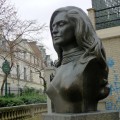
Discover Montmartre hill, via the small paths, the Saint Vincent cemetery, Dalida, the old village, the Basilica, superb views of Paris.
Green spaces in Paris’s 9th arrondissement
 3.02 mi
+121 ft
-154 ft
1h 30
Easy
Departure from Paris
3.02 mi
+121 ft
-154 ft
1h 30
Easy
Departure from Paris
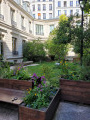
The ninth arrondissement of Paris is distinguished by its lively and central character. It has historical links to the world of entertainment, with numerous theatres, cinemas and concert halls. As a shopping district, it is home to department stores, boutiques and iconic covered arcades. It blends Haussmann-style architecture with more recent buildings, whilst remaining a residential area.After the first two arrondissements, the ninth has the least amount of green space. These are mainly local, much-frequented gardens that play an important social role. The area as a whole reflects an old urban fabric, not particularly conducive to the creation of large natural spaces.
Discovery tour of Haussmann's Paris
 Association / Club / Walk leader
 2.15 mi
+13 ft
-46 ft
1h 00
Easy
Departure from Paris
2.15 mi
+13 ft
-46 ft
1h 00
Easy
Departure from Paris
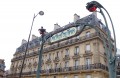
Baron Haussmann transformed Paris between 1852 and 1870. The 9th arrondissement of Paris is at the heart of this transformation: the new thoroughfares, grand boulevards and square-shaped junctions showcase buildings suited to life under the Second Empire: department stores, the Opéra, theatres, music halls, churches, press offices, banks, covered arcades, Morris columns, kiosks, etc. This tour will introduce you to the remnants of that era and how they have adapted to modern-day Paris.