Country:

 City:
City:


Parking is available at the harbour master's office in Santa Lucia, Saint-Raphaël.
(S) Walk up the southern basin of the port until you are opposite the Lion de Terre islet. The path begins with a staircase that leads to a pine forest. Turn right when you reach the canopy, then follow the water's edge as closely as possible to pass under the first villas. After a few acrobatic moves to warm up your legs, you will reach Santa Lucia Beach.
(1) Walk around the beautiful semicircle of this charming first beach and continue along the opposite shore. The rocky passages continue beneath what appear to be luxurious villas until you reach Fournas Beach, another small, discreet sandy gem.
(2) Pass Pointe des Cadéous, which closes off this cove, to emerge onto a wider bay, at the end of which lies La Péguière Beach. As you pass, note the remains of a small private harbour.
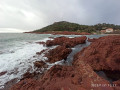
(3) After La Péguière, the shore becomes less angular. The red sandstone found here is less aggressive than the rock you walked on before, but the going is still challenging. Protected by rocky bars a short distance from the shore, the passage often skirts the waterline. So be careful in certain passages where you need to keep an eye on the waves. Pass several private harbours, with varying degrees of development. At the end of the succession of sandy banks that form the Plage d'Arène Grosse, you come to the small Port de Boulouris.
(4) Walk along the harbour and then pass the point behind which it is sheltered. The route then alternates between rocky and sandy sections, making it easier to walk.
(5) Cross Pescade Beach and then pass under large wooded areas. After the point that opens onto Anse de Boulouris, you will pass, without really noticing it, a small white pavilion, set on the rampart that protects the neighbouring property from the sea. This rather improbable but very photogenic construction will be a landmark for much of the route ahead. This is the Temple of Love at Villa Terre Sauvage.
(6) Cross Boulouris Beach, then continue along the rocks to go around a tiny harbour carved into the rock. Walk along this path to Aigue Bonne Beach, then Garde Vieille Beach.
(7) There is one more rocky point to go around to reach Pierre Blave Beach.
(8) Leave this beach via the steep street that leads from the coastal road, as beyond the point, it is no longer possible to pass under the luxury hotels.
Turn right onto the road and follow it up to the first left. Cross the railway line and take the path that runs alongside it to the right, just before the entrance to the campsite.
Continue along this path until you reach the first of the Dramont ponds.
(9) This pond and the next one are the remains of the blue porphyry quarries that were used to make the paving stones of Marseille and Genoa. Follow the series of information panels explaining the site and what this industry was, until you reach the Dramont railway station. Go past the station and take the underpass to the other side of the railway line.
(10) Cross the coastal road with caution and head to the esplanade commemorating the landing on 15 August 1944. Pass to the left of the landing craft to go down to the beach, passing under a white archway.
(11) Once at the water's edge, continue to the left to reach the small Port du Poussaï.
(12) At the end of the quay, take the steps leading up from the water's edge and follow the path that also climbs through the woods. At the first crossroads, turn right and follow the track that climbs the hill. Leave the path that leads to the semaphore on your left and continue straight on until you reach the viewpoint overlooking Cap du Dramont.
(13) Pass the viewpoint and begin the climb up the winding path to the top of the last ramp, which leads to a small pass between the semaphore and the antenna. Continue towards the antenna until you reach a concrete bunker. The view then opens up onto Agay Bay, towards which the walk continues.
(14) Retrace your steps and descend the track that branches off to the right. Pass a bend and then leave two tracks on the left to continue towards Pointe de Camp Long, where you will find yourself back near the water.
(15) At the point, turn left until you reach the car park overlooking Camp Long Beach, a small, well-sheltered gem. Go down to the beach to walk around it, and perhaps take a swim, as the location is ideal for this.
(16) At the end of the beach, the path continues along the water's edge, passing the point that closes off the northern end of the channel leading to the sea. Walk around the properties on this point to reach the coastal road. Follow the path that runs alongside this road to Pourrousset Beach.
(17) After this new beach, follow the road either along the path that runs along the shore or further along the pavement until you enter the old village of Agay.
(18) Pass the few shops there, then at the chapel, which is on the other side of the railway line, go down to the tiny harbour with its colourful huts and boats (E).

 Visorando Member
 Moderate
  Easy
Easy