Country:

 City:
City:


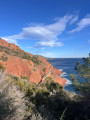
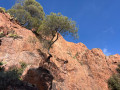
Departure from the large car park at Dramont landing beach after Saint-Raphaël. Take the time to read the information panels about the 1944 landings and the tributes to these courageous liberators.
(S/E) Go down to the beach and turn left towards the east, following the coastline (small beaches and rocks). At the end, take a small staircase that leads to the Port du Poussaï.
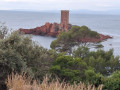
(1) Go around the port and take a small staircase to continue along the marked path (it climbs a little). Very quickly, you will find yourself on a track in the woods that winds eastwards around the foot of the rock on which the Dramont Semaphore stands.
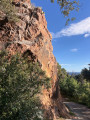
(2) Once past the Pointe du Dramont, do not take the paved path that climbs northwards, but descend a small stony path towards the east and the rocks, and quickly turn northwards, climbing a few metres. The path then runs along a balcony above the coastline, still heading east. It goes around the Mare Règue cove, passes under the huge relay antenna, then descends. After passing a bench facing the sea, the path turns north and reaches a fork.
(3) Take the path on the right (broken fence) which winds down towards the rocks by the sea, then continue north through the undergrowth. You will soon reach the ruins of the Camp Long batteries and a track.
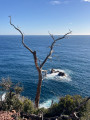
Descend to Camp Long Beach, cross it and continue along the small path at the water's edge, then over the rocks (yellow markings), going around a large property (Pointes Longues). Cross another small beach and continue to follow the blue markings on the rocks, then climb back up to the road.
(4) At Pourrousset Beach, cross the road to enter the Cap Estérel estate and immediately take the small wooden staircase on the left (still following the blue markings).
Cross over the railway line, continue along the road to the roundabout and descend opposite on the right to the large car park.
(5) Walk along the car park on your right until you reach the end, where a small iron gate leads to a pretty blue-marked trail. Walk up the Vallon des Ferrières until you reach an old picnic area (with a masonry oven and work surfaces).
(6) Look for a path (the best marked) to the south-west that leads into the woods. It heads generally south and is the most frequently used. After a few bends, you will come to a large gate, a track and a small hairpin bend (signposted Cap Estérel). Follow the road which climbs slightly towards Dramont for 250 m.
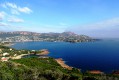
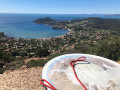
(7) Turn right onto a path that is very rutted at the start (signposted Belvédère). It zigzags southwards to the summit, offering magnificent views of Agay and the Estérel.
(8) At the top, at a crossroads (signposted Belvédère), take the path on the left that descends south behind the sign. You will soon reach a level path and turn right towards the west. Continue down this rocky path marked in blue, which winds down in several hairpin bends.
(9) When you reach the entrance to the paintball field, take the track on the left (east) which runs alongside two large basins that are former Roman quarries reused in the 19th and 20th centuries and now converted into a leisure area. Take the opportunity to read the information boards explaining the history of these quarries and the work of the quarry workers. When you reach the second basin, after a small car park, go down the path on the left towards the water's edge and take the tunnel that passes under the railway line and the road to come out at the Dramont car park (S/E).


 Visorando Member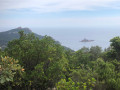
 Easy
Easy