From the Col de Sainte-Marie-aux-Mines to the Chaume de Lusse

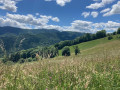
This circular hike links the Col de Sainte-Marie-aux-Mines to Chaume de Lusse, through typical Vosges forests of beech, fir, blueberry and high-altitude meadows. The forest paths and roads offer beautiful panoramic views of the Val d'Argent and Meurthe valleys. This is a fairly dynamic route that leads to Chaume de Lusse via a varied course, including sustained climbs (which is why we rate it as difficult), forest passages and open ridges. Part of the route runs between Alsace and Lorraine on paths and trails marked by the GR®531, the former border from 1871 to 1918, with boundary stones marked D (Deutschland), often hammered, and F, marking the historic border and named "Chemins de la Grande Guerre" (Paths of the Great War).

Details

87739671
Creation:
Last update:
Last review:
  • Walking
    Activity: Walking
  • ↔
    Distance: 13.69 km
  • ◔
    Average duration: 5h 15 
  • ▲
    Difficulty: Difficult

  • ⚐
    Back to start: Yes
  • ↗
    Ascent: + 465 m
  • ↘
    Descent: - 465 m

  • ▲
    Highest point: 984 m
  • ▼
    Lowest point: 771 m

Description of the walk

Parking RD459, coming from Sainte-Marie-aux-Mines, just before the hotel "Le Belle Vue", located at 2 Route du Col. The departure point is opposite the car park, on the other side of the road.

(S/E) Take the path on the left (GR®531), marked with a blue rectangle, and begin a beautiful, steady climb along a narrow path. Reach the ruins of Château de Faîte: beautiful panorama with a table and two benches for a pleasant break, with a view on a clear day.

(1) Continue to Roche des Chèvres: caution, this area is not secure. Unobstructed view to the west, above the trees.

(2) Continue along the path until you reach a star-shaped crossroads (which you will pass again on the way back).

(3) Follow the GR®531 straight ahead, keeping to the left: this route is called the "Tour du Val d'Argent". You will reach a crossroads.

(4) Continue straight ahead, following the blue rectangle markings, and you will reach the Croix Jardon, a cross erected in memory of a woodcutter who died in 1839 after falling from a tree.

(5) From the crossroads, take the path on the right, uphill, to reach a beautiful viewpoint over the peaks. You will reach the Hauts des Yraux shelter and observatory, a beautiful observatory on stilts with a splendid view of the valley and the surrounding area. A round table with two small benches allows you to take a break in the shelter and at a height.

(6) Return to the crossroads.

(5) Turn right onto the path marked Croix Rouge.

(7) Pass over the Maurice-Lemaire Tunnel without noticing it or seeing any signs, and continue on to reach the Route Forestière du Tacot.

(8) Turn right: blue rectangle with white stripe (GR®531) signpost. Reach a crossroads.

(9) Continue straight ahead on the GR®53 and reach Chaume de Lusse, atthe junction of the Tacot Forest Road and the Chaume Forest Road.

(10) Return to the previous crossroads.

(9) Turn left onto the GR®531 (marked with a blue rectangle) and begin a beautiful climb.

(11) Take a short detour to the left to reach the Grande Molle viewpoint (not marked). Return to the trail and continue on the left.

(12) Turn left at the hairpin bend: blue rectangle with white stripe markings. You will come out onto Chemin des Boules.

(13) Head left and you will reach a three-way junction shaped like an inverted Y.

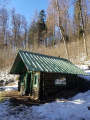
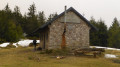
(14) Continue straight ahead, ignoring the path that branches off to the left before arriving at the Robinot Refuge. Above the forest path, this shelter is unguarded but open to all. It is equipped with a stove, a table and five chairs inside, and a large table and two benches for a dozen people outside.

(15) From there, continue straight ahead, following the blue disc markings. You will reach a fork in the road.

(16) Continue straight ahead; the forest path is now marked with a blue rectangle with a white stripe.

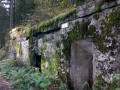
(17) Pass in front of the Soldiers' Wash House.

(18) Then pass in front of the Lion Monument, then in front of the grave of soldier Max Richter, killed in 1916, and arrive at the star-shaped crossroads, which you already passed on the way there.

(3) Turn left onto Chemin du Hégelau, following the blue rectangle with a white stripe.

(19) Take a short detour to the left to visit the national necropolis, which houses the remains of 230 French soldiers. Return to the path and continue to the left to quickly reach the car park (S/E).


Waypoints

  1. S/E : km 0 - alt. 773 m - Parking RD459 - Col de Sainte-Marie (772m)
  2. 1 : km 0.43 - alt. 882 m - Château de Faîte, ruins
  3. 2 : km 0.85 - alt. 872 m - Roche des Chèvres
  4. 3 : km 1.3 - alt. 818 m - Crossing the circular
  5. 4 : km 1.88 - alt. 870 m - Crossroads
  6. 5 : km 2.98 - alt. 949 m - Croix Jardon (Sainte-Marie-aux-Mines)
  7. 6 : km 3.36 - alt. 984 m - Haut des Yraux shelter/observatory
  8. 7 : km 4.57 - alt. 875 m - Maurice Lemaire Tunnel
  9. 8 : km 4.91 - alt. 851 m - Tacot Forest Road
  10. 9 : km 5.34 - alt. 848 m - Crossroads
  11. 10 : km 5.51 - alt. 837 m - Chaume de Lusse
  12. 11 : km 6.14 - alt. 920 m - Towards the Grande Molle viewpoint
  13. 12 : km 6.74 - alt. 969 m - Pin on the left
  14. 13 : km 6.93 - alt. 954 m - Chemin des Boules
  15. 14 : km 8.7 - alt. 805 m - Three-way junction, straight ahead
  16. 15 : km 9.79 - alt. 874 m - Refuge Robinot (875m)
  17. 16 : km 10.96 - alt. 856 m - Junction, straight ahead
  18. 17 : km 11.38 - alt. 841 m - Soldiers' wash house
  19. 18 : km 11.78 - alt. 825 m - Lion Monument
  20. 19 : km 13.41 - alt. 781 m - Nécropole Nationale (Sainte-Marie-aux-Mines)
  21. S/E : km 13.69 - alt. 771 m - Parking RD459 - Col de Sainte-Marie (772m)

Notes

This circular can be done in either direction. If you set off at around 9 a.m. in the direction suggested, depending on your pace, you can have lunch at the Robinot refuge. Nestled at an altitude of 875 metres, the Robinot refuge has been restored by students studying for a vocational diploma in forestry at the Lycée Polyvalent Louise Weiss, in partnership with the town of Sainte Marie aux Mines and the Club Vosgien De Ste Marie Aux Mines.

Before 1871, the Bruche Valley was part of the Vosges department from Wisches onwards. It was a French-speaking valley with a Romance dialect from Wisches to the Col de Saales, which the Germans tried to Germanise like the rest of Alsace. One solution considered was to deport the inhabitants far to the east (Silesia) and replace them with real Germans, but the war did not give the Nazis time to carry this out. The French-speaking children of these villages were educated in 1940-45 by German teachers.

This hike was mapped out by Sepp, a founding member of Les Branquignol.e.s (the famous group of epicurean Alsatian hikers whose motto is to enjoy life one step at a time), who hiked it in November 2025.

Worth a visit

Tellure Mining Park

Immerse yourself in history and let yourself be transported by this unique underground world. Tellure is a tourist complex built on the largest man-made underground cavity in the Vosges Mountains, the Saint-Jean Engelsbourg mine, known as "La Colonne Saint-Jean". Tellure offers you the opportunity to relive the golden age of the valley, and no booking is required! Got two hours to spare? Let's go!

Located between the hamlet of Echery and the Col des Bagenelles, the Forestum is an educational forest trail designed to promote trees and forests.
Visitors will discover more than 80 local and exotic species identified in the field, as well as 10 illustrated information points to help them understand the history, landscapes, nature and use of the forest and wood in the Val d'Argent. Approximately 2 hours (access to the site + visit to the Forestum). Leaflets available at the Val d'Argent Tourist Office.

The military heritage route

Four trails allow you to discover the remains of the Great War and retrace the particularities of the Vosges front. Between the Col des Bagenelles and the Chaume de Lusse, the German fortified sector of the Vosges Front features concrete and stone sentinels overwhelmed by the destructive fire of enemy artillery, a network of fortified shelters, observation posts such as the "Alderhorst" and "Minenwerfer" firing platforms, the effective German trench artillery.
The First World War Interpretation Trail has a comprehensive guidebook which is free and available from the Val d'Argent Tourist Office. The booklet is available in German and English.

Many others are also available: tourisme@valdargent.com. Tel . 03 89 58 80 50

www.valdargent-tourisme.fr

Sources: Sainte-Marie-aux-Mines Town Hall and Val d'Argent Tourist Office.

Always be cautious and plan ahead when you're outdoors. Visorando and the author of this route cannot be held responsible for any accidents occurring on this route.

The GR® and PR® markings are the intellectual property of the Fédération Française de Randonnée Pédestre.

Reviews and comments

5 / 5
Based on 1 review

Reliability of the description
5 / 5
Ease of following the route
5 / 5
Route interest
5 / 5
WILY68
WILY68

Overall rating : 5 / 5

Date of your route : Jan 26, 2026
Reliability of the description : ★★★★★ Very good
Ease of following the route : ★★★★★ Very good
Route interest : ★★★★★ Very good
Very busy route : No

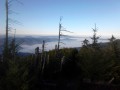
Completed on 25 January above the fog, beautiful views, 14.5 km with an elevation gain of 600 m.

Machine-translated

Other walks in the area

For more walks, use our search engine .

The GPS track and description are the property of this route's author. Please do not copy them without permission.