From Chiromme to La Mue

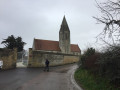
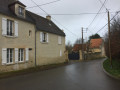
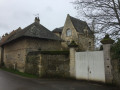
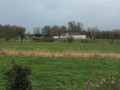
This walk passes through villages with striking architecture and also crosses rural areas along the Chiromme and the Mue.

Details

4833971
Creation:
Last update:
Last review:
  • Walking
    Activity: Walking
  • ↔
    Distance: 9.70 km
  • ◔
    Average duration: 2h 50 
  • ▲
    Difficulty: Easy

  • ⚐
    Back to start: Yes
  • ↗
    Ascent: + 30 m
  • ↘
    Descent: - 27 m

  • ▲
    Highest point: 60 m
  • ▼
    Lowest point: 38 m
  • ⚐ Country: France
  • ⚐ City: Lasson (14740)
  • ⚑
    Start/End: N 49.230268° / W 0.463582°
  • ❏
    IGN map(s): Ref. 1512OT
  • Hour-by-hour weather

Photos

Description of the walk

Park in front of the Lasson-Rosel community centre.

(S/E) Facing the centre, turn right, pass Rue Jean Sauvalle (on the left) and the bridge over the Mue (on the right). Continue along Avenue du Château towards the castle, negotiate the left-hand bend, and take La Ruelle on the left (pedestrian crossing – red and white markings).

At the junction, turn left and follow Rue du Capitaine Poinlane. After the last houses, in this large plot on your left, you will find the remains of the sheepfold. Continue to the wayside shrine at the junction with the D126.

(1) Turn right, then immediately right onto the dirt track (Chemin de Saint-Gabriel), which you follow until you cross the Ruisseau du Chiromme, walking along the hedge to the end. Cross the stream between two imposing plane trees.

(2) Turn left onto the path that runs alongside a field on the right and the hedge bordering the Ruisseau du Chironne on the left (black markings). Continue along the path, following the hedge and the stream, and ignore the bridge on the left that crosses the Chiromme as you come out of a right-hand bend.

(3) At the end of the path, in the hamlet of Bray, turn left onto the D126, cross the bridge and then, after about 200 m, turn right onto the Sente du Puits. At the end of the path, turn left onto the Chemin de la Garenne. Continue straight on until you reach the junction with a tarmac road.

(4) Turn right then left after the Vauculey pumping station (green signposting). The Vauculey borehole supplies drinking water to the Bretteville-l’Orgueilleuse Inter-municipal Drinking Water Supply Association. It is the only active borehole belonging to this Association, which comprises ten surrounding municipalities.

(5) Originally, the route branched off to the left and passed through the courtyard of Vauculay Farm to join the Chemin du Ricaras.

A municipal by-law dated June 2020 prohibits, until further notice, access by pedestrians and vehicles to the bypass road around the Vauculay farm due to falling slates. Regulatory signage has been put in place to warn walkers of the danger they face. It is tempting to take the field opposite to rejoin the original route and bypass the Vauculay farm on the right, but this is private property. The rightful owner is firmly opposed to hikers passing through. For your information, an alternative route is being considered with the local council, but until it is established, there is no alternative but to continue along the local path

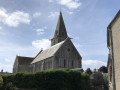
Consequently, turn onto the path on the right, walk for about 400 metres, ignore the path branching off to the right before the small wood, negotiate the S-bend running alongside the buildings; the Ortial Chapel is on the left. Continue along Chemin de la Chapelle to the junction. Turn left onto Chemin de la Cavée, cross the bridge over the Mue and continue to the village of Rots.

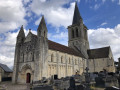
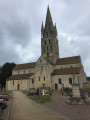
(6) Cross Rue de l’Église Saint-Ouen (D 170) with care and turn left towards Cairon. Pass in front of Rots church, continue straight on, leave the village, and ignore Chemin des Fosses on the right at the hamlet of Les Perrelles.

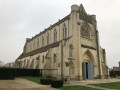
(7) At the fork, turn left onto the Chemin du Ricaras towards Rosel. Ignore the path on the left (known as the Chemin de Vauculey, leading to the Vauculay farm) to rejoin the original route here and continue straight on. Walk past the castle, continue straight ahead and then carry on along the same path into Chemin de l’Églantine (green signposted). 100 m after rounding the bend to the right, turn left into Rue de l’Église, go round the cemetery and Rosel church, and continue to the junction.

(8) Turn left onto Rue Boulay (D 126) and keep to the left-hand side. Take the path running alongside the Town Hall, go down the steps on the right, and cross Rue Boulay with care. Continue to the left towards Lasson, cross the bridges over the Mue and, after the second bridge, turn left to return to the starting point (S/E).


Waypoints

  1. S/E : km 0 - alt. 40 m - Located opposite the Lasson community centre
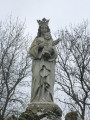
  2. 1 : km 0.9 - alt. 50 m - Lasson Calvary
  3. 2 : km 2.21 - alt. 44 m - Bridge over the Chiromme
  4. 3 : km 3.5 - alt. 45 m - Bridge over the Chiromme at Bray (D 126)
  5. 4 : km 4.94 - alt. 43 m - Tarmac road
  6. 5 : km 5.53 - alt. 42 m - The Vauculay farm. No entry.
  7. 6 : km 6.67 - alt. 54 m - Rue de l'église Saint-Ouen in Rots (D 170)
  8. 7 : km 7.53 - alt. 50 m - The Chemin du Ricaras towards Rosel
  9. 8 : km 9.17 - alt. 44 m - Rue Boulay (D 126)
  10. S/E : km 9.7 - alt. 40 m - Located opposite the Lasson community centre

Worth a visit

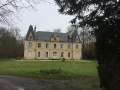
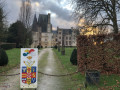
Lasson Castle

It appears to have been built in two phases: around 1530, the Thésard family is said to have asked Hector Sohier, who was at that time building the Church of Saint-Pierre in Caen, to rebuild the castle, then Gothic in style, in the Renaissance style.
In 1628, through marriage, the château passed to the Croismare family. Louis de Croismare, a Councillor at the Parliament of Rouen, died at Lasson in 1654. His son Nicolas de Croismare (1629–1680), Marquis de Lasson, was known as a mathematician, man of letters and painter. The descendants of the Croismare family occupied the château under this name until 1768.
Through marriage, the property passed to the Montalembert family and then to Étienne Alexandre Lhoste, Marquis of Livry. Upon his death in 1874, the château was sold on several occasions. It was no longer regularly inhabited or maintained from 1895 onwards.
Since 1980, and with the help of the State and the General Council, the current owners have undertaken restoration work.
This château is privately owned; it can be visited on exceptional occasions, such as during Heritage Days. Further information can be obtained from the Association des Amis du Château de Lasson, 64 avenue du Château des Rentiers, 75013 Paris.

Georges Poinlane

Born on 12 March 1919, originally from Lasson, he was a quartermaster in the navy (discharged in 1940).
A member of the French Forces of the Interior, he served in the Scamaroni Squadron (with the rank of Captain).
He was killed on 23 August 1944 at the age of 25 near Lisieux Town Hall whilst serving as a scout during the liberation of the town.
For your information, a commemorative plaque in his honour is located to the right of the entrance to Lisieux Town Hall.
His grave is near the war memorial in Lasson Cemetery.
When his ship was decommissioned in 1940, he was demobilised but wanted to continue serving his country. Mr Frémont gave him the opportunity to do so by smuggling three British airmen from the occupied zone to the free zone and then on to England. He subsequently became acquainted with several resistance networks in Caen. Wounded in the arm during an operation, he took part in the fighting to liberate Caen at Le Mesnil-de-Louvigny in July 1944.

Lucien Frémont

Born on 11 April 1901, Mayor of Lasson, he was shot by the Germans at Mont Valérien, in Suresnes near Paris, on 31 March 1942.
His grave is near the war memorial in the cemetery at Lasson.
Arrested after being denounced on 6 July 1941, Lucien Frémont had given shelter to a young French officer from the Free French Forces who had been parachuted into Carpiquet.
As German troops surrounded the property, one of the mayor’s sons managed to help the agent—who was still on the premises at the time of the arrest—to escape.

Jean Sauvalle

Born in Paris on 28 October 1910, he was a farmer in Lasson. He was called up in September 1939 on thesecond day of mobilisation.
A lieutenant in the36th Infantry Regiment stationed in the Ardennes, he was killed in action at Inor, in the Meuse, near Verdun, on 20 May 1940, leaving behind a widow and three children.

Reviews and comments

4.6 / 5
Based on 4 reviews

Reliability of the description
5 / 5
Ease of following the route
5 / 5
Route interest
3.8 / 5
Nathalie Lacote
Nathalie Lacote

Overall rating : 5 / 5

Date of your route : Sep 02, 2025
Reliability of the description : ★★★★★ Very good
Ease of following the route : ★★★★★ Very good
Route interest : ★★★★★ Very good
Very busy route : No

A wonderful discovery of the surroundings near our holiday home. Beautiful residences, a relaxing and rejuvenating break in the chapel. Thank you!

Machine-translated

jeangazon
jeangazon

Overall rating : 3 / 5

Date of your route : May 10, 2025
Reliability of the description : Not used / Not applicable
Ease of following the route : ★★★★★ Very good
Route interest : ★☆☆☆☆ Very disappointing
Very busy route : No

From the start to kilometre 5: vast, unattractive farmland.
From 5 to 6: the only really lovely part of the walk.
From 6 to 7: a VERY DANGEROUS country road. I dare not imagine what it would have been like if I’d had a dog with me...
From 7 back to the start: roads through the town...
This walk is completely uninteresting.
I sped up so much to get it over with that I did it in 1 hour 45 minutes.
I wouldn’t recommend it at all.

Machine-translated

huguesV
huguesV

Overall rating : 4.7 / 5

Date of your route : Sep 23, 2023
Reliability of the description : ★★★★★ Very good
Ease of following the route : ★★★★★ Very good
Route interest : ★★★★☆ Good
Very busy route : No

Pleasant

Machine-translated

Vivrenature19
Vivrenature19

Hi, J.P. BUTEAU
My comment is mainly for those who, like me, try to avoid the tarmac; it’s a double-edged sword – either we get through or we turn back.
Kind regards
Vivrenature

Machine-translated

Jean-Paul BUTEAU
Jean-Paul BUTEAU

Hello Vivre Nature,

According to my description and route, there is no question of taking any path other than the Églantine path, so you must negotiate the right-hand bend to reach Rue de l’Église. My post was published 10 months ago, so the layout of the area may have changed since then; at the time, I hadn’t noticed a path leading to private property that could mislead a walker. I will take note of your comment, pay particular attention to this when I next walk the route, and clarify this point as best I can.

Machine-translated

Vivrenature19
Vivrenature19

Overall rating : 5 / 5

Date of your route : Dec 21, 2021
Reliability of the description : ★★★★★ Very good
Ease of following the route : ★★★★★ Very good
Route interest : ★★★★★ Very good
Very busy route : No

A very interesting walk combining paths and beautiful buildings. Do not take the path between points 7 and 8, near L'Eglantine, as three-quarters of the way along it leads onto private land. It’s a shame this isn’t mentioned in the description. (There is a beehive in the undergrowth.)

Machine-translated

Other walks in the area

For more walks, use our search engine .

The GPS track and description are the property of this route's author. Please do not copy them without permission.