Country:

 City:
City:


(S/E) Leave the Barenghi bivouac heading north to climb the very rocky Col de la Gypière.
(1) Leave your rucksack just below the pass, sheltered by a rock, so you can climb light to the Tête de la Fréma. The track is very easy to follow on the shoulder between the pass and the summit. At a small, ruin-like rocky ridge, turn left as you climb, i.e. towards the Lac des Neuf Couleurs.
(2) The arrival at the Tête de la Fréma is spectacular. Watch your step. The summit is a bit rocky. It’s quite exposed on the Italian side...
On the descent, take the track on your right at the ruiniform rocks, i.e. on the Barenghi side. Another lake, another shade of blue-green. You then return to your rucksack and the Col de la Gypière.
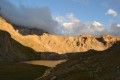
(1) Descend the north-facing slope to Lac des Neuf Couleurs. This lake is often covered in patches of ice and snowdrifts around its edges... be careful, the water is very cold.
(3) You then follow a very goodGRP®®-marked path westwards to Lac Long at the foot of the ridges of the enormous moraine beneath Chambeyron.
(4) Continue westwards and descend to the Chambeyron Refuge.
(5) You then simply head to Lac Premier via theGRP®® Tour du Chambeyron trail.
::6: The path then climbs steeply to the Pas de la Couletta: the atmosphere is somewhat reminiscent of the Dolomites... with tower-like rock formations and strange shapes.
(7) The well-marked trail descends south-south-west through scree before reaching the verdant Vallon des Aoupets and its shepherd’s hut.
(8) At the bottom of the valley, turn left (east-southeast) at the crossroads to head up the Vallon de Plate Lombarde.
(9) Go round the Tête de Plate Lombarde and reach the Col du Vallonet and its lake. As you pass, be sure to take in the immense walls of the Massour and the very austere Col de Stroppia. Quite a contrast to the verdant valley.
(10) At the pass, you join theGR®®5, which here merges with theGR®®56... and perhaps the crowds... On the other side of the pass, you cross a wetland to reach a junction where you leave theGR®®2/GR®®56on your right and continue on the GRP®®.
(1) The Col de la Portiolette is in our sights. We return to the rugged, windswept terrain. The terrain looks hostile but the path is very well marked and this pass isn’t as bad as it seems. As soon as it’s no longer possible to stay on the grassy patches, the path continues easily over well-stabilised boulders. Only the final few metres, which are rather ‘gravelly’, are a bit tricky because they offer less grip.
(12) Pass through the “very small gate” at the Col de la Portiolette and descend on the other side. The path leads to a grassy dome and rejoins a scree slope, which is crossed on a slightly descending traverse before reaching the junction with the path ascending from Larche.
(13) Turn left and climb to the Col de Sautron.
(14) Then on to the Cime de la Costes du Col.
(15) This offers a view of the interesting Danilo Sartore bivouac (around 2,450 m, slightly below the Croce Paeasnu) on the Italian side. It may be a good option for those wishing to continue without descending to Larche. Return to the Col de Sautron.
(14) then follow the path down to the previous junction.
(13) Continue south-west then south to cross the Isalette pass.
(16) Descend the right bank of the Riou Rouchouse, heading generally west then south, to Larche to reach the Lombard Lodge (E).
 Visorando Member
 Difficult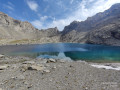
 Association / Club / Walk leader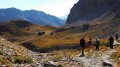
 Moderate