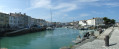
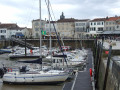
Stage 1: From the 13th centuryonwards , Saint-Martin-de-Ré was a bustling market town, developed around its port, where wine, salt, wood and wheat were traded. The town, originally structured by a network of north-south streets, became denser in the 17th century with the construction of numerous mansions. The port activity, orchards, vegetable gardens and lively urban life shaped a vibrant and prosperous town. In the 17th century, Vauban described Saint-Martin as "the most inhabited and best built place onthe island". He had imposing fortifications built, which, without disrupting the urban fabric, gave the landscape a lasting structure. The creation of new roads facilitated access between the gates of the enclosure and the heart of the town, while the parade ground became a central public space.Over the centuries, the town retained its organisation into districts, some of which had a strong religious dimension. Several institutions were established there, such as the hospital, the Capuchin monastery, the governor's residence and the Maison Centrale. Urbanisation remained limited in certain areas, such as around the citadel and to the east of the town. The 19th century saw a decline in traditional maritime trade, affecting port-related trades. However, Saint-Martin retained its central role on the island. Even today, its historical heritage, port and fortifications shape its identity, striking a balance between permanent life and tourist appeal. The municipality has just under 2,500 inhabitants and remains marked by its historical role as the capital of the Île de Ré.
Stage 2: Set back from the port, Rue del'Orneau takes you to the old quarters of Saint-Martin. Its narrowness and sharp bends are a response to a necessity of all urban planning on the Île de Ré: protection from the wind. This makes it possible to walk through the narrow streets and alleys that define and give charm to the historic urban layout of the villages on the Île de Ré.These streetsareoftenpaved with irregularly shapedstones, a reminder of the period when ballast stones from ships were used to pave the roads. The central gutter was used to drain both rainwater and sewage, allowing pedestrians and carts to pass without getting dirty.
The wells: The streets ofthe Île deRé arecharacterised by the absence of pavements and thepresence of building facadesthat open directly onto the street. They punctuate thelayout of the streets with their projections andrecesses. As a result, many small squares seem to be the result of widening thealleys ratherthan careful urban planning. These "quéreux",oftenlocatedatthe intersectionof alleys, serve as sharedspaces for residents.Thepresenceof a wellraises the question of drinkingwater supply forthe communitieson the Île de Ré.The absence offresh water onthe island of Réwas aproblemthat was solvedby drilling wells, either in areas open to the public or on privateland. These wellswere of vital importance for a long time ,asit was not until the secondhalf of the 20th century that a pipeline brought drinking water tothe island ofRé from the mainland.
Stage 3: During the medieval period, urban centres were organised so that different economic sectors were grouped together by neighbourhood. This was partly due to the existence of guilds, which exerted influence over entire sectors of craftsmanship, for example. It was not uncommon to have streets dedicated to the clothing or food trade. Although these neighbourhoods have now disappeared, the street names perpetuate this memory. Here, Rue de la Forge (Forge Street)and Rue du Four (Oven Street)indicate the presenceof activities and structures that were important to everyday life on the Île de Ré. The forges produced metal tools as well as horseshoes and iron hoops needed for the construction of barrels. The oven was often owned by the lord , to whom the inhabitantshad to pay a fee to use it. Each village had its own blacksmith , whose forge was a place where people gathered.The name Rue de Cîteaux highlights the links between the Île de Ré and the religious communities affiliated with the abbey of thesame name.These communitiesoftenbrought agriculturalexpertise to the island ,such asviticulture.
Stage 4: Rue Mérindot and Place Anatole France (formerly Place du Soir) offer an opportunity to discover and comparedifferent façades. Those with half-timbered walls are reminiscent of medieval buildings , while others are more regular in style, typical of Renaissance houses. It is noticeable that the openings in the facades of half-timbered houses indicate the presence of a shop on the ground floor, above which are living quarters. Hidden beneath these buildings are cellars that were once used to store goods and foodstuffs. Today, most of the façades on the Île de Ré have been renovated and decorated in accordance with the recommendations and requirements of the local urban developmentplan (PLU). Thisplan recommends the use of a specific colour palette for the shutters of houses on the island: shades of green for whitewashed façades and grey for stone façades . Of course , there are a few exceptions to these rules, such as the two houses with red shutters in the old village of Saint-Martin, which, according to legend, were once used to produce vinegar, which would explain the colour of the shutters...
The town's current church owes its unique appearance to the ravages of the Wars of Religion in the 16th and 17th centuries. While our eyes are naturally drawn to the remaining Gothic elevations, we should also take a look at one ofthe building's often overlooked treasures : its old Gothic portal , with its sculptures representing both figures and curly kale leaves, a recurring decorative element in the late Middle Ages. The beauty of the Gothic pinnacles (located opposite the bell tower) gives an idea of what the church must have looked like before it was destroyed during the wars.The current church, dedicated to Saint Martin, follows on from an earlier Romanesque church that was destroyed during the Hundred Years' War. It also houses commemorative plaques in memory of the painful massacres of the Wars of Religion and the persecution ofCatholic priests during the Revolution.
Stage 5: This street isnamed in honour of the father of Madame de Sévigné, a 17th-century woman of letters. Celse Rabutin de Chantal was a nobleman whose taste for adventure and duelling brought him into conflict with the royal authorities . Seeking to distance himself from the latter,he joined his friend, the Lord of Toiras, on the Île de Ré, where he was killed during the landing of English troops in 1627. This streetoffers a glimpse of the style of the mansions built by the minor nobility and bourgeoisie of the Île de Ré in the 18th century. At the beginning of this century, the merchant Jean Masseau de Beauséjour had the Hôtel de la Baronnie built after purchasing the title of Baron of Ré. The façade features the regular proportions of the neoclassical style with its regular vertical bays and smaller upper floors . Here, however, there is no concession to commerce, but a large door signalling the importance of the owner. The dwellings and rear garden were occupied by a variety of residents. In the 19th century, the Sainte-Marie de la Providence community from Saintes established a boarding school there . Another building, at No. 25, was used for a similar purpose at the end of the 17th century with the establishment of a school run by nuns from the Order of Saint Vincent de Paul, before undergoing major alterations in the 19th century.



 Country:

 City:
City:


 Visorando Member
 Moderate