Country:

 City:
City:


Park in the Vauban car park. Please note that this car park is subject to charges from 20 March to 11 November.
(S/E) From the north exit of the car park (sea side), turn right and take Allée de la Guyane. This will take you to the entrance of the Citadel (central building of Saint-Martin-de-Ré).
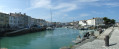
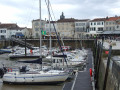
Built from 1681 onwards according to Vauban's instructions, the citadel symbolises the strategic importance of the Île de Ré in defending the coastline. To facilitate supplies by sea, the structure includes a small fortified port. In the 19th century, the citadel was converted into a prison.It housed many prisoners destined for penal servitude , including some of the Paris Commune rebels , who are now honoured by a plaque on the walls of the fortified port.
(1) Retrace your steps to the north exit of the Vauban car park.
(S/E) Continue west on Avenue Victor Bouthillier. Pass the Ernest Cognacq Museum, housed in the Hôtel de Clerjotte.
Built at the end ofthe15thcentury,the Hôtel de Clerjotte has served as a stately home , a war arsenal, officers' quarters and, today, a museum.Themuseum has a rich collection of objects and documentsdedicated tothe history ofthe Île deRé. The French gardens at the rear ofthe museum are alsorenowned for theirbeauty.
Continue west along Avenue Victor Bouthillier. Go around the port on the left (Quai Job Foran then Quai de la Poithevinière). Then take Cours Pasteur. Cross this road at the pedestrian crossing and climb a flight of steps to reach the Bastion de Mer.
There isan exceptional view of the Pertuis Breton and theVendéecoastopposite. On the right, you can seethe Baie del'AiguillonNational Nature Reserve .
(2) Head south, follow the fortifications and return to Cours Pasteur. Follow this road south. When it turns right, take Cours Marcelin Berthelot on the left and you will soon reach the Porte des Campani.
Originally called the Porte de La Couarde, the Porte des Campani was renamed in honour of a former regiment of the royal army that fought on the Île de Ré in the 17th century. Well preserved, it allows visitors to see both the military equipment and the centuries-old decorations with which it was adorned when it was built in 1681.
(3) Turn left onto Rue Aristide Briand. Take the first left onto Rue Leudaste. At the end, turn right. Then turn left and right to cross Rue Suzanne Cothonneau and follow Rue Mérindot. Continue straight ahead until you reach a T-junction behind Saint-Martin Church.
The current Gothic-style church replaced an earlier church that was destroyed during the Hundred Years'War .It was ransacked during the Wars of Religion and subsequently restored. Its bell tower is open to visitorsand offers exceptional views of the village, the fortifications and the surrounding area. The interior contains many remarkable details , including the epitaph dedicated to the Baron de Chantal, father of the famous 17th-century woman of letters,Madame de Sévigné.
(4) Go around the church on the left, taking Rue de Sully, Cours Bailly des Écotais and Place Eudes d'Aquitaine in succession. Continue along Rue Bailly d'Aulan. At the end, turn into Place de la République and turn left.
(5) Take Rue de l'Hôpital. Then turn right onto Rue Rapé and follow it to the end. Turn left onto Rue du Rempart. After about 30 metres, turn right to reach the Salle de la Poudrière.
This building wasrenovated between 2023 and 2025 with co-funding from local authorities, enabling the municipality of Saint-Martin to preserve its architectural heritage while providing premises for cultural and community activities.
(6) Turn left, cross Cours Vauban and continue to Porte Thoiras.
This gate was named at the end of the 19th century in honour of the governor of the island who resisted the English invasion of 1627. Before being occupied by the prison administration , the Toirasbarracks were used to house soldiers assigned to the defence of Saint-Martin-de-Ré and then those trained to leave for the colonies.
(7) Turn left and quickly join Cours Vauban. Follow this road to the right and continue straight ahead until you reach the Vauban car park (S/E).


 Visorando Member
 Moderate