Lay Saint Christophe
In Old Lorraine, lay refers to a hill or small mountain. The village is indeed located on a hillside. The word lay, in the old language, refers to structures built on high ground.
In 1965, several Merovingian objects were found in the municipal area, including a double hernia bandage now kept at the Lorraine Museum in Nancy.
The Gallo-Roman village of Layum became the residence of the mayors of the palace of Austrasia during the Merovingian period: Saint Arnoul, Bishop of Metz and ancestor of Charlemagne, was born at the Château de la Haute-Lay around 580. He shared the education of the young King Dagobert with Pépin de Landen, whose daughter married his son: they were the grandparents of Charles Martel.
Lay-Saint-Christophe was the site of a very prosperous abbey. There was a church in Basse-Laye from the 12th century onwards.
The commune had around 1,000 inhabitants in the 18th and 19th centuries: at that time, there were two iron mines and many prosperous industries, including sawmills, tanneries, tile works, brush factories and carbon black factories. Today, they have all disappeared.
Civil buildings
Remains of protohistoric enclosures.
17th-century private house, known as "de la Samaritaine": house, west wing staircase, interior decoration, bathroom, gallery, terrace, garden, listed as a historic monument by decree of 13 September 2000.
Hospice (former castle).
18th-centuryMoulin Noir mill.
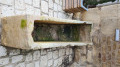
19 fountains (former wash houses) from the 18th and 19th centuries.
The town hall houses a museum of Lorraine arts and traditions.
Numerous mansions from the 15th to 20th centuries in Haute-Lay.
Religious buildings
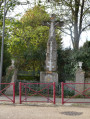
Saint-Christophe Church
Ruins of an 11th-centuryRomanesque priory church in Haute-Lay, listed as a historic monument by decree on 24 February 1986.
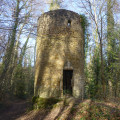
Remains of the 11th-centurypriory in Haute-Lay: Saint-Arnou tower and former monastic buildings converted into dwellings, also listed as historic monuments by decree on 24 February 1986.
Saint-Christophe Church in Basse-Lay, rebuilt in 1862: 12th-century bell tower, 14th/16th/17th-century carved wooden statues.
Source: Wikipedia (excerpts)
Restoration of the three fountains
Chavenois fountain
Fed by a spring located upstream in the neighbouring forest, this fountain was built in 1811.
A real hub of community life and the focal point of the village, the inhabitants came here to fetch water, wash their clothes and
livestock came here to drink. In 1856, Sieur François Grandjean, owner of a tile factory, signed an agreement with the municipality allowing him to collect the water needed to run his factory from the slopes of Bouxières and Fontenois. He collected water from the springs and distributed it to the existing fountains. As a result, he supplied this fountain with water from the Chavenois spring. Work is needed to restore the fountain to its former glory.
Fontaine des Dames
This fountain was built in 1857 to supply water to the lower part of the village. During
to improve the town's sanitation system in 1966, the fountain was demolished. In 1977, thanks to the determination of a local resident, Mr Jean Edouard, it was rebuilt by volunteers based on the details of a postcard. Its reconstruction was the subject of a great mobilisation effort, with the inhabitants providing the necessary materials and equipment. Today, the fountain stands on a paved square, surrounded by lawns and recently planted apple trees. Unfortunately, time, bad weather and careless handling by humans have taken their toll. The coping stones are badly damaged, the trough is cracked,
the seal is practically non-existent and the monk is worn away.
Courcelles Fountain
This old wash house, dating from 1811, is fed by the Lolincourt spring. This channelled spring, with a very
, was a meeting place for washerwomen. At the time, the wash house consisted of three large wooden troughs
: one for washing and the other two for rinsing and draining. Over time, it lost its usefulness and became a fountain. Restored in 1973, the fountain has retained its monk, but the troughs have been reduced in size and are no longer watertight. Since the end of 2017, the Bassin de Pompey tourist route has included a tour dedicated to the fountains of Layenne, entitled "the village along the water". The restoration of these three fountains will be highlighted as part of this discovery route.
Source: Appeal for sponsorship with the Heritage Foundation
Some famous Layens:
Louis Guingot
Louis Guingot lived in Lay-Saint-Christophe on his property "La Tuilerie" in Les Corvées from 1936 to 1948 (the year of his death). During this period, which was not the best of his artistic career, he made his living mainly from gardening rather than his art. This was because, in 1939, the war cut him off from his main job as set designer for the theatre in Lunéville.
To find out more
Antonin Daum and Emile Wirtz
These two figures from the Nancy School and Daum crystal works stayed in our village at the beginning of the 20th century, where a street and a square are named after them.
Find out more
The Baron de Courcelles
benefactor of Lay-Saint-Christophe
Find out more
Source: official website of the municipality



 Country:
 City:
City:


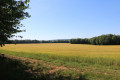
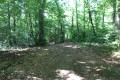
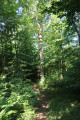
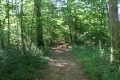



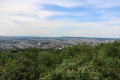
 A lovely little hike... bright sunshine... even very warm for the season... so very pleasant to hike in the woods of Chavenois... full of 🦅 birds that really brightened up our walk...
 Visorando Member


 Easy
Easy