From Lay-Saint-Christophe to Bois de Faulx

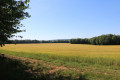
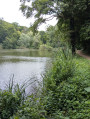
A pleasant hike on the forest plateau above Lay-Saint-Christophe. It crosses the Bois d'Eulmont and the Forêt Communale d'Eulmont and offers a very natural route on the outskirts of the city of Nancy. Hikers will be accompanied by the song of numerous birds throughout the route. The village of Lay-Saint-Christophe has 17 fountains, some of which are on or near the path.

Details

3425395
Creation:
Last update:
Last review:
  • Walking
    Activity: Walking
  • ↔
    Distance: 10.46 km
  • ◔
    Average duration: 3h 35 
  • ▲
    Difficulty: Moderate

  • ⚐
    Back to start: Yes
  • ↗
    Ascent: + 202 m
  • ↘
    Descent: - 202 m

  • ▲
    Highest point: 398 m
  • ▼
    Lowest point: 201 m

Photos

Description of the walk

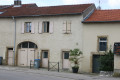
The car park is located on the north side of the church in Lay-Saint-Christophe, next to the Town Hall and below the entrance to the HEPAD.

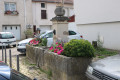
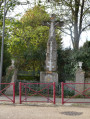
(S/E) Head east towards the Town Hall. Turn right at the end of the church (fountain on the left). You will come out onto Rue du Baron de Courcelles (fountain) and follow it to the left for about 30 metres. Take thefirst left, Grande Ruelle, which, as soon as you pass the school, becomes a steep grassy path. Pass the retirement home and continue to Place Lalincourt (war memorial).

(1) Turn left onto Rue de l'Armée Patton. After about 50 metres, take a narrow alleyway that continues as a footpath. At the end, turn right onto Chemin Blanc, which is flat. Cross Rue des Bénédictins on the right-hand side, then turn left onto Chemin de Routeuil, which is partially tarmac at the start. Continue along a path that leads towards the woods and climbs the Routeuil valley (quite steep).

(2) At the crossroads, take the sharp right turn onto the path on the right. After a flat section, descend and join the top of Rue des Sapins. Then turn sharply left and continue up the hill on a stony path that follows the street: this is Chemin de Leyr. When you reach the plateau, the path leaves the woods and crosses a cultivated area.

(3) At the crossroads, go straight ahead (from here, the route is marked with yellow dots on a white background). Stay on the edge of the Bois d'Eulmont on your left and ignore two paths on the right.

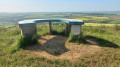
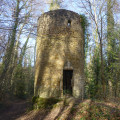
(4) About 200 m after entering the woods, turn right onto a path to go to the Croix des Pestiférés. Retrace your steps.

(4) Continue north-northeast on the forest path and ignore all the turnoffs on the left.

(5) At the fork, take the left-hand path that runs alongside the Eulmont Communal Forest. This turns left and runs along the edge of the woods at the edge of a large cultivated area.

(6) At a place called Le Grand Cugnot, the forest path enters the woods again. At the crossroads of forest paths, turn left (not signposted) and begin a gentle descent. Shortly afterwards, the path winds westwards and crosses the Eulmont Communal Forest.

(7) At the crossroads, turn left (the path on the right is reserved for authorised users). Descend and pass the Croix du Soldat. Follow the Chemin de Faulx, marked by a small yellow cross on a white background.

(8) At the intersection, continue straight ahead (south-west) on the marked, stony path, which is in good condition.
Stay in the woods and ignore the paths branching off to the sides.

(9) At the crossroads, turn left and follow Chemin du Rupt d'Adoue. After a short climb, follow a flat stretch of cultivated land on your left. When you reach Les Côtes, the path descends and turns into a street as soon as you reach the first houses. This is an area with some beautiful properties.

(10) When the street turns left, turn right onto the steeply sloping street called Chemin du Rupt d'Adoue. At the bottom, turn left onto Rue de Faulx. When the street turns right, cross straight ahead through a small square (fountain) and continue along Ruelle du Pont Bachat.

(11) When you reach Rue du Baron de Courcelles, take a look at the Fontaine Chavenois fountain on the right. Retrace your steps.

(11) Follow Rue du Baron de Courcelles to the right. Take thefirst left, Rue de l'Eglise, then thefirst right to return to the car park (S/E).


Waypoints

  1. S/E : km 0 - alt. 205 m - Parking at the Town Hall and Museum
  2. 1 : km 0.59 - alt. 254 m - Place Lalincourt
  3. 2 : km 1.59 - alt. 334 m - Routeuil
  4. 3 : km 2.95 - alt. 353 m - Chemin de Leyr - Chemin de Bazelu crossroads
  5. 4 : km 3.82 - alt. 367 m - Access to the Croix des Pestiférés
  6. 5 : km 4.58 - alt. 372 m - Fourche
  7. 6 : km 5.17 - alt. 396 m - Le Grand Cugnot
  8. 7 : km 6.54 - alt. 372 m - Crossroads
  9. 8 : km 7.14 - alt. 359 m - Intersection
  10. 9 : km 8.94 - alt. 262 m - Crossroads
  11. 10 : km 9.67 - alt. 251 m - Crossroads - Chemin du Rupt d'Adoue
  12. 11 : km 10.22 - alt. 201 m - Access to the Chavenois Fountain
  13. S/E : km 10.46 - alt. 205 m - Parking at the Town Hall and Museum

Notes

This hike takes place on varied terrain and requires sturdy footwear.

This route is only partially marked. Consequently, it is advisable to follow the directions in this description and on the map, while also paying attention to the landscape. Distance indications from the starting point, or even GPS coordinates of the waypoints (including the starting point), can also help hikers find their way.
This route does not present any orientation difficulties as it follows wide forest paths.

Hike completed by the author on 28 June 2020.

Worth a visit

Lay Saint Christophe
In Old Lorraine, lay refers to a hill or small mountain. The village is indeed located on a hillside. The word lay, in the old language, refers to structures built on high ground.
In 1965, several Merovingian objects were found in the commune, including a double hernia bandage now kept at the Lorraine Museum in Nancy.
The Gallo-Roman village of Layum became the residence of the mayors of the palace of Austrasia during the Merovingian period: Saint Arnoul, Bishop of Metz and ancestor of Charlemagne, was born at the Château de la Haute-Lay around 580. He shared the education of the young King Dagobert with Pépin de Landen, whose daughter married his son: they were the grandparents of Charles Martel.
Lay-Saint-Christophe was the site of a very prosperous abbey. There was a church in Basse-Laye from the 12th century onwards.
The commune had around 1,000 inhabitants in the 18th and 19th centuries: at that time, two iron mines were in operation and many industries were thriving, including sawmills, tanneries, tile works, brush factories and carbon black factories. Today, they have all disappeared.

Civil buildings:
Remains of protohistoric enclosures.
17th-centuryprivate house, known as "de la Samaritaine": house, west wing staircase, interior decoration, bathroom, gallery, terrace, garden, listed as a historic monument by decree on 13 September 2000.
Hospice (former castle).
18th-centuryMoulin Noir mill.
19 fountains (former wash houses) from the 18th and 19th centuries.
The town hall houses a museum of Lorraine arts and traditions.
Numerous mansions from the 15th to the 20th century in Haute-Lay.

Religious buildings:
Saint-Christophe Church
Ruins of an 11th-centuryRomanesque priory church in Haute-Lay, listed as a historic monument by decree on 24 February 1986.
Remains of the 11th-centurypriory in Haute-Lay: Saint-Arnou tower and former monastic buildings converted into dwellings, also listed as historic monuments by decree on 24 February 1986.
Saint-Christophe Church in Basse-Lay, rebuilt in 1862: 12th-century bell tower, 14th/16th/17th-century carved wooden statues.
Source: Wikipedia (excerpts)

Restoration of fountains:
Chavenois fountain
Fed by a spring located upstream in the neighbouring forest, this fountain was built in 1811.
A real hub of community life and the focal point of the village, the inhabitants came here to fetch water, wash their clothes and
livestock came here to drink. In 1856, Sieur François Grandjean, owner of a tile factory, signed an agreement with the municipality allowing him to capture the water needed to run his factory from the slopes of Bouxières and Fontenois. He collected water from the springs and distributed it to the existing fountains. As a result, he supplied this fountain with water from the Chavenois Spring. Work is needed to restore the fountain to its former glory.
Fontaine des Dames
This fountain was built in 1857 to supply water to the lower part of the village. During
to improve the town's sanitation system in 1966, the fountain was demolished. In 1977, thanks to the determination of a local resident, Mr Jean Edouard, it was rebuilt by volunteers based on the details of a postcard. Its reconstruction was the subject of a great mobilisation effort, with the inhabitants providing the necessary materials and equipment. Today, the fountain stands on a paved square, surrounded by lawns and recently planted apple trees. Unfortunately, time, bad weather and careless handling by humans have taken their toll. The coping stones are badly damaged, the trough is cracked,
the seal is practically non-existent and the monk is worn away.
Courcelles Fountain
This old wash house, dating from 1811, is fed by the Lolincourt Spring. This channelled spring, with a very
, was a meeting place for washerwomen. At the time, the wash house consisted of three large wooden troughs
: one for washing and the other two for rinsing and draining. Over time, it lost its usefulness and became a fountain. Restored in 1973, the fountain has retained its monk, but the troughs have been reduced in size and are no longer watertight. Since the end of 2017, the Bassin de Pompey tourist trail has included a tour dedicated to the fountains of La Layenne, entitled "the village along the water". The restoration of these three fountains will be highlighted as part of this discovery route.
Source: Appeal for sponsorship with the Heritage Foundation

Some famous Layens:
Louis Guingot
Louis Guingot lived in Lay-Saint-Christophe on his property "La Tuilerie" in Les Corvées from 1936 to 1948 (the year of his death). During this period, which was not the best of his artistic career, he made his living mainly from gardening rather than his art. This was because, in 1939, the war cut him off from his main job as set designer for the Lunéville theatre.
For more information: here

Antonin Daum and Emile Wirtz
These two figures from the Nancy School and Daum crystal works stayed in our village at the beginning of the 20th century, where a street and a square are named after them.
For more information: here

The Baron de Courcelles
This benefactor of Lay-Saint-Christophe.
For more information: here
Source: official website of the municipality

Reviews and comments

4.7 / 5
Based on 10 reviews

Reliability of the description
5 / 5
Ease of following the route
4.8 / 5
Route interest
4.4 / 5
User 13685781

Overall rating : 4.3 / 5

Date of your route : Sep 06, 2025
Reliability of the description : ★★★★★ Very good
Ease of following the route : ★★★★☆ Good
Route interest : ★★★★☆ Good
Very busy route : No

A pleasant walk that is not very difficult

Machine-translated

catrine
catrine

Overall rating : 5 / 5

Date of your route : Aug 14, 2025
Reliability of the description : ★★★★★ Very good
Ease of following the route : ★★★★★ Very good
Route interest : ★★★★★ Very good
Very busy route : Yes

A route that I discovered and which is also very shaded

Machine-translated

patptout
patptout

Overall rating : 4.7 / 5

Date of your route : Jan 15, 2025
Reliability of the description : ★★★★★ Very good
Ease of following the route : ★★★★☆ Good
Route interest : ★★★★★ Very good
Very busy route : No

A very beautiful hike in glorious sunshine, done in the opposite direction. There was a minor issue with a tree that had been cut down in the middle of the path, and the arrival point was changed because the path is being repaired. We returned via the next street without any problems and discovered the Daum Fountain.

Machine-translated

Elisabeth54
Elisabeth54

Overall rating : 5 / 5

Date of your route : Jul 20, 2024
Reliability of the description : ★★★★★ Very good
Ease of following the route : ★★★★★ Very good
Route interest : ★★★★★ Very good
Very busy route : No

At the start, do not take "la grande ruelle"

the main lane is closed due to a collapsed wall. Start the hike at point 1 or continue along Rue de Courcelles, then turn left onto Rue du Vieux Rupt, then left again onto Rue de Lolincourt and return to point 1.

A beautiful hike in dry, warm weather. We spotted a deer.

Machine-translated

Darksaturne
Darksaturne

Overall rating : 5 / 5

Date of your route : Sep 30, 2023
Reliability of the description : ★★★★★ Very good
Ease of following the route : ★★★★★ Very good
Route interest : ★★★★★ Very good
Very busy route : Yes

A beautiful walk with excellent explanations.
You may even encounter some lovely animals.

Machine-translated

ABat
ABat
• Edited:

Overall rating : 4.3 / 5

Date of your route : Jan 30, 2022
Reliability of the description : ★★★★★ Very good
Ease of following the route : ★★★★★ Very good
Route interest : ★★★☆☆ Average
Very busy route : No

I have enjoyed this hike in the past, but this year everything has changed. There was some light rain during the week and despite the sunshine today, the path between points (4) and (7) is impassable. It is extremely muddy and slippery, rutted by 4x4 vehicles, tractors and motocross bikes. The only solution in some places is to make your way through the undergrowth... with suitable clothing. Unfortunately, this is increasingly the case on forest paths. It's a real shame.

Machine-translated

titan54390
titan54390

Overall rating : 4.7 / 5

Date of your route : Aug 23, 2021
Reliability of the description : ★★★★★ Very good
Ease of following the route : ★★★★★ Very good
Route interest : ★★★★☆ Good
Very busy route : Yes

A beautiful hike, and I didn't meet many people.

I wanted to start at point 7 as I live in Faulx, so I did it backwards, covering many more kilometres (23.05 km). It was tricky at first to get to point 7, but I don't regret it at all.
I highly recommend it.

Machine-translated

FJ54
FJ54

Overall rating : 5 / 5

Date of your route : Mar 08, 2021
Reliability of the description : ★★★★★ Very good
Ease of following the route : ★★★★★ Very good
Route interest : ★★★★★ Very good
Very busy route : No

A very pleasant walk
ideal after a period of rain, as the paths are not muddy

Machine-translated

TEXIER
TEXIER

Overall rating : 4.7 / 5

Date of your route : Feb 27, 2021
Reliability of the description : ★★★★★ Very good
Ease of following the route : ★★★★★ Very good
Route interest : ★★★★☆ Good
Very busy route : No

A pleasant walk just outside Nancy. But don't forget to take a detour to see the fountains!

Machine-translated

pgetrochon
pgetrochon

Thank you for your message.
Enjoy your walks.

Machine-translated

franchie
franchie

Overall rating : 4.7 / 5

Date of your route : Jul 18, 2020
Reliability of the description : ★★★★★ Very good
Ease of following the route : ★★★★★ Very good
Route interest : ★★★★☆ Good
Very busy route : No

A pleasant walk mainly along wide forest paths. A pretty finch accompanied us for part of the way.

Machine-translated

Other walks in the area

For more walks, use our search engine .

The GPS track and description are the property of this route's author. Please do not copy them without permission.