Country:

 City:
City:


Departure from Kerners Chapel.
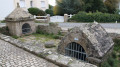
(S/E) Go down the street that runs along the south side of the chapel and when you reach the bottom of the slope (fountain on the right), turn left. Follow this small street to the sea.
When you reach the coast, turn right, pass the houses, and take the coastal path that climbs up the small cliff.
(1) This path follows the coastline, a few metres above the sea, while skirting around Pointe de Saint-Nicolas. On the other side of the channel, Pointe de Nioul, on Île aux Moines, appears very close. Continue towards Pen Castel by following the other side of the point.
(2) When you reach the road leading to the Pen Castel tide mill, turn left to cross the dyke and pass the mill. When the road begins to climb towards the other bank, leave it to reach the beach. Walk a few dozen metres to find the entrance to the path on the right, as soon as the cliff rises a little.
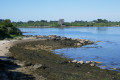
The coastal path follows the seafront to Pointe du Béché, where it veers away to skirt around a few houses. You will reach the water again after passing the last house, and continue along the shore until you reach a sand spit jutting out into the sea, which marks the entrance to Anse du Poul.
(3) You can turn right as you approach it, or you can walk towards the point and follow its outline to return to the coastal path. It is also a beautiful spot for a swim.
The cove is empty at low tide and the path then follows a landscape that is half marsh, half forest until it reaches and passes the hamlet of Porh Nèze and its beautiful waterfront houses.
(4) Three hundred metres after the hamlet and just before reaching the cycle path, turn left to continue along the coastal path, which you follow for another kilometre.
On the outskirts of the village of Le Net, nestled at the end of Anse du Poul, you will come to the cycle path. Turn left to enter the village.
(5) Before you even see the first houses, follow the cycle path signs on the right. You enter the village via a pretty, shaded path that winds between the stone walls of the riverside properties. At the first crossroads, turn right and then left 50 metres further on, towards the craft industry zone. Turn left again and follow the road that runs alongside the workshops. A little further on, as it approaches a small slope, it comes close to the district road, under which you pass to cross it.
(6) When you come out of the underpass, turn left and follow the cycle path that runs between the embankment of the main road and another small road. Join, cross and leave the roundabout via the sandy cycle path that branches off to the left onto the road to Saint-Gildas-de-Rhuys. After about 500 metres, it joins the right-of-way of the old Rhuys railway line, on which most of the cycle path has been built. At Arzon and Saint-Gildas, its route is clearly visible on the map, alternating between long curves and a few straight sections, such as those used to bypass the Étang de Kerpont.
(7) You follow this lake, sensing its presence below the path but never seeing it. The dyke of the upper lake marks the upper limit of this body of water, which stretches for nearly a kilometre but remains very discreet at the bottom of its wooded valley.
When the long curves of the old railway line give way to a fairly tight chicane, turn right onto the path that winds down towards Kerpont.
When you reach the D198, cross over and continue straight ahead on the path that joins the Hent Bihan path.
(8) Turn right and go up this path, known as the Petit Chemin (Hent Bihan in Breton), pass a dead end on the left and turn left at the next crossroads. Join the Route du Pont, turn left, then right 50 metres further on, to go down a small path that leads to the Kerpont lagoon. At the bottom of the slope, continue to the right, and when you reach the property entrances, take a small path on the left that leads under the willow trees. The area is probably very wet in winter or during high tide, as it resembles a mangrove swamp. Further on, the path reaches the bottom of the dune, and between two rows of wooden posts, you climb between the lagoon and the dune to reach the footbridge that crosses the stream blocking the path.
(9) Cross the footbridge and go up the road on the left that leads to the Govelins Beach car park. It's a lovely spot for a dip, unless you'd prefer to do so at Kervert Beach, which is coming up soon.
After passing the car park and the beach huts, leave the road when it turns right and rejoin the coastal path that follows the coastline. The view opens up onto the Mor Braz (the Great Sea, as opposed to the Gulf, the Little Sea - Mor Bihan, in Breton) and the islands that line the horizon: Hoëdic, Houat, and Belle-Ile, in the distance. Further west and to the left as you continue walking, the Quiberon peninsula, the islet of Méaban and the Pointe du Petit Mont close off the bay.
When the rocky coast gives way to the immense Kervert Beach, which stretches to the Rocher de Kerjouanno, the path veers to the right to reach the car park and the main access to the beach. Turn left to go down to the sand.
(10) When you reach the beach, there are two options depending on the season and the tide.
You can either continue along the beach, walking on the wet sand, or take the coastal path that runs slightly behind the top of the dune. This option is reserved for those who enjoy soft sand and those who might be uncomfortable with the presence of naturists on part of the beach.
Follow the beach until it forms a sort of point opposite the Rochers du Petit Rohu.
(11) After passing this single protrusion in the immensity of the beach, take the first passage that allows you to leave it. It climbs back up the dune to rejoin the coastal path further on. Turn left, then right at the three-way junction a little further on. Below the path lie the Kervert golf course and the ponds that border it.
When you reach the edge of the first one, turn right and cross the wetland, then head back up towards Tumiac. When the path becomes a road and starts to climb, it seems as if the fountains have gathered here, as there are at least four of them within a few dozen metres.
(12) Cross the village and turn left when you reach the main street. Follow it to leave Tumiac until you reach the D780. Cross the ditch and the departmental road with the utmost caution, as this road can be very busy.
Opposite, you will see the path leading to César's Mound.
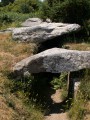
(13) This bush-covered hill rises about fifteen metres above the surrounding meadows. It is said that this tumulus served as Caesar's observation point during his battle against the Veneti. It is true that the view from the top is quite breathtaking, both of the ocean and the Gulf. It also allows you to see much of the territory you have covered so far. (According to a recent user of this route, it seems that it is no longer possible to climb the mound, but you can still walk around it.)
Descend from César's Hill via the north side and turn right to rejoin the path at the foot of the hill.
Before returning to the cycle path, turn left and cross it to continue along a beautiful tree-lined path. As you approach the Étang de Pen Castel, you will come across a cross path. Turn left for a few metres, then leave it on the right. The area is green and the path is little used. A trail was visible when we passed through, but we had to use our walking sticks in a few places to make walking easier. After a few hundred metres, which are a little prickly for bare calves, the path branches off to the left, before leading to the road that goes to Kerners.
(If the last path is impassable, return to the last crossroads, turn right to join the cycle path, then right when you reach it, and finally right when it crosses the Kerners road).
(14) When you reach the road, turn right and follow it until you return to the village and its chapel (S/E).

 ))
)) Visorando Member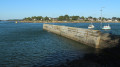

 Easy
Easy