In the Laval and Western Ourthe valleys

A few sculptures, a bit of a nature reserve with the occasional sign of beavers here and there, and a bit of countryside: that’s what this walk has to offer.

Details

4865711
Creation:
Last update:
Last review:
  • Walking
    Activity: Walking
  • ↔
    Distance: 9.90 km
  • ◔
    Average duration: 3h 15 
  • ▲
    Difficulty: Moderate

  • ⚐
    Back to start: Yes
  • ↗
    Ascent: + 138 m
  • ↘
    Descent: - 131 m

  • ▲
    Highest point: 468 m
  • ▼
    Lowest point: 363 m

Photos

Description of the walk

Car park near Sprimont school.

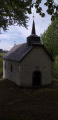
(S/E) Head towards the school and continue towards Bastogne. Pass a small chapel and continue to the junction with Rue des Aigrettes.

(1) Turn left towards Aviscourt. Cross over the Grand Ri, a stream in Sprimont. Ignore the road on the left and, at the junction, carry on straight ahead until the next crossroads, where you’ll see a white barrier.

(2) Turn left onto Chemin de l'Étang. Follow the path for just under 1 km, with a view of the Laval on your left, until you reach the Étang d'Orti and its nature reserve.

(3) Turn left onto the wooden walkway. Cross the footbridge and, halfway across, turn round to admire the artwork Maiandros suspended between two trees. At the end of the footbridge, continue along the sunken path and head uphill: you’ll see the village of Lavacherie on your right. Walk past the sculpture ‘Ceci est un arbre’. Walk to the steps on your right, after the picnic area.

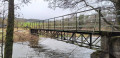
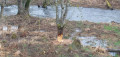
(4) Go down the stairs and turn right. Follow the old Marche-Amberloup-Martelange railway line. Walk past the artworks Nature Jura Sua Semper Resumit and then 'L'eau, source de vie'. Continue by crossing the Ourthe via the old metal bridge. Just after that, on the right below, look for signs of beavers on a tree trunk. Carry on to the crossroads.

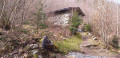
(5) Take a sharp right-hand bend and walk towards the house. Look out for signs of beavers on your left. Walk past the house to see the next artwork, Domino d’Orti. Return to the level of the house’s terrace and turn right towards the footbridge. Look under the bridge and discover the artwork Le Nageur. Cross over, head right, then take thefirst path on your left (GR® cross). Climb up and follow a path running alongside a meadow. Continue until you reach a fork.

(6) Turn left and walk in the open. Take another path on your left and continue straight on until you reach the road. Turn right, passing the War Graves Cemetery. Ignore thefirstforestpathon the left and continue to the next path on your left.

(7) Take this farm track between fields and a pine forest. At the end, turn right. At the road, turn left, head uphill and turn right into Rue des Longs Prés. Walk to the sign for the Herbaimont built-up area.

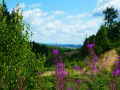
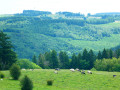
(8) Take the dirt track on the right just before the sign. The dirt track becomes a road. View of the valley on your right. Continue to the crossroads.

(9) Carry on straight along the dirt track, then head downhill. The track turns sharply right then left. Carry on to a junction.

(10) Keep to your left and return to the Étang d'Orti.

(3) Take the path on the left and follow the Laval until you reach the road.

(2) Turn right, continue straight on, returning to the other road. Cross the Grand Ri again and walk to the N826.

(1) Turn right and return to the car park (S/E).

Waypoints

  1. S/E : km 0 - alt. 377 m - Car park near the school
  2. 1 : km 0.27 - alt. 385 m - Towards Aviscourt
  3. 2 : km 0.56 - alt. 393 m - Path to the pond
  4. 3 : km 1.43 - alt. 372 m - Étang d'Orti
  5. 4 : km 2.16 - alt. 382 m - Stairs after the orchard. Head towards the - Ourthe (rivière) - Belgique
  6. 5 : km 3.43 - alt. 365 m - Crossroads
  7. 6 : km 4.24 - alt. 396 m - Exposed farm track
  8. 7 : km 5.25 - alt. 435 m - 2nd path
  9. 8 : km 6.54 - alt. 468 m - Herbaimont town sign
  10. 9 : km 7.29 - alt. 440 m - Crossroads
  11. 10 : km 8.36 - alt. 380 m - Junction
  12. S/E : km 9.9 - alt. 377 m - Car park near the school

Notes

Avoid this route during high water. It is impossible to cross to reach the footbridge after (5) as the path is under water.
Good waterproof footwear is recommended after heavy snow or rain.
From October to December, please be aware of hunting dates; we use a large section of the Promenade d’Orti.
No drinking water available along the route.
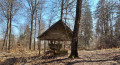
Picnic table: car park at the start, Étang d'Orti at (3), before (4).
Bench at (7) and after (7).
The circular route is often exposed, so remember to protect yourself from the sun.

Worth a visit

During

The pond at the Orti Nature Reserve.

Traces of beavers after the bridge over the Ourthe after (4) and before the house after (5).

The War Graves Cemetery: 150 former prisoners of war and political prisoners are buried here.

Six of the nine works on the Orti Art Trail:

1/ Maiandros by Alexandre Rossignon ‘Norska’ (Coutisse). Maiandros, or meanders, to evoke the confluence of the Laval with the Ourthe. A work that welcomes visitors and sets the tone through the symbolism of arms, the meanders formed by a river as it winds through a wetland. The meander of life, the passage from one bank to the other. A riverbed that shifts with the seasons, water levels and rainfall; one could almost describe it as a braided bed…
A mural made of steel blades that vibrate in the wind, undulate, not to say flow… A current, a stream, a movement in the plane, that of arms and meanders.
Materials: twisted steel, cables – 2019

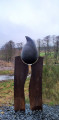
2/ This is a tree by Koen Van Elsen (Warempage). A dead tree that ‘comes’ to life, a metaphor. A tree connects the sky to the earth, like the tentacles of an octopus. The vertical glass veins symbolise water and minerals drawn from the earth and rising upwards. Combined with solar energy, new cells develop.
The glass at the tips of the truncated branches reflects the meadows, the clouds, the sky... They draw our attention to the environment.
Materials: oak, glass – 2019

3/ Natura Jura Sua Semper Resumit or "Nature always reclaims its rights" by Guy Fagny (Vance). “Like a wide-eyed child who carefully picks up what they have found on the ground and protects it in a makeshift container, the cylinder simply encircles the chosen trunk and whispers a message of caution and preservation to passers-by.
The tree will continue to produce its branches. It will grow within a setting that jealously reveals its richness. From time to time, as the seasons pass, depending on its vigour, if necessary, it will be tended… If, unfortunately, the plant falls ill, or worse still, dies, the setting will be moved and serve as a casing for another tree…
Nature will reclaim its rights, but man will once again be able to harmoniously control the excesses of new branches or encourage them by balancing, as he sees fit, the steel placed there and the vegetation’s growth.”
A small insect hotel is concealed behind the perforations in the steel.
Materials: 5 mm Corten steel – 2019

4/ Water, the source of life by Georges Blaise (Grune). “Drop by drop, it drips, becoming a puddle, a pool, a pond, or trickling towards the river. It feeds the water table and creates the wetlands essential for combating flooding and soil erosion during storms and thunderstorms. Woman and man unite and give life. By holding the drop of water at arm’s length, woman and man are the guardians of the preservation and restoration of wetlands, on which countless species of aquatic plants and animals depend.”
Materials: Belgian blue stone, 10 mm steel – 2019

5/ Domino d’Orti by Kris Rabaut (Erneuville). A work that expresses the complex, fragile and sometimes paradoxical balance found in wetlands and nature in general. “During my visits to the Orti site, I was struck by the constant changes: the water level rising or falling, the current growing stronger or calming down, trees falling,… a dam forming,… a complex interplay of forces and actors at work… arising from nothing; forces that one day work together and the next day fight each other.” Domino d’Orti expresses this interplay of tension between these forces, sometimes in collaboration, sometimes in discord, whether apparent or invisible. Like a spiral of dominoes, when one element is removed, the balance is broken and the whole collapses.
Some may also interpret this as the work of the beaver, which is very much present on the site.
Small holes drilled into the wood provide a home for our pollinators.
Materials: Douglas fir, black locust pegs, Paalupiste galvanised steel piles – 2019

6/ The Swimmer by Alexandre Rossignon ‘Norska’ (Coutisse). The playfulness, the magic of swimming, diving, movement, the wave. A figure that is half-fish, half-human swimmer. A light silhouette made of golden metal filaments. A silhouette gliding through the current.
Materials: steel, gold paint – 2019
A work that is both substantial and discreet, yet unexpected.

Always be cautious and plan ahead when you're outdoors. Visorando and the author of this route cannot be held responsible for any accidents occurring on this route.

The GR® and PR® markings are the intellectual property of the Fédération Française de Randonnée Pédestre.

Reviews and comments

4.6 / 5
Based on 4 reviews

Reliability of the description
4.7 / 5
Ease of following the route
4.3 / 5
Route interest
4.8 / 5
CELADRI
CELADRI

Overall rating : 4.7 / 5

Date of your route : Feb 12, 2023
Reliability of the description : ★★★★★ Very good
Ease of following the route : ★★★★☆ Good
Route interest : ★★★★★ Very good
Very busy route : No

A walk in the woods, surrounded by silence with only nature to keep us company.
A lovely moment

Machine-translated

Denis  Jusseret
Denis Jusseret

Overall rating : 3.7 / 5

Date of your route : Apr 05, 2021
Reliability of the description : ★★★★☆ Good
Ease of following the route : ★★★☆☆ Average
Route interest : ★★★★☆ Good
Very busy route : Yes

This route is signposted in the opposite direction to that described for route A3 – this description combines several sections of routes from the Sainte-Ode Tourist Office. The map allows you to follow different routes without getting lost by following the signposting; we avoid crossing the meadow in the event of heavy rain. The most beautiful view of the Ourthe Valley is in the opposite direction. – A great idea for those who have already followed the signposted routes. Map available from the Sainte-Ode Tourist Office on 061 32 88 01

Machine-translated

SERVAIS Michel
SERVAIS Michel

Overall rating : 5 / 5

Date of your route : Mar 28, 2021
Reliability of the description : ★★★★★ Very good
Ease of following the route : ★★★★★ Very good
Route interest : ★★★★★ Very good
Very busy route : Yes

The route was explained in great detail.
We didn’t go a single metre out of our way.
Thanks for the route. The lovely views and the information about the picnic benches helped us plan our lunch.

Machine-translated

elise_be
elise_be

Overall rating : 5 / 5

Date of your route : Feb 28, 2021
Reliability of the description : Not used / Not applicable
Ease of following the route : ★★★★★ Very good
Route interest : ★★★★★ Very good
Very busy route : No

A really lovely route, with beautiful scenery... the Orti Nature Reserve is absolutely lovely.
It wasn’t warm enough to stop there, but the few picnic benches along the way must be lovely in summer!

Machine-translated

Other walks in the area

For more walks, use our search engine .

The GPS track and description are the property of this route's author. Please do not copy them without permission.