From one castle to another from La Bussière-Sur-Ouche

A circular route starting from the village of La Bussière-sur-Ouche, linking the châteaux of Châteauneuf-en-Auxois, Commarin and L'Oizerolle, running briefly alongside the Panthier reservoir and then, on the return leg, skirting the hamlet of "La Pourrie", a private estate still owned by the family of the Burgundian writer Henri Vincenot. A long but easy route, taking around 8 hours at a normal pace (9 hours if visiting the villages).

Details

3453099
Creation:
Last update:
Last review:
  • Walking
    Activity: Walking
  • ↔
    Distance: 29.16 km
  • ◔
    Duration according to the author: 8 hrs 
  • ▲
    Difficulty: Very difficult

  • ⚐
    Back to start: Yes
  • ↗
    Ascent: + 547 m
  • ↘
    Descent: - 548 m

  • ▲
    Highest point: 555 m
  • ▼
    Lowest point: 315 m

Description of the walk

Head to La Bussière-sur-Ouche via the D33. Park in the town centre after the church, in a large green square where there are plenty of marked parking spaces.

(S/E) Start from the large square in the town centre. Head up to the left along the Grande Rue, passing under the western gate of the ancient Cistercian abbey’s enclosure. Turn left at the next junction, following signs for Les Mélèzes. At the following junction, turn right.

(1) Follow the Chemin du Point du Jour uphill. At the last house, the tarmac road turns into a track suitable for vehicles, leading into the woodland. Shortly after passing a meadow, keep to the right (Compostela Way signposting). At the next fork, continue along the right-hand path uphill. Continue along the path, which has turned white. At the end, go through a gate and you’ll come out onto the VC3.

(2) Set off along the road to the left. Walk for about 180 m before turning right at the top of the hump onto a well-maintained woodland path.
Option: Return trip to the Croix Gauveney, via the first white path on the left.
Follow it for a long way until you cross a distinct hollow (a crossing ditch) and then, immediately afterwards, turn left onto a path that forms a semicircle at the start.

(3) Just before reaching the edge of the woods with a field in the distance, turn right at the first crossroads of tracks. Pass under a high-voltage power line. When you reach a white track, keep to the left. Pass under a second high-voltage power line. Follow this power line to the right before veering off to the left. At the end of the white track, you’ll reach a meadow at the far end. Follow it along a path on the left through the undergrowth. It forms a bend, veering left and then back to the right, passing along the edge of the woodland before opening out onto a field. Follow this field to the left. At a place called La Chaux, there is a sign pointing towards Châteauneuf.

(4) Leave the edge of the field on the right just after passing La Chaux farm to join a tarmac road. Turn left. At the next crossroads, keep left to go up Route de La Bussière, then, immediately afterwards, turn left.

(5) Follow the wide, unpaved track for a long way until you reach a T-junction with a passage blocked by a metal barrier opposite.

(6) Turn right onto the signposted path which leads into the woods and goes straight to Châteauneuf. It descends into a valley before climbing steeply up to the village. It comes out onto Route de la Tannerie.

(7) Turn left and enter the village via Rue du Faubourg. At the fork, keep right then stay left on Rue de la Porte Huilier until you reach the junction with Rue de l'Église. Follow this street to the building on Place du Général Blondeau. Rear and side view of the castle with the remains of an old access bridge. Retrace your steps back to the start of Rue de l’Église, turn left onto Place aux Porcs, then turn left again to reach the castle gates.

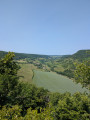
(8) Walk away from the castle to reach the war memorial on Place du Marché straight ahead, via Grande Rue and then Place aux Bœufs. Pass under the old gate of the village’s eastern wall. Immediately afterwards, turn left to reach, 50 metres further on, a cross and a viewpoint offering a superb 180° view of the Auxois region.

(9) Retrace your steps to return to the previous crossroads. Turn left, following the signs for the Notre-Dame du Chêne Chapel. Keep right at the crossroads of tracks located immediately after the car park. Further on, Caution! Bear crossing... (a female bear and her three cubs carved from tree trunks). Continue to the chapel.

(10) In front of the chapel, head right then immediately veer left to walk alongside a high stone wall, keeping to the left. At the next fork, turn left, then left again at the following junction. When you reach a wide cross-path, turn right until you come to a fork (yellow markings).

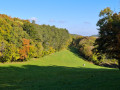
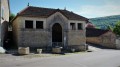
(11) Keep left onto a narrow track, leaving the yellow markings behind. It descends and stays away from the edge of the woodland, which is nevertheless visible on the left, as are the first signs of the Panthier reservoir. It emerges from the woodland at La Crochère. Beautiful view opposite and to the left. Follow the path (gravel then tarmac) down through the fields towards the hamlet of Solle. Join the D977 bis, turn right until you reach the next crossroads. To the left of the road, there is a wash house/watering trough and a wayside cross.

(12) Turn left towards Créancey via the D114d. Cross the Ruisseau de Commarin. Turn left at the next crossroads. After the last houses, take the first tarmac track on the left, “Epie des Chiens”, which leads to the banks of the Panthier reservoir. Turn right to follow the water’s edge, then keep left. Join the D114d and follow it for about 150 m before turning right after crossing an irrigation canal.

(13) Follow a grassy path to the right of this canal until you reach the hamlet of La Magnanerie, heading towards Commarin Castle. It leads onto Rue du Parc. Turn left to cross the hamlet. At the end of the hamlet, near the agricultural sheds on the right-hand side of the road, turn right to follow the irrigation canal again, but this time keep left. Turn right at the junction with the D114e, then right again at the crossroads with the Route de Dijon. Follow this road through Commarin to the castle gates.

(14) Start with your back to the castle entrance gate. Cross the road and the car park to head straight up the main avenue. Pass under a medium-voltage power line. Just before the end of the avenue, the path branches off to the right into the woodland. It climbs steadily in a series of S-bends. Once on the plateau, keep left at the fork, just after passing two large trees (to the right of the path).

(15) Follow the path to a large crossroads of tracks and turn right. Join the tarmac road which, on the left, leads to L'Oiserolle Castle.

(16) Continue carefully along this road, passing under high-voltage power lines before turning onto the first unpaved track on the right at a farm shed. It turns into a field track and descends slightly to the hamlet of Saunière. Cross it from north to south, keeping to the right to join the tarmac road, then turning left at the next junction. At the southern end of the hamlet, turn left at the junction.

(17) Follow signs for “Puits Roland”. Head up towards the woods along the gravel track. When you reach the hunting lodge (on the left), continue straight ahead along a very wide stony track. Ignore the side paths. At a fork, a large clear-cut area comes into view. Keep left to skirt this area, which is surrounded by a wire fence, and head right. The path enters the undergrowth again and crosses a dirt track further on. Continue straight ahead and descend slightly to the right. At the next crossroads, turn left.

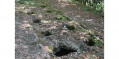
(18) The path descends, curves to the left at the edge of a meadow and continues along a meadow; keep to the right. Follow this route consistently, ignoring any side paths. Green paint on trees serves as waymarking. Rear view of the private property and the Vincenot family graves. At the next crossroads, turn sharp right.

(19) Green arrows are painted on the trees. Go round the property, keeping to the right. At the bottom of the descent, you’ll reach a T-junction (near the main entrance to the property); turn left to reach the Comberainbeuf-le-Bas farm. Continue along the tarmac road until you reach a crossroads with a wooden cross in the middle.

(20) Go straight ahead along the Chemin des Chagnons, which goes round a house on the right. Partial view to the right of the grounds of La Bussière Abbey. Join the Grande Rue whilst turning right to reach the car park, the starting point (S/E).

Waypoints

  1. S/E : km 0 - alt. 316 m - The square in the centre of La Bussière
  2. 1 : km 0.3 - alt. 330 m - On the right, the Point du Jour path
  3. 2 : km 3.58 - alt. 487 m - VC3 junction
  4. 3 : km 4.46 - alt. 480 m - Turn left after crossing the ditch
  5. 4 : km 6.57 - alt. 530 m - La Chaux farmstead
  6. 5 : km 6.98 - alt. 509 m - To the left from the road, onto a white track
  7. 6 : km 8.29 - alt. 475 m - Turn right at the crossroads
  8. 7 : km 9.32 - alt. 454 m - Turn left towards the centre of Châteauneuf
  9. 8 : km 10.1 - alt. 471 m - Entrance to the castle tours
  10. 9 : km 10.36 - alt. 475 m - View from the Châteauneuf viewpoint
  11. 10 : km 11.06 - alt. 494 m - Former Notre-Dame du Chêne Chapel
  12. 11 : km 11.68 - alt. 508 m - Turn left at the fork
  13. 12 : km 13.74 - alt. 367 m - Turn left onto the D114d towards the hamlet of Solle
  14. 13 : km 15.02 - alt. 375 m - Turn right after crossing the irrigation canal
  15. 14 : km 17.69 - alt. 372 m - Main entrance to Commarin Castle
  16. 15 : km 20.45 - alt. 535 m - Turn left at the fork
  17. 16 : km 21.62 - alt. 536 m - Main entrance to L'Oiserolle Castle
  18. 17 : km 23.64 - alt. 498 m - Crossroads south of the hamlet of Saunière
  19. 18 : km 25.55 - alt. 497 m - Turn left at the crossroads
  20. 19 : km 26.73 - alt. 455 m - Turn right at the crossroads
  21. 20 : km 28.72 - alt. 337 m - Go straight ahead at the crossroads
  22. S/E : km 29.16 - alt. 316 m - The square in the centre of La Bussière

Notes

- Picnic area near a well, in the hamlet of Solle, on the D114d.
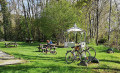
- Picnics can be enjoyed on the grassy banks of the Panthier reservoir (shaded area).
- Picnic area at the entrance to Commarin, just after the cemetery.
- Walking sticks recommended for forest crossings (uphill and downhill sections).
- A pair of binoculars is useful for viewing the successive panoramic views along the route.

Worth a visit

- The Cistercian Abbey of La Bussière-sur-Ouche or Notre-Dame des 3 Vallées. Founded in the 12th century, it began to decline from the 16th century onwards. The abbey church was built in 1140 before becoming a parish church. The monks were expelled in 1791 during the Revolution, before it was sold at auction. The abbey was donated to the Bishopric of Dijon for spiritual retreats. 2005 marked its purchase and restoration by the “Relais et Châteaux” group. The grounds cover 7 hectares. The church and the 13th-century walkways, the chapel, the refectory, the dovecote and the remains of the cloister still stand.

- The western gate of the enclosure of the former Cistercian abbey. The statues adorning it date from the 15th century. They were deliberately damaged during the Revolution of 1789.

- The church of Châteauneuf-en-Auxois dates from the late 15th and early 16th centuries. Dedicated to Saint Philip the Galilean and Saint James the Greater. A curial parish from 1572 onwards. Three bells dating from 1526 (the medium-sized one), 1583 (the small one) and 1896 (the largest).

- Place Général Jacques Blondeau honours a general of the Revolution and the Empire, born in 1766 and died in 1841. He was made a Baron of the Empire in 1813, a Commander of the Legion of Honour in April 1814 and a Knight of the Order of Saint Louis under Louis XVIII in September 1814. The general’s grave is located to the left of the church.

- Châteauneuf-en-Auxois is one of the most beautiful villages in France, with its medieval town centre and listed limestone houses typical of the 14th to 17th centuries. It boasts an exceptional wealth of history and heritage. The new market halls date from 1840, built on the site of the former 15th-century medieval market halls.

- In the 12th century (1150–1175), a fortified settlement known as Châteauneuf was built on a rocky outcrop. The Lordship of Châteauneuf endured from 1181 to 1457. Jean de CHAUDENAY had a square keep built and dry moats dug. In 1457, the estate passed to Philippe POT, at the behest of the Duke of Burgundy, Philip the Good. POT subsequently transformed the site, carrying out extensive improvements. He became governor of Burgundy in 1475, under Louis XI. His family owned it until 1533, before it became part of the MONTMORENCY estate. In 1627, it belonged to the estate of VIENNE and then, in 1766, to Parisian bankers, the PARIS de MONTMARTEL family, who, having fallen into ruin, sold it to the Marquis d’ANTIGNY. Between 1811 and 1936, it was owned by a branch of the Vogüé family (just like the châteaux of Vaux-le-Vicomte and Commarin). Converted into a public building in 1936, it was acquired by the Bourgogne-Franche-Comté region in 2008.

- Superb view over part of the Morvan, the Auxois plain and, in particular, the Burgundy Canal valley from a wayside shrine situated at the north-western exit of Châteauneuf (point 9).

- Beautiful panorama at the mouth of La Crochère (woods/fields) with the hamlet of Solle directly ahead and the Panthier reservoir to the left.

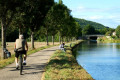
- The 130-hectare Panthier reservoir feeds the Burgundy Canal. Dating from 1830, it is a bird sanctuary. Its earthen embankment is 1.1 km long. It has a capacity of 8,050,000 m³ with a head of 14 m. The walk around it is 4.6 km.

- Commarin Castle was built in the 17th and 18th centuries, retaining the moat and two round towers from an earlier fortified house and then a 14th-century fortified castle. It features an east wing dating from the reign of Louis XIII and a west wing from the reign of Louis XIV, with the two large original round towers at either end. The English-style park covers 5 hectares. The furnishings and interior decorations date from the 17th and 18th centuries. It has been in the same family for 900 years (through marriage to the Vogué family since 1802). It has never been sold or looted.

- The Château de L'Oiserolle or Loiserolle is situated in the commune of La Bussière-sur-Ouche. It dates from the mid-19th century. Its walls are made of pink brick. It houses a listed barn and calvaries, the Saint-Sylvestre chapel and the dwellings of former farmers. The private estate, owned by British nationals, covers 26 hectares. The site is thought to have been the site of an abbey prior to 1130 (?).

- The hamlet known as "La Pourrie", a private property, belongs to the family of Henri Vincenot. Born in 1912, died in 1985. He was a writer, painter and sculptor. He graduated from ESC Dijon and HEC Paris before working as an engineer for the SNCF (PLM). He retired to Commarin, before buying and restoring the hamlet of "La Pourrie". He made his name as a writer in 1976. He was made a Commander of the Order of Arts and Letters in 1978. He is buried with his wife and one of his sons behind his house, where a row of Celtic crosses can be seen.

Reviews and comments

4.7 / 5
Based on 6 reviews

Reliability of the description
4.7 / 5
Ease of following the route
4.8 / 5
Route interest
4.7 / 5
User 778372

Overall rating : 4.7 / 5

Date of your route : Apr 19, 2026
Reliability of the description : ★★★★☆ Good
Ease of following the route : ★★★★★ Very good
Route interest : ★★★★★ Very good
Very busy route : No

Completed in 6 hours without going to Commarin – around 21 km, so less elevation gain and physically more manageable (at point 11, go straight on following the yellow markings and rejoin the route at point 16 in front of Loizerole). A very pleasant route, with plenty of sections through woodland, making it ideal in hot weather. The paths are good and pass through some beautiful beech forests. Châteauneuf is the reward, with the chance to cool off at the Auberge du Marronnier (it’s become so rare to find a café in the countryside). Before point 2, when you reach the white path, it is blocked by a chain bearing the sign ‘private property – no entry’; however, the Way of St James markings do indeed follow this path right up to the road. This sign might lead one to think that you shouldn’t continue the walk… Personally, I ignored it. One of the most beautiful walks of my early season.

Machine-translated

JYPX
JYPX

Overall rating : 5 / 5

Date of your route : May 01, 2025
Reliability of the description : ★★★★★ Very good
Ease of following the route : ★★★★★ Very good
Route interest : ★★★★★ Very good
Very busy route : No

A very interesting route with a succession of castles to admire (the length of the walk means there isn’t time to visit them), plus the Panthier Dam (a masterpiece of 19th-century engineering). Very pleasant paths with no difficulty at all. There are indeed some private sections, but the gates do not stop walkers. However, this route must be avoided at all costs during the hunting season.

Machine-translated

Vivoactimo
Vivoactimo

Overall rating : 4.7 / 5

Date of your route : Sep 04, 2021
Reliability of the description : ★★★★★ Very good
Ease of following the route : ★★★★★ Very good
Route interest : ★★★★☆ Good
Very busy route : No

We completed this hike in 6 hours and 40 minutes, having to hurry due to a storm during the final few kilometres, including a 30-minute lunch break (at point 10, at the 10km mark, just outside Châteauneuf by the chapel).
This walk offers very varied and pleasant scenery; the forest paths are wide, which is great for groups.
Between points 11 and 12, we chose to turn left, following the ‘3 Castles’ route to walk alongside the lake; this section was lovely and we recommend this option. However, this stretch is in full sun.

The only downside to this route is that it passes through private land, which may be closed off for the upcoming hunting season. We had to cross two gates explicitly closed to the public between points 16 and 17. These paths do, however, lead onto public paths and roads.

Despite this uncertainty regarding whether hikers are permitted to pass through, this walk was very interesting and allows you to discover beautiful villages and castles, which make you forget the length of the journey.
Thanks to the author.

Machine-translated

Bofed
Bofed

Overall rating : 4 / 5

Date of your route : Feb 28, 2021
Reliability of the description : ★★★★☆ Good
Ease of following the route : ★★★★☆ Good
Route interest : ★★★★☆ Good
Very busy route : No

A varied route, taking in both woodland and plateau sections. It’s a shame the pubs in Châteauneuf are closed (due to Covid).

Machine-translated

Manishane
Manishane

Overall rating : 5 / 5

Date of your route : Oct 10, 2020
Reliability of the description : ★★★★★ Very good
Ease of following the route : ★★★★★ Very good
Route interest : ★★★★★ Very good
Very busy route : No

Unfortunately, we only managed to do part of this magnificent hike: a circular route starting from Châteauneuf, where we were staying. It was a very pleasant walk through the woods and a lovely stroll along Lake Panthier, with a visit to Commarin Castle as an added bonus.

Machine-translated

Chabanis
Chabanis

Overall rating : 5 / 5

Date of your route : Sep 04, 2020
Reliability of the description : ★★★★★ Very good
Ease of following the route : ★★★★★ Very good
Route interest : ★★★★★ Very good
Very busy route : No

A lovely walk, mostly through the woods; long but not difficult (two long but gentle climbs) along very pleasant paths. Brilliant! Thanks

Machine-translated

Other walks in the area

For more walks, use our search engine .

The GPS track and description are the property of this route's author. Please do not copy them without permission.