Country:
 City:
City:


Depart from the Pors Carn car park, near the Prehistoric Museum to the north-east of the village of Saint-Guénolé.
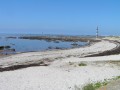
(S/E) Head east: depending on the tide, walk down to the beach or follow the path along the top of the dunes. At the end of the beach lies Pointe de la Torche, a surfing hotspot that is best explored when the sea is rough. This beautiful, immense curved beach is a paradise for wave lovers and is also very pleasant to walk along.
(1) Climb back up the dune to the first cypress grove, which marks the Toul Gwin car park. Cross it and join the access road. Continue along the dirt track opposite and you will reach the Marais de Lescors.
(2) Turn right, then left. The path follows the edge of the marsh where peaceful cows graze. Beyond the marshy expanse, the church of Penmarc'h barely raises its squat bell tower above the other buildings. Outside the marsh, the absence of tree vegetation makes the density of the habitat visible.
Join the D53 road that connects the village of Penmarc'h to Saint-Guénolé, at the bridge that crosses the marsh drainage canal.
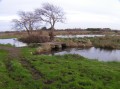
(3) Cross the road and follow it to the left until you reach the Keréon cul-de-sac. Turn right, pass between the houses and turn right again. The route follows a gravel path that leads to the Marais de la Joie (Loc'h ar Joa). Turn left at the crossroads, then take the first path on the right. Continue along the marshland until you reach the cycle path.
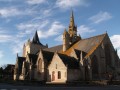
(4) Take the path opposite, which continues along the edge of the marsh. It leads to a small road that serves a few houses before joining the coastal road at the Notre-Dame de la Joie chapel. This beautiful Breton Gothic building has faced the waves since the 16th century.
(5) Walk north along the dyke to the port of Saint-Guénolé. The view of the outer harbour gives an idea of the skill required by captains as they weave between rocks and buoys to bring their boats safely into port.
(6) Once past the first dry dock, follow the embankment that leads to the deeper part where the fishing boats are moored. Go around the basin to reach the opposite quay and pass to the right of the fish market. Turn left and join the coastal path that heads off to the right, towards the rocks of Saint-Guénolé. Avoid this section if the sea is rough. This is where the "Rochers des victimes ou du préfet" (Rocks of the Victims or the Prefect) are located, whose name commemorates a tragic walk during which the family of the Prefect of Finistère was swept away. There is a viewpoint at this point, which is the highest point of the route (8m!).
(7) Go around the property enclosed by a large stone wall to reach the cove of Poul Briel. This section of the coastline is undoubtedly the most spectacular, and the rocks that line it are each more remarkable than the last. Be careful of the dangerous nature of the area and do not get too close to the shore.
Continue along the coast, first along Rue de Menez Kerouil, then along the path that passes in front of the houses. These houses seem to be planted on the moorland, with no fences to mark the boundaries of the properties. Sometimes, only a small row of stones marks the boundary. Nothing obstructs the view of the long strip of land that borders Audierne Bay.
(8) At Le Viben, the path joins the coastal road. Follow it along the bottom of the cove and turn left onto Rue Scrafic, then take the coastal path to Pointe de Pors Carn. A few boats are moored behind the shelter of the point, while the waves break in the bay to the delight of surfers.
Cross the foreshore or follow Rue des Flots and the coastal path to reach the car park (S/E).



 Visorando Member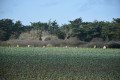
 Difficult
 Moderate