Extreme route of the Cirque de Mourèze – caves – monuments – Lake Salagou

An extreme challenge: this route takes you from the Cirque de Mourèze to the shores of Lake Salagou, followed by a climb up some of the most beautiful peaks and past several landmarks along the way. As many kilometres as there are places to visit!

Prehistoric site and UNESCO Global Geopark, Natura 2000

Details

85641663
Creation:
Last update:
Last review:
  • Walking
    Activity: Walking
  • ↔
    Distance: 13.04 mi
  • ◔
    Duration according to the author: 10 hrs 
  • ▲
    Difficulty: Very difficult

  • ⚐
    Back to start: Yes
  • ↗
    Ascent: + 3,825 ft
  • ↘
    Descent: - 3,802 ft

  • ▲
    Highest point: 1,752 ft
  • ▼
    Lowest point: 453 ft

Description of the walk

Start from the car park at the Clermontais Tourist Office, on the edge of the D8.

(S/E) Join the main Cirque de Mourèze trail by taking the steps at the corner of the Tourist Office, then follow the path to the right. Walk to the Belvédère des Dolomies viewpoint and enjoy your first view of the cirque’s impressive rock formations.

(1) Continue along the path, pass a small gully and arrive at a fork.

(2) Follow the Cirque de Mourèze circular route to the left, staying on the signposted path. The path then curves to the right and heads north.

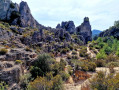
(3) Cross the heart of the Cirque de Mourèze amidst the gigantic natural sculptures shaped by erosion. At the wide fork, continue straight ahead and reach another three-way junction.

(4) Turn left, passing the stone barrier, then continue the climb along the main path towards the peaks until you reach a fork.

(5) Keep to the right and you’ll soon reach the Baume Nègre:an impressive cavern carved into the dolomite rock. Its vast natural portal is easily accessible from the path. Take care near the cliffs and on exposed sections. Then retrace your steps back to the previous fork.

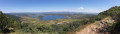
(5) Head right and reach a fork on the ridge:a magnificent panorama of the Cirque de Mourèze at an altitude of around 420 m.

(7) Turn left and continue to the ruins of the Hermitage of Saint-Jean d’Aureillan (risk of rockfalls).

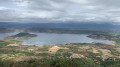
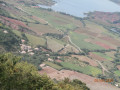
(8) Walk past the ruins, climb up to the next viewpoint and take in the panoramic view overlooking Lac du Salagou, its red cliffs and the surrounding hills.

(9) Then head back to the fork on the ridge where the route ends.

(7) Continue along the ridge to reach a 360° viewpoint offering one of the most beautiful views on the route.

(10) Continue along the ridge almost to the end, then turn left and head down towards the Liausson Cave. This is situated to the right of the main path. This vast natural cavity is easily accessible. A torch is strongly recommended for exploring the deepest and darkest parts.

(11) Return to the main path and continue downhill to the end of the Chemin de la Combe in the village of Liausson. First turn left then right, follow Rue de la Clastre, then take the steps on the left.

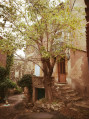
(12) Explore the Church of Saint-Félix and the old alleyways overlooking the lake. Take Rue des Escaliers and, at the corner by the Town Hall, turn right to find Chemin du Galant on your right.

(13) Follow this path down to the shores of Lake Salagou, continuing along the track.

(14) Enjoy a pleasant stroll along the water’s edge in a Natura 2000-designated area, continuing to the right along the bank, passing a dirt car park on your right. Carry on for about a hundred metres past the end of the road.

(15) Return to the junction.

(14) Keep to the right to complete a circular route, return to the access path and follow it in the opposite direction back to the village.

(13) Head right, then quickly turn left onto the Chemin de Lacan. Pass close to the Château and the Manoir de la Marguerite (testaments to Liausson’s historical past) and reach a three-way junction.

(16) Continue left and climb up to the junction at the Col des Portes.

(17) Turn left and begin a steady climb until you reach a fork in the road.

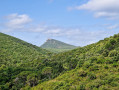
(18) Turn left and reach the summit of the Montagne de Liausson (535 m), offering an exceptional panoramic view of Lac du Salagou, Mourèze and the hills of the Haut-Languedoc.

(19) Then return to the previous fork.

(18) Climb to the left and, once on the ridge, reach the ‘Panorama des Orgues’ viewpoint overlooking the Cirque de Mourèze.

(20) Then head back to the Col des Portes.

(17) Continue straight ahead and follow the summit section of the ridge to a viewpoint.

(21) Continue along the path which veers to the left and joins the western slope. Reach the edge of the woodland and discover, on the left, the menhir known as the ‘Pierre Droite de l’Ouïsse’, a megalithic monument dating from the Neolithic period.

(22) Continue downhill along the main path to reach the Col des Lousses.

(23) Turn right and climb straight up the slope to the summit of Mont Mars, where you’ll find the Chapelle Sainte-Scholastique.

(24) After taking in the views, continue along the path and descend to a track.

(25) Follow it to the right and, at the next three-way junction, keep left; then, at the following junction, turn right. You’ll reach a crossroads a few metres after skirting a field.

(26) Carry on to the left towards the Cirque de Mourèze. Keep to the right until you reach the next wide path on the right.

(27) Take this path, cross the valley floor quickly and continue along the hillside. You’ll reach a fork after passing beneath theŒilde Mourèze rock.

(28) Turn left and rejoin the Cirque de Mourèze route.

(29) Turn right, continue through the rocky scree towards the village and reach the fork just before the first house.

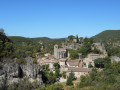
(30) Carry on straight ahead to reachthe Church of Sainte-Marie de Mourèze, first mentioned in the year 990 and a remarkable example of the local heritage.

(31) Take the opportunity to visit Roc Castel and the ruins of Mourèze Castle, then return to the junction at the entrance to the village.

(30) Turn right, head down to the bottom of the valley and carry on straight ahead until you reach the small copse leading to the ancient prehistoric site on the left.

(32) Then continue along the path which leads to the Mourèze Tourist Office and the car park (S/E).

Waypoints

  1. S/E : mi 0 - alt. 659 ft - Tourist Office / Car park
  2. 1 : mi 0.24 - alt. 820 ft - Dolomites Viewpoint
  3. 2 : mi 0.45 - alt. 820 ft - Route du cirque sur la gauche
  4. 3 : mi 0.72 - alt. 846 ft - Heart of the - Cirque de Mourèze
  5. 4 : mi 1.18 - alt. 1,043 ft - Stone barrier on the left
  6. 5 : mi 1.45 - alt. 1,348 ft - T-junction (there and back)
  7. 6 : mi 1.48 - alt. 1,453 ft - Baume Nègre Cave
  8. 7 : mi 1.71 - alt. 1,660 ft - T-junction (there and back)
  9. 8 : mi 1.82 - alt. 1,699 ft - ermitage st jean d'aureillan
  10. 9 : mi 1.91 - alt. 1,709 ft - Panoramic view of Lake Salagou
  11. 10 : mi 2.26 - alt. 1,716 ft - 360° panorama
  12. 11 : mi 2.86 - alt. 1,243 ft - Grotte de Liausson
  13. 12 : mi 3.66 - alt. 774 ft - Saint Félix Church in Liausson
  14. 13 : mi 3.8 - alt. 712 ft - Chemin des Galants
  15. 14 : mi 4.4 - alt. 459 ft - Arrival at Lake Salagou
  16. 15 : mi 4.67 - alt. 453 ft - Return point
  17. 16 : mi 6.18 - alt. 725 ft - Three-way junction
  18. 17 : mi 6.96 - alt. 1,253 ft - T-junction (there and back) - Col de Portes (557 m)
  19. 18 : mi 7.21 - alt. 1,522 ft - T-junction (there and back)
  20. 19 : mi 7.4 - alt. 1,752 ft - Summit of Montagne de Liausson
  21. 20 : mi 7.72 - alt. 1,270 ft - Les Orgues
  22. 21 : mi 8.57 - alt. 1,503 ft - Viewpoint
  23. 22 : mi 8.87 - alt. 1,503 ft - The ‘Pierre Droite de l’Ouïsse’ menhir
  24. 23 : mi 9.47 - alt. 1,152 ft - Col de Lousses
  25. 24 : mi 9.86 - alt. 1,647 ft - Sainte-Scholastique Chapel and Mont Mars
  26. 25 : mi 10.76 - alt. 883 ft - Trail
  27. 26 : mi 11.03 - alt. 883 ft - Crossroads of trails
  28. 27 : mi 11.48 - alt. 948 ft - Route du cirque on the right
  29. 28 : mi 11.95 - alt. 853 ft - T-junction
  30. 29 : mi 12.12 - alt. 873 ft - T-junction
  31. 30 : mi 12.38 - alt. 738 ft - T-junction (there and back)
  32. 31 : mi 12.51 - alt. 728 ft - Sainte-Marie de Mourèze Church, dating from the year 990
  33. 32 : mi 12.81 - alt. 705 ft - Prehistoric Site
  34. S/E : mi 13.04 - alt. 659 ft - Tourist Office / Car park

Notes

Given the numerous trails, we recommend using the Visorando app to follow the route.

Please note: hiking is prohibited during periods of fire risk.

Cirque de Mourèze and Lac du Salagou.

Camping is permitted at the summit: check the weather forecast beforehand; do not camp in strong winds.

Hiking boots are compulsory; take at least 2 litres of water per person, and pack snacks for before and after the hike, plus a protein-rich meal!

Wear hiking clothing for comfort; a rucksack of at least 20 litres is required.

Helmet and climbing equipment, if you’re a caving enthusiast or simply for safety’s sake.

First-aid kit and one survival blanket per person, survival whistle, knife, torch, etc.

Hotel and restaurant nearby; paid parking with video-enforced ticketing.
30 mins free / €2 for 4½ hours / €3 for 6½ hours / €4 for hours / €5 for 10½ hours / €20 for 24 hours

+ Practical information available on the website or via the Tourist Office.

Prehistoric site and UNESCO Global Geopark, Natura 2000 – please respect the natural environment and follow the safety guidelines.

Worth a visit

Highlights of the Cirque de Mourèze walk

(31) Sainte-Marie Church in Mourèze
First mentioned in the year 990, it was part of the medieval castrum of Mourèze. The present church retains Romanesque features from the 12th century and was for a long time the village’s religious centre.

(31) Ruins of Mourèze Castle on the Roc Castel
A former medieval fortress overlooking the village, probably built between the 10th and 12th centuries. All that remains today are a few ruins perched on the rock, which were once used to keep watch over the valley. (Ruins and castle: no public access).

(23) Sainte-Scholastique Chapel
Situated on the heights between Mourèze and Salasc. This pre-Romanesque chapel is thought to date from the late 10th or early 11th century. Dedicated to Saint Scholastica, sister of Saint Benedict, it served as an annex to the church of Mourèze.

(22) Menhir of La Pierre Droite de l’Ouïsse
A prehistoric megalithic monument probably dating from the Neolithic period (around 3000 to 2000 BC). It bears witness to very ancient human settlement in the area.

Lake Salagou
An artificial lake created in 1969 following the construction of a dam on the River Salagou. It is famous for its red earth, known as ‘ruffes’, which contrasts with the blue of the water.

Caves and caverns of the Cirque.
The numerous natural cavities in the cirque served as shelters for prehistoric peoples as early as 7000 BC. Some were also used by shepherds and charcoal burners over the centuries.

Between (13) and (16) Liausson Manor and Castle
The village of Liausson boasts several historic houses and the remains of a medieval manor linked to the surveillance of the Salagou. The site has been inhabited since the Middle Ages.

(12) Liausson Church
The village church, dedicated to Saint-Geniès, has medieval origins dating back to the 11th–12th centuries, with several alterations made over the following centuries.

(32) Les Courtinals prehistoric site
A real archaeological treasure in Mourèze. Excavations have revealed continuous occupation from the Neolithic period through to the Iron Age. A reconstruction of a Gallic settlement dating from around 350 BC can be seen on the site.

(3) Cirque de Mourèze
This spectacular dolomite landscape was formed from rock deposited around 160 to 165 million years ago. Erosion has carved out a labyrinth of towers, arches and natural formations for which the site is now renowned.

In short, discover an exceptional heritage combining prehistoric remains dating back over 7,000 years, a Neolithic menhir, a 10th-century chapel, the ruins of a medieval castle, Romanesque churches, the mysterious caves of the Cirque de Mourèze and magnificent panoramic views over Lake Salagou and Mount Liausson.

Other walks in the area

For more walks, use our search engine .

The GPS track and description are the property of this route's author. Please do not copy them without permission.