Paths of remembrance for those shot at Vingré

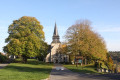
In December 1914, six French soldiers were shot as an example in the village of Vingré. This memorial hike retraces these events from the beginning of the First World War. The route is first marked by a transcription of the last letter written by these unfortunate men and by the sober monument that pays tribute to them. We pass by the Broken Cross, then the ruins of the Farm and the quarries of Confrécourt, all of which bear witness to the unprecedented violence of this war.

This walk is part of a multi-day hike: Paths of remembrance from the Great War

Details

1486018
Creation:
Last update:
Last review:
  • Walking
    Activity: Walking
  • ↔
    Distance: 5.43 km
  • ◔
    Average duration: 1h 45 
  • ▲
    Difficulty: Easy

  • ⚐
    Back to start: Yes
  • ↗
    Ascent: + 64 m
  • ↘
    Descent: - 64 m

  • ▲
    Highest point: 140 m
  • ▼
    Lowest point: 76 m

Photos

Description of the walk

Departure from the entrance/exit of the village of Vingré on the D138:
- Coming from Saint-Christophe-à-Berry, it is just before the village entrance sign and a large shed.
- When coming from the main town of Nouvron-Vingré via the D2020, once you reach the village of Vingré, turn left onto the D138, pass the monument to those who were shot and continue to the village exit.
Taking care not to obstruct traffic, park either on the side of the road or on the side of the paths that lead off from the bend in the road.

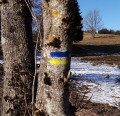
Yellow and green markings
The markings are clearly visible at intersections, but relatively rare elsewhere. In the village of Vingré, the route is marked by plaques bearing the names of the six soldiers who were shot, mentioned in the description below, with photos and reproductions of their last letters.

(S/E) Follow Rue des Vignes towards the centre of the village. Note the plaques of four soldiers:
- at No. 15, on the right-hand side, Pierre Gay;
- at No. 13, Jean Blanchard;
- at the end of the long building at No. 11, Claude Pettelet;
- after a small field on the left-hand side and before No.18bis, Jean Quinault.
Continue along the road uphill.

(1) At the sign "Monument des Fusillés à 150m" (Monument to those shot 150 metres away), continue straight ahead and you will find three stopping points:
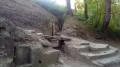
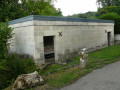
- on the right, the cellar where the soldiers spent their last night before the execution;
- above, a large information panel recounting the events;
- a little further on the left, the monument erected on the site of the execution.
Then head to the intersection in the centre of the village (small stone cross).

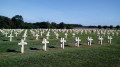
(2) Turn left and, atNo. 1bis, you will find the plaque dedicated to Henri Floch (spelled Henry on site). Continue along the street and you will find a few graves and a stele on the right, the remains of a temporary military cemetery.

(3) Retrace your steps to the previous intersection.

(2) Continue straight ahead on Rue de la Chaînée towards the Broken Cross. On the left-hand side, you will find the plaque dedicated to Francisque Durantet. Pass a wash house, follow the road uphill and note the entrance to an old stone quarry on the left-hand side.

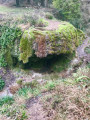
(4) On the plateau, at a two-branched telephone pole, leave the road and turn right onto a field path that leads to a grove. Note the silhouette of the old Confrécourt distillery on the left. Enter the grove and discover the Croix Brisée monument (information panel).

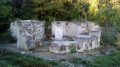
(5) Cross a small road and take the path opposite, which starts between two posts and heads south-west across the fields. You will come to the ruins of the Confrécourt farm.

(6) Before following the arrow to the right, make a quick detour to the left to see a small ruined building and a memorial to 11 soldiers who went missing in September 1914 and were found here in 1999.

(6) Continue north-west on the marked path (straight ahead when you return from the memorial stone).

Red and white markings

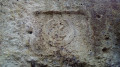
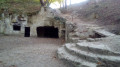
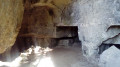
(7) After about 150 metres, leave the path momentarily, go down a staircase on the left, follow theGR®®12and you will soon reach the Carrières de Confrécourt site (former troop quarters; remains of a tunnel carved into the limestone to access the trenches). Go back up to the main path.

Yellow and green + red and white markings

At the top of the steps, follow the main path to the left (north-west).

Yellow and green markings

You will come to a small road; follow it to the left (leaving theGR®® trail on your right). When the tarmac gives way to a stony track, walk along the woods on your right.

(8) At the corner of the woods, turn right (there is no arrow or marker here, but on the left side of the track there is a sign indicating the Chemin de Vingré à Vaux). After passing the woods, descend between the fields. Cross a small wood and you will come out onto the D138 at the sign for "Monument des Fusillés à 150m" (Monument to those shot 150m away).

(1) Follow the road to the left until you reach the sign for the village exit (S/E).

Waypoints

  1. S/E : km 0 - alt. 76 m - Entrance/exit to the village of Vingré on the D138.
  2. 1 : km 0.63 - alt. 89 m - Crossroads of the circular
  3. 2 : km 0.92 - alt. 92 m - Intersection after the - Monument des Fusillés de Vingré
  4. 3 : km 1.05 - alt. 96 m - Old military cemetery
  5. 4 : km 1.75 - alt. 134 m - Start of the trail
  6. 5 : km 2.08 - alt. 140 m - La Croix Brisée
  7. 6 : km 3.02 - alt. 134 m - Ruins of the Confrécourt Farm
  8. 7 : km 3.3 - alt. 133 m - Access to - Carrières de Confrécourt
  9. 8 : km 3.99 - alt. 131 m - Path from Vingré to Vaux
  10. S/E : km 5.43 - alt. 76 m - Entrance/exit to the village of Vingré on the D138.

Notes

In dry weather, good trainers are sufficient for this short hike, which follows good paths and small tarmac roads.

There are no water sources or shops along the route.

A detailed map is useful (at least the one accompanying this description).

Additional information:
This hike can be combined with the hike "The hillsides of the Aisne and the Guésot quarries". At the ruins of the Confrécourt Farm (6), follow the path to the left (east-southeast) which passes in front of a stele and continues along the edge of the woods. Find the route for the second hike at point (6). After completing the circular route through the village of Fontenoy, return to the fork (6) and continue straight ahead along the edge of the woods to the ruins of the Ferme de Confrécourt. Finish the first hike at point (6). The entire hike is approximately 17km, including the connecting section.

Hike completed by the author on 5 October 2018.

Worth a visit

The hike follows the route "Les dernières heures des fusillés de Vingré" (The last hours of the Vingré shootings), designed and developed on site by the Retz-en-Valois Community of Communes and the Soissonnais 14-18 association.

The case of the Vingré shootings (source: Soissonnais 14-18 association):

In November 1914, a trench occupied by two squads of the298th Infantry Regiment was taken by the Germans amid great confusion. Some soldiers retreated, following the orders of a non-commissioned officer (who denied having given such an order), while others were taken prisoner but managed to escape during the ensuing chaos. The commander of the army corps concerned, General de Villaret, learned of the event and wanted to make an example of them. The 24 soldiers involved were court-martialled on 3 December and six of them, apparently chosen at random, were sentenced to death. They were executed at Vingré on 4 December 1914.

The six men shot at Vingré:
- Jean Blanchard, born on 30 September 1879 in Ambierle (Loire).
- Francisque Durantet, born on 5 October 1878 in Ambierle (Loire), farmer.
- Henri Floch, born on 31 July 1881 in Breteuil-sur-Iton (Eure), clerk of the justice of the peace.
- Pierre Gay, born on 30 November 1884 in Tréteau (Allier), farmer.
- Claude Pettelet, born on 13 February 1887 in La Guillermie (Allier), farmer.
- Jean Quinault, born on 14 March 1886 in Saint-Victor (Allier).

The first steps towards rehabilitation were taken in February 1919 by the widows of two of the convicted men. They received the staunch support of a former regimental comrade and witness to the scene, Claudius Lafloque (1879-1954), a bank employee in Vichy, and the assistance of a lawyer, Jean Nicolaÿ. The hearing before the Court of Cassation took place on 30 November and1 December 1920. The verdict of rehabilitation was handed down on 29 January 1921.

The soldiers' remains, initially buried in Vingré, were repatriated to their home villages in February 1922. A subscription was launched to erect a monument on the site of the execution, which was inaugurated in Vingré on 5 April 1925. Subsequently, streets or squares named after the Martyrs of Vingré were established in several towns in France, mainly in the departments of Loire and Allier, where most of the soldiers ofthe 298th Infantry Regiment came from. In 2004, the department of Aisne elevated the six soldiers who were shot to the rank of honorary citizens.

To see along the way:

In the village of Vingré, between (S/E) and shortly after (2), six points (marked in the description) are dedicated to each of the six soldiers. In particular, you can read reproductions of their last letters, written to their wives. Reading them is poignant, and reveals two points common to all these letters. On the one hand, these men all claim to be innocent of the crime of abandoning their posts in the face of the enemy, for which they are accused, and show that they are fully aware that they have been condemned to set an example. On the other hand, they all ask their wives for forgiveness for the hardship that their deaths, in these circumstances, will cause them, convinced that they will be the subject of suspicion and condemnation given the supposed cowardice of their husbands.

Shortly afterwards (1), the cellar where the condemned men spent their last night, the large information panel and the monument erected in 1925 on the site of the execution are particularly moving. The monument is very sober and has three plaques affixed to it:
- At the top, the names of the soldiers are listed; it is stated that they "fell gloriously", and the dates of their execution and rehabilitation are indicated.
- In the middle, a tribute from the veterans of the298th Infantry Regiment "in memory of their innocent comrades who died as victims of example".
- At the bottom, a plaque that is undoubtedly more recent and more general in scope: "During the Great War, hundreds of soldiers were shot, some 'to set an example'. Forty-two were rehabilitated. May this monument, erected in memory of the six soldiers shot at Vingré, also remind you of all those who, shot to set an example, suffered the same unjust fate."

In (5), La Croix Brisée (The Broken Cross) was erected in 1929 on the initiative of the Marquis de la Croix (sic) in memory of the soldiers who died on the plateau.

In (6), the Confrécourt Farm was the scene of fierce fighting and was subjected to numerous bombardments. The ruins appear to have been left as they were.

In (7), the Confrécourt quarries served as barracks for French troops. Access is not free, but you can get a first glimpse through the gates. Visits are organised every first Sunday of the month, from March to September (€2 per person). Meet at 3pm in front of the Croix-Brisée monument. Contact: Soissonnais 14-18, tel. 03 23 55 17 18.

Always be cautious and plan ahead when you're outdoors. Visorando and the author of this route cannot be held responsible for any accidents occurring on this route.

The GR® and PR® markings are the intellectual property of the Fédération Française de Randonnée Pédestre.

Reviews and comments

4.9 / 5
Based on 3 reviews

Reliability of the description
4.7 / 5
Ease of following the route
5 / 5
Route interest
5 / 5
Jose. Montfront@wanadoo.fr

Overall rating : 5 / 5

Date of your route : Sep 18, 2021
Reliability of the description : ★★★★★ Very good
Ease of following the route : ★★★★★ Very good
Route interest : ★★★★★ Very good
Very busy route : Yes

A very beautiful and moving route with its history. Brave boys who died for nothing. I think it's important to put up a sign at the car park at the start. Thank you for your information sheets, which are very well done. Best regards. I didn't see any prohibition signs at the car park!

Machine-translated

Netra
Netra ★

Hello josnieppe, and thank you for your comments.

Thank you for the information about the parking spot: I will amend the description accordingly. Just to make sure I understand correctly, when you say "upstream", do you mean going up towards the memorial or further away from it?

Machine-translated

josnieppe
josnieppe

Overall rating : 4.7 / 5

Date of your route : May 19, 2019
Reliability of the description : ★★★★☆ Good
Ease of following the route : ★★★★★ Very good
Route interest : ★★★★★ Very good

Please note: the indicated car park is no longer available. The owner has put up "private property" signs in front of the large farm shed. According to the neighbour, there are too many vehicles and buses at certain times. It is possible to park 200 metres further up on a small area that leads to the fields.
Otherwise, a very interesting route. Highly recommended.

Machine-translated

Antitez
Antitez

Overall rating : 5 / 5

Date of your route : Feb 24, 2019
Reliability of the description : ★★★★★ Very good
Ease of following the route : ★★★★★ Very good
Route interest : ★★★★★ Very good

A very pleasant route and a striking history lesson. However, it should only be attempted in very dry weather.

Machine-translated

Other walks in the area

For more walks, use our search engine .

The GPS track and description are the property of this route's author. Please do not copy them without permission.