Memory trails around Autrêches

During the First World War, the front line divided the commune of Autrèches in two! This memorial hike recounts the lives of the combatants on both sides as well as those of the inhabitants during those four difficult years.

This walk is part of a multi-day hike: Paths of remembrance from the Great War

Details

609006
Creation:
Last update:
Last review:
  • Walking
    Activity: Walking
  • ↔
    Distance: 7.04 km
  • ◔
    Average duration: 2h 20 
  • ▲
    Difficulty: Easy

  • ⚐
    Back to start: Yes
  • ↗
    Ascent: + 124 m
  • ↘
    Descent: - 129 m

  • ▲
    Highest point: 151 m
  • ▼
    Lowest point: 63 m
  • ⚐ Country: France
  • ⚐ District: Autrêches (60350)
  • ⚑
    Start/End: N 49.443723° / E 3.126286°
  • ❏
    IGN map(s): Ref. 2511E
  • Hour-by-hour weather

Photos

Description of the walk

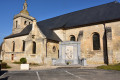
Departure from Autrêches church (large car park).

Blue signposting "Sur les traces du35e RI" (In the footsteps of the 35th Infantry Regiment)
Signs are in the form of posts at each intersection. Along the way, you will crossPR®® trails or follow some sections of them; in the following description, the corresponding yellow markings are only mentioned when necessary.

(S/E) From the church car park, cross Rue de la Horse (on the left) and take Rue de la Montagne opposite. After the last house, the tarmac gives way to a path that enters a wood. Ignore a turn-off to the left and climb up a path that becomes steep.

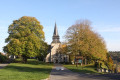
(1) At the top (information board and signpost on the left), take thefirst path on the right, which is wide and stony. It makes a sharp turn to the right before leaving the woods: cross a meadow with the church tower clearly visible opposite. You will come out onto a street (Rue du Beaumontoir) and follow it to the left. Just after No. 19bis, note an old gravestone inserted into a wall on the left and, above it, an old Adrian hut (see the section "During the hike").

(2) At the corner of No. 24, turn right and go downhill. At the three-way junction at the bottom, go left. Cross a stream and go up the opposite side. Ignore a path on the right (Red variant), continue on the tarmac road and cross the hamlet of Massenancourt. At the end, continue on a path that climbs through the undergrowth.

(3) At the top, head roughly opposite (east-northeast) onto a field path located on the route of an old French trench (known as Boyau des Couleuvres due to its winding nature). After about 200 m (elevation 132), continue along a narrow tarmac track (ignore the Yellow and Green variants on the right). Walk straight ahead between the fields.

(4) At the crossroads, take thesecond right (east-southeast, Yellow marker; be careful, the Blue arrow seems to invite you to go left, which you should not do). Follow this wide gravel path between the fields.

(5) At the next crossroads, follow a small road to the right and pass in front of the monument known as Petit Julot. Further on, at an intersection, ignore the road on the right (arrival of the Green variant).

(6) After about 20 metres, before the road descends steeply, leave it and take a wide, flat path on the left. Head south along the edge of the woods and ignore all the paths on the left. Enter the woods (yellow marker) and follow two bends, first to the right then to the left, down a steep slope (note the limestone bench on the right). Continue south downhill on a narrow path lined with beech trees (known as the Vallée des Prisonniers). At a crossroads, continue straight ahead on a gentler slope.

(7) At the end of the path (which we learn is called Chemin du35e RI), turn right onto Rue du Puits de l'Alouette. Cross Rue des Champs on the left and continue straight ahead.

(8) At the fork (calvary, stele), turn left towards the church, whose bell tower is clearly visible (note that there are no side roads for a good hundred metres). Stay on the tarmac road, passing the cemetery and the war memorial, then the Ferme du Château. At the crossroads, turn right towards the church. Veer right towards Square de la Paix (ruins) and continue uphill to the church (S/E).

Waypoints

  1. S/E : km 0 - alt. 81 m - Église Saint-Victor (Autrêches)
  2. 1 : km 0.48 - alt. 128 m - Plateau Saint-Victor
  3. 2 : km 1.2 - alt. 87 m - Intersection
  4. 3 : km 1.99 - alt. 125 m - Boyau des Couleuvres
  5. 4 : km 3.22 - alt. 151 m - Crossroads
  6. 5 : km 3.85 - alt. 138 m - Crossroads - Petit Julot Monument
  7. 6 : km 4.76 - alt. 126 m - Start of the trail
  8. 7 : km 5.91 - alt. 64 m - Chemin du 35e RI x Rue du Puits de l'Alouette
  9. 8 : km 6.22 - alt. 65 m - Calvary - Stele
  10. S/E : km 7.03 - alt. 81 m - Église Saint-Victor (Autrêches)

Notes

Hiking boots recommended.

Toilets are available in the church car park (S/E).

Shorter variations of this route are possible, starting from the same point: Red (3 km), Yellow (4 km) or Green (5 km). See the corresponding signposts on site.

Although the signposting is very good, a detailed map is always useful (at least the one accompanying this description).

Hike completed by the author on 15 September 2018.

Worth a visit

This hike follows the "Sur les traces du35ème RI" (In the footsteps of the 35th Infantry Regiment) route, created in tribute tothe 35th Infantry Regiment, which was particularly active in the area. This route was designed, signposted and provided with information on site by the "Musée Territoire 14-18 Aisne-Oise" museum.

See a military timeline concerning Autrèches between 1914 and 1918.

Numerous richly illustrated information panels line the entire route.
- Autrèches Church (early 16th century, rebuilt in the early 20th century), Gothic in style with a Romanesque crypt (S/E).
- Tombstone inserted into a wall, Rue du Baumontoire, shortly before (2). This is a stone engraved with the name of a German soldier killed on 18 January 1915 and later reused by the Germans themselves for masonry work.
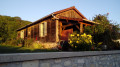
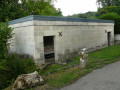
- Former Adrian barrack, in the same location, now a residential house. These demountable wooden barracks were designed by engineer Louis Adrian (1859-1933), best known for inventing the helmet that was adopted by the French army from 1915 onwards. Adrian barracks were used during the war for accommodation and, after the war, as temporary buildings in areas devastated by bombing. Several of these barracks still exist today and are mainly used as small houses: temporary structures that have stood the test of time, so to speak...
- Layout of an old French trench, the Boyau des Couleuvres (3).
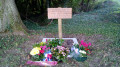
- Monument to Petit Julot (5). A simple wooden plaque engraved in tribute to several soldiers killed in action on 20 August 1918, including "Petit Julot".
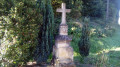
- Calvary and stele in tribute to the soldiers who died in the sector (8).
- Plaques in tribute to certain soldiers on the wall behind the war memorial, after (8).
- Square de la Paix, shortly before (S/E). Remains of a house destroyed by bombing (wall, chimney) and plaque commemorating its inauguration in 2014.

Always be cautious and plan ahead when you're outdoors. Visorando and the author of this route cannot be held responsible for any accidents occurring on this route.

The GR® and PR® markings are the intellectual property of the Fédération Française de Randonnée Pédestre.

Reviews and comments

4.8 / 5
Based on 2 reviews

Reliability of the description
5 / 5
Ease of following the route
5 / 5
Route interest
4.5 / 5
vivierois
vivierois

Overall rating : 5 / 5

Date of your route : Sep 07, 2020
Reliability of the description : ★★★★★ Very good
Ease of following the route : ★★★★★ Very good
Route interest : ★★★★★ Very good
Very busy route : No

A route covering several kilometres (choose your colour). Explanations at each point on well-maintained signs.
Part of the 7 km route on flat ground is only good for walking at a brisk pace, as you take the time to read the signs.
What's more, you start at this surprising church.

Machine-translated

JackyPG60
JackyPG60

Overall rating : 4.7 / 5

Date of your route : Jun 26, 2020
Reliability of the description : ★★★★★ Very good
Ease of following the route : ★★★★★ Very good
Route interest : ★★★★☆ Good
Very busy route : No

This route was only part of my route.
A few fallen trees blocked the path in the circular (not far from point 1).
The route is marked with explanatory panels that are very interesting. You need to take the time to immerse yourself in the period described to give meaning to the route.
On the way back, the church is majestic, but unfortunately it was closed.

Machine-translated

Other walks in the area

For more walks, use our search engine .

The GPS track and description are the property of this route's author. Please do not copy them without permission.