Country:
 City:
City:



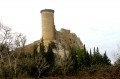
Head to the Château des Papes on the heights of Châteauneuf-du-Pape and park in the car park.
There are no painted markings but there are a few signposts at crossroads in the Rhône area.
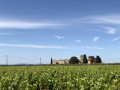
(S/E) Turn your back to the castle and take the paved road that led to the car park. On the left, you will see a small vineyard with information panels about the different grape varieties planted there. Continue until you reach the entrance gate.
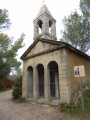
(1) Turn left and follow the road for 200 metres until you reach a crossroads with an oratory. Turn left onto Chemin Monseigneur André Mestre.
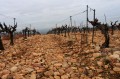
When you reach a crossroads with an oratory that serves as a roundabout, turn right onto Avenue des Oliviers. Further on, the tarmac ends and gives way to a stony path that continues between the vineyards. After a short descent, the path leads to a new tarmac section.
(2) Turn left to follow this road down the small valley to the D17. Cross the road with caution and continue opposite on Chemin des Arméniers.
after 250 metres, pass two roads on your left and take the path that branches off to the right. Quickly pass a path on your right, cross the Pierrelatte canal and you will reach another crossroads.
(3) Turn right, then left and continue straight ahead for about 800m. In a bend, leave the path on the left and stay on the main path which turns right between the vineyards to rejoin a tarmac road.
(4) Turn left, then right at the next junction. Further on, a path replaces the tarmac and continues along a hedge of Italian poplars, ending at the Domaine de l'Hers signpost.
(5) Turn left onto the path that runs alongside the canal, following the signs for "Chemin de halage et four à chaux" (towpath and lime kiln).
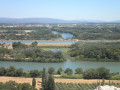
Admire the Château de l'Hers on your right, perched on a rocky outcrop overlooking the Rhône.
When the path ends, a trail continues straight ahead, then turns left and rejoins a path. (The route on the map continues along the Rhône, but it appears that this access is no longer passable).
(6) Follow the path to the right and you will come to a vineyard on your left. After the vineyard, the path enters the woods and comes to a fork. Turn right towards an open space where there is an old lime kiln.
(7) Continue along the path that passes under the kiln and goes around it on the right. The path becomes a paved slanting street as it climbs. Ignore all the paths on the left and continue along this dead arm of the Rhône until you reach the Clos Bimard signpost.
(8) Continue straight ahead towards Islon Saint-Luc. At the end of a vineyard, there are two options:
* Leave the path opposite and turn left, then right to immediately reach a fork. Take the path on the right, which rejoins the Bois de la Ville signpost 100 metres further on (route marked on the map).
* Take the path opposite, which descends and immediately climbs back up towards the woods, then crosses a small BMX track. At the end of the track, descend the small dyke on the left to reach the Bois de la Ville marker.
(9) Continue along the vineyards for about 800 m until you reach the Islon Saint-Luc crossroads.
(10) Turn left onto the paved road between the vineyards towards Fours à Chaux via the vineyards and follow it to a roundabout.
Continue straight ahead on Chemin du Sel. After the stadium, turn left to go back up towards the town centre via Chemin de la Calade.
(11) Cross Rue de la République and go up Rue Joseph Ducos opposite. Pass the next two streets on your left, then the one on your right. Walk alongside the church and pass two more streets on your left. Just after the church, take the steps up to the right, then walk a few steps to the right into the street and turn left onto a new set of steps.
Go around the castle on the right to reach its esplanade. Enjoy the view and return to the car park.




 Association / Club / Walk leader

 Visorando Member
 Moderate