Country:

 City:
City:


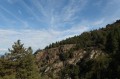
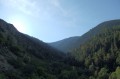
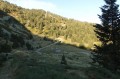
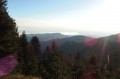
(S) Set off from behind the mountain refuge (on the side with a view of the Mediterranean) via theGR®®10–GR®®36, which passes beneath the refuge’s generator. Head due north, following the red and white markings, without trying to cut across the hairpin bends of this lovely path. Do not take the alternative route (Balcon du Canigou).
Join a track. Turn right then left, following this track as it descends due north. Arrive at Ras des Cortalets (2,055 m).
(1) Junction of tracks and paths. Leave the red and white markings. Turn left, heading due west, following a track in poorer condition. The track turns south-west as it continues to descend.
(2) Fork in the path. Turn right onto a wide, grassy path that is very clearly marked on the ground. This path is blocked at the entrance by two steel posts. An enamelled sign points towards La Jasse, which can be seen below. This lovely path avoids the need to descend via the track.
Reach the Jasse des Cortalets refuge (1,930 m). Continue descending along the track heading due north. Ignore the paths branching off to the right towards Balatg. Continue along the track, which then turns north-west. You’ll come to a hairpin bend to the right. Col des Voltes (1,838 m)
(3) Junction of track and footpaths. Set off straight ahead along a path that descends north-west. An enamelled sign points towards Vernet-les-Bains.
Please note: from here on, you will be descending 770 m over a distance of 2,250 m, representing a gradient of 33 per cent.
Descend at your own pace, according to your ability. The path is very well marked and free of hazards.
The path descends steeply but steadily, with no steps and no danger.
Descend into this valley, where the Ruisseau de Fillols flows further down.
Just imagine the effort it must have taken to build such a path in such a steep and enclosed valley.
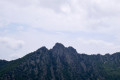
You’ll arrive in an open area with a rocky peak (La Mort de l’Homme, 1,249 m) high up on your right. Continue descending. You’ll reach a track (1,070 m).
Turn left onto this track, which descends to a right-hand hairpin bend after 200 m.
(4) Fork in the path. Water tanks. Leave the track; a sign points towards Vernet-les-Bains. Go round the brown-painted water tanks and take a path that remains flat for a short while. It then descends towards the Ruisseau de Fillols. Follow the stream along the right bank, then cross it.
Be careful, there is no footbridge. Choose a suitable spot to cross.
The steep descent is now over.
The path climbs very steeply up the opposite bank and crosses to the left bank. You’ll reach an altitude of 990 m.
(5) Fork in the path. Take care here. Turn right. Leave the climb to the Pic de Cogoullo on your left. After 15 m, the path turns left towards the south.
Just after this bend, there is another fork. Go straight on. Pass the sign for Fillols on your right. Follow signs for Vernet-les-Bains and Col de Juell.
(6) 700 m further on, a fork in the path. Go straight on. Pass the path towards Fillols on your right. You’ll reach the Col de Juell (899 m), marked as 895 m on the green sign.
(7) Junction of tracks and paths. Continue straight on towards Vernet-les-Bains. Pass the climb to the Pic de Cogoullo on your left. Pass the climb to the Col de la Truja on your right. Join a track. Pass an old building, Saint Jean (796 m), in very good condition, on your left. The track becomes suitable for vehicles.
(8) Junction of tracks and paths. Head downhill along the tarmac road. Pass a grassy track on your left leading towards a farmhouse, and a path signposting the climb to Canigou with a 215-metre elevation gain. Join a main road (D 27).
(9) Crossroads. Turn left onto the D 27, keeping well to the left on the wide, grassy verge. Cross a bridge over the channelled stream. Arrive at the entrance to Vernet-les-Bains. Walk round the cemetery.
(10) Fork in the road. Just after the car park at the cemetery, turn left, following the sign for the Saint-Vincent Waterfall. Head up the road, continuing to follow the signs for the Saint-Vincent Waterfall. You’ll reach the car park where this section of tarmac road ends. Yellow and white markings may help you. Continue uphill along a wide track, following the signs for the Saint-Vincent Waterfall. Keep away from the adjacent tracks and paths during the ascent. Pass the 801 m altitude mark. End of markings.
(11) Fork in the path. Turn right onto a wide path that climbs, following the direction of the Col de Llavent. Leave the signposted route to the Saint-Vincent Waterfall on your left.
Please note: After 200 m, there is a fork in the path. Turn right. The signs do not indicate the Col de Llavent.
Continue uphill along a narrow path, which is very clearly marked on the ground. You will reach an open area where the stone retaining walls of the terraces and the ruins of a very old barn remain. Pass the old Canal Rabent. Arrive at the Col de Llavent (858 m)
(12) Head straight on towards Casteil (added in felt-tip pen on the sign). Pass the climb to Saint-Martin du Canigou on your left, and the climb to the Pic de l’Alzina on your right.
Descend along a very steep path towards the Ravin de la Guilla. Cross this ravine.
Follow the .gpx route carefully. The IGN route is incorrect.
Caution! This section is well-maintained and safe, but very steep. A handrail may be of assistance. Follow the right bank of the Ruisseau Dels Asmoursadous. The slope levels out.
Walk alongside a wooden fence on your right. You’ll come out onto a road at the entrance to the campsite. Walk 100 metres further down this road. Turn right towards the car park to return to your vehicles (E).


 Visorando Member
 Moderate