Country:

 City:
City:



Departure from the market halls of Saint-Jean-du-Bruel.
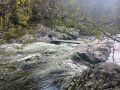
(S/E) Cross the Pont Neuf bridge and admire the Dourbie river and its "la Pansière" causeway. On the right is one of the chimneys of the old pottery works. Take thefirst street on the left, called Rue du Moulin. Walk past two canneries and the old medieval mill, now converted into a water feature called "Noria". The old 13th-century bridge spans the river.
Go to the middle of the bridge to enjoy a simple panorama upstream and downstream. Return to the square and take Rue du Pont Vieux on the left. This neighbourhood, known as the faubourg, was occupied in the Middle Ages by many craftsmen (dyers, tanners, potters, etc.).
At the crossroads, turn left onto Route de Seingleys. The floods of 1963 destroyed all the magnificent gardens that lined the river.
(1) As you enter the hamlet of Seingleys, turn right, pass the La Fabarède stopover lodge and take the path on the right along the Ruisseau de Seingleys.
Leave the first track on your left, then the second one on your right 150 metres further on, and you will come to a fork.
(2) Continue straight ahead. Cross the Ruisseau des Valettes. On the left, you will see the Cévennes schist, and on the right, the sandstone. 100 m further on, on the left, the limestone cliffs appear, topped by low walls that once supported the vines.
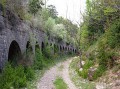
As you climb the path, you will see a row of five calamine kilns on your right, incorrectly labelled as lime kilns on the IGN map.
(3) The mule track ends a few metres from the building on the right, at the black clay of the Lias, rich in fossils. This is where the potters of Saint-Jean came to load this black clay, which, mixed with red clay, was their raw material.
Beyond this point, the road becomes a path and climbs towards the Causse through an oak grove, which is replaced higher up by a beech forest. When you reach the edge of a field, cross it, turn left and then right. A little more effort and you will arrive at the Œil de Bœuf (altitude 829 m).
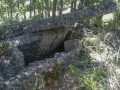
(4) Take the old path on the right, known as Nant à Dourbies, towards Causse-Bégon. After about 500 m, on your left, the Baumelle sheepfold (a jasse) is worth a stop. Then a sign tells you "80 m le Tombeau du Géant" (80 m to the Giant's Tomb) and invites you to turn left to visit this megalithic site.
(5) Return to the road. Turn left and continue to the 868 metre mark, a four-way intersection for Causse-Bégon and Barjac, leaving the turnings on your right.
(6) Go straight ahead towards Barjac, then continue straight ahead at the fork that follows immediately. Continue straight ahead to reach the D295.
(7). From this point, there is a remarkable view of the Cévennes towards Lingas and Mont Aigoual.
On your right, a sign invites you to descend to the Barjac farm and cross it, continuing straight ahead for 100 m until you reach a fork.
(8) Turn left and after the right-hand bend, continue straight ahead and join another fork at the entrance to the low vegetation area. Turn slightly left until you reach a path coming from the left.
(9) Ignore it and start the descent back to the D341. Visit the lime kiln.
(10) Retrace your steps and continue downhill through the chestnut groves. Take the D341 downhill for 200 m until you reach the Saint-Jean sign.
(11) Leave the road and continue on a path on the left towards La Sentinelle until you reach the new Saint-Jean sign indicating the start of the path on the left.
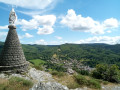
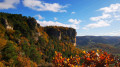
(12) Descend this path towards Le Périgoul. Enjoy the panoramic view of the high gorges of La Dourbie. At the bend, you will rejoin the D341.
(13) Follow it down to the village. Panoramic view of Le Bruel, La Dourbie and Saint-Jean-du-Bruel. At the roundabout, turn left and cross the Pont Neuf bridge opposite to reach the market halls and the starting point (S/E).



 Association / Club / Walk leader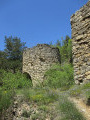

 Easy
Easy 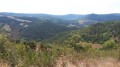
 Visorando Member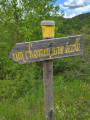
 Difficult