Country:

 City:
City:


Departure from the market halls of Saint-Jean-du-Bruel, in the centre of the village.
(S/E) Cross the Pont Neuf bridge and admire the Dourbie river and its beautiful causeway (la Pansière). On the right is one of the chimneys of the old pottery works.
Turn left onto Rue du Moulin. Walk past two canneries, "Noria", the water house, and reach the 13th-century Pont Vieux bridge opposite. Go to the middle of the bridge for a panoramic view of the Dourbie and retrace your steps.
Take Rue de la Cabrune, formerly known as Camin Ferrat, cross Route de Seingleys and take Chemin de la Cabrune.
(1) This shaded path climbs steadily between chestnut groves lined with schist walls, often built in a vertical pattern to resist the pressure of the earth. Leaving the tarmac section, about 250 metres further on, you will see on your right the remains of the largest slate quarry in the country (over 1 hectare), which ceased operations in 1946.
Continue straight ahead, heading north-east, until you reach the D341.
(2) Go up the road on the left (towards Trier).
(3) At the first hairpin bend, continue straight ahead on the path. The shaded track remains in the chestnut grove, then suddenly leaves the schist and enters the sandstone. You will reach a three-way junction.
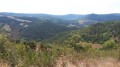
(4) Turn left onto the path that continues downhill, offering beautiful panoramic views of the Saint-Jean valley. After crossing the ridge, you will find yourself in the sibadières area. In the past, small fields on poor schistose sandstone soil were sown with oats or sibade.
Continue for a few hundred metres until you reach a fork where a path joins from the right.
(5) Turn left and continue downhill to a junction just before the Saint-Gleys stream, which joins the Valettes stream further down. This region was the subject of mining research at the beginning of the last century, particularly for zinc, lead and iron, but unfortunately nothing came of it.
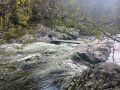
(6) Turn left and follow the stream to the ford.
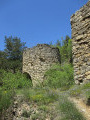
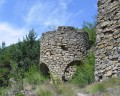
(7) After crossing the ford, turn right at the hairpin bend, then go straight on at the next junction to reach the old calamine furnaces.
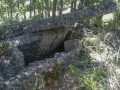
(8) These furnaces, incorrectly labelled "lime kilns" on the IGN map, were used to reduce zinc ore (calamine) to make it easier to transport. However, work that began in 1905 was halted in 1914.
Retrace your steps.
(7) Continue straight ahead to descend towards Saint-Gleys along the stream. Once you reach the road, turn left, then left again onto Route de Saint-Gleys and continue to the junction with Rue du Pont Vieux.
Turn right onto this street, leave the Pont Vieux on your right and continue to the Pont Neuf, which you must cross to return to the market halls (S/E).




 Association / Club / Walk leader
 Easy
Easy 
 Visorando Member
 Difficult