Country:
 City:
City:


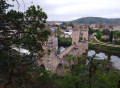
(S) From the campsite, head south along Rue de la Rivière. Pass the rugby pitches and the stadium entrance. Follow the signs for Cahors Centre (Please note: do not follow the red and white markings, which are for theGR®36!). Follow the River Lot to the Pont de Cabessus. Cross the bridge over the River Lot. (For your information, in the large car park after the stadium, you can take the free shuttle bus which takes you to the tourist office and follows the same route).
(1) Turn left towards the tourist office, then right onto Place Champollion. Walk to the right of Saint-Étienne Cathedral onto Rue Maréchal Foch. Cross Place Jean Jacques Chapou and continue straight ahead to stay on Rue Maréchal Foch. Continue to the traffic lights.
(2) Turn left onto Boulevard Léon Gambetta. Walk past the tourist office and continue to the roundabout.
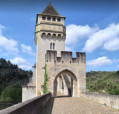
(3) Turn right towards Pont Valentrė and continue along the banks of the Lot. Walk on until you reach Pont Valentré. (You are now back on theGR®65; from here on, follow the red and white markings)
(4) Cross this beautiful bridge, carefully cross the Chemin de la Chartreuse, then begin the first climb of the day by heading left onto a narrow path that climbs the cliff via a few concrete steps, to reach the plateau near the Croix Magne.
(5) Continue to the right along the Chemin de Magne and pass through a residential area before reaching a ‘give way’ sign.
(6) Turn left, then left again, onto the Chemin de Peyrolis, and follow the D820 for about 800 m.
(7) At the bottom, in the bend, turn right to go under the D820, then turn left to follow the D820 in the opposite direction along the Route de Fontanet. Walk for 1.3 km along a tarmac road, heading towards La Rosière then Les Mathieux. Continue to La Fourche, where you’ll find the gate of house number 187 in the middle.
(8) Head left onto a stony path, slightly uphill, crossing the meadows, towards the village of La Rosière.
(9) Continue left onto the Chemin des Amandiers and follow the dead-end track to the end of the road. After the last house (No. 882), carry straight on along the narrow path through the woods to reach a T-junction at a place called Pech de Baulut.
(10) Turn right onto Chemin de Couaillou and continue to the junction with Route de la Rosière.
(11) Turn left, pass a garage, then head right onto the small path running alongside the Route de Montcucq before crossing it carefully. Follow the signs for Labastide-Marnhac. Continue to the D7 after crossing the Ruisseau de Bartassec.
(12) Turn immediately right onto the stony Chemin des Uclades, which climbs gently towards the scrubland. Continue to the hamlet of Les Uclades.
(13) Turn left and continue past the primary school in Labastide-Marnhac before reaching the D7. Continue along this road to the right.
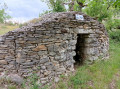
(14) Cross the D7 with care and follow signs for Labastide-Marnhac. Ride through the village and continue to the Stop sign. Pass the church, then the town hall, before reaching the Stop sign at the junction with the D67. Cross the D67 carefully and continue in the same direction on the D7 for a few metres, until you reach a small stone building known as a cazelle.
(15) Turn left onto the path between the cazelle and a large beech tree.
(16) Ignore the alternative route leading to Lhospitalet and continue straight ahead on theGR®65, through woods and meadows, to the Trigondina stopover lodge.
(17) Where the Lhospitalet alternative route joins the GR® 65, at the entrance to the lodge, turn right to rejoin the tarmac on the road to Labouriète and continue to the small hamlet of Le Pouget.
(18) After a sharp left-hand bend, continue to the junction with the Chemin des Gaussères.
(19) Head left, then follow the path on the right. Cross the Las Cordès valleys, then Pech Del Clerc before arriving at a picnic area on the Route de Belcastel.
(20) First turn right then left onto Route de Belbastel, cross the hamlet of Terre Rouge and continue along Chemin de Marannes.
(21) Head right, towards Baffalie, along the stony, downhill path. Cross the hamlet of Baffalie and continue to the cross.
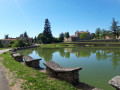
(22) Keep left and continue to the wash house on the banks of the Verdensson. At the small bridge, turn left onto Chemin de la Gravelle. Continue to the hamlet of La Gravelle.
(23) Turn right and walk to Lascabanes Town Hall. Continue along Rue de l’Église, pass the cemetery and carry on, turning right onto Chemin de Saint-Gery, a steep climb, following the red and white markings ofthe GR®65.
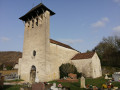
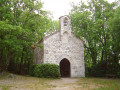
(24) Turn right onto Route Saint-Jean-l-Froid and head towards the chapel of the same name, your campsite for the night (E).
 Visorando Member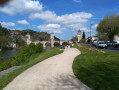
 Easy
Easy