


Refine your search for walks in Bourscheid (Luxembourg)
Randonnées Bourscheid (Luxembourg)


 Bourscheid Castle in all its glory
 Visorandonneur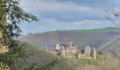
 7.12 mi
 +1,808 ft
 -1,791 ft
 4h 50
4h 50
 Moyenne
 Départ à Bourscheid (Luxembourg) (Luxembourg (Country))
Discover all the facets of the ruins of Bourscheid Castle on its rocky outcrop. This castle is not only the largest in the country but also one of the most important between the Rhine and the Meuse.
From Goebelsmühle station to Michelau station via Bourscheid Castle
9.05 mi
+2,096 ft
-2,175 ft
6h 00
Moyenne
Départ à Bourscheid (Luxembourg) (Luxembourg (Country))
This walk takes us up above the meanders of the Sûre into the heart of the Éislek, following part of the Escapardenne Lee Trail, a hiking trail linking Ettelbruck to Kautenbach. Once we’ve reached Luxembourg’s largest fortified castle, we can walk around the next bend and head uphill to reach a remarkable viewpoint before descending towards Michelau station. If you’re short on time or energy, you can reach the station more directly by taking the Haute Sûre path down from the castle.
It was designed to be accessible by train (free in Luxembourg since March 2020).
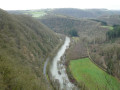
The Sûre valley between Michelau and Erpeldange
 12.36 mi
+2,100 ft
-2,083 ft
7h 30
Moyenne
Départ à Bourscheid (Luxembourg) (Luxembourg (Country))
12.36 mi
+2,100 ft
-2,083 ft
7h 30
Moyenne
Départ à Bourscheid (Luxembourg) (Luxembourg (Country))
Starting from Michelau station (free parking, free access by train or bus from anywhere in the Grand Duchy of Luxembourg), the walk heads south, crosses the Sûre (a river similar to the Ourthe and Semois in Belgium) and climbs up the right bank, following its course along a forest path, a small country road and a slightly steep trail.
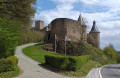
From Dirbach to Bourscheid Castle
 7.46 mi
+1,736 ft
-1,745 ft
4h 55
7.46 mi
+1,736 ft
-1,745 ft
4h 55
 Difficile
Départ à Heiderscheid (Luxembourg (Country))
Difficile
Départ à Heiderscheid (Luxembourg (Country))
Circular route in the Our Nature Park, taking part of the Escapardenne Lee Trail. Route can be done in all seasons.
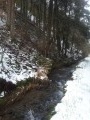
Route in Hoscheid
 8.27 mi
+1,965 ft
-1,952 ft
5h 30
Difficile
Départ à Hoscheid (Luxembourg (Country))
8.27 mi
+1,965 ft
-1,952 ft
5h 30
Difficile
Départ à Hoscheid (Luxembourg (Country))
Route in Hosingen Park, taking part of the Escapardenne Lee Trail and the Hoscheid sound trail, which can be enjoyed at any time.
Éislek circular pad starting from Hoscheid
6.97 mi
+1,549 ft
-1,549 ft
4h 35
Moyenne
Départ à Hoscheid (Luxembourg (Country))
This path winds through the Schlindertal valley. A slight detour will take you to its memorial. The isolated Saint-Michel chapel is a remnant of an ancient village that is now uninhabited. The highlight of the hike is the Molberlee, an exposed slate ridge offering spectacular views of the valley.
Schuttbourg Castle in Kautenbach
 6.46 mi
+1,381 ft
-1,381 ft
4h 10
Moyenne
Départ à Kiischpelt[2] (Luxembourg (Country))
6.46 mi
+1,381 ft
-1,381 ft
4h 10
Moyenne
Départ à Kiischpelt[2] (Luxembourg (Country))
Head to Schuttbourg Castle via three national trails: the Escapardenne Eisleck Trail, the Sentier du Nord and finally the Escapardenne Lee Trail.
From the Wiltz Valley to the Clerve Valley
 8.79 mi
+1,670 ft
-1,663 ft
5h 30
Moyenne
Départ à Kiischpelt[2] (Luxembourg (Country))
8.79 mi
+1,670 ft
-1,663 ft
5h 30
Moyenne
Départ à Kiischpelt[2] (Luxembourg (Country))
From one side to the other, circular walk from Kautenbach in the Our Nature Park.
Starting from Kautenbach, a village in the canton of Wiltz
 10.20 mi
+2,034 ft
-2,044 ft
6h 30
Difficile
Départ à Kiischpelt[2] (Luxembourg (Country))
10.20 mi
+2,034 ft
-2,044 ft
6h 30
Difficile
Départ à Kiischpelt[2] (Luxembourg (Country))
Explore the Wiltz Valley via a section of the Escapardenne Lee Trail.
Short walk from Wahlhausener Dickt to La Sapinière
2.41 mi
+180 ft
-151 ft
1h 15
 Facile
Départ à Hosingen (Luxembourg (Country))
Facile
Départ à Hosingen (Luxembourg (Country))
Much of the walk takes place through the woods, with the option to extend the walk via the arboretum. It is an easy walk suitable for everyone, though there is a slight incline. The path is wide and suitable for pushchairs.
Circular along the Our River in Vianden
4.78 mi
+837 ft
-837 ft
2h 55
Moyenne
Départ à Vianden (Luxembourg (Country))
Here is a hike around the Vianden region. Along the way, you will find points of interest and get a semi-complete tour of the region! If you want to see or take other trails, refer to the possibilities on the basic maps!
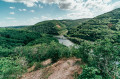
Circular route in the Our Valley starting from Vianden
 12.41 mi
+2,795 ft
-2,822 ft
8h 10
Difficile
Départ à Vianden (Luxembourg (Country))
12.41 mi
+2,795 ft
-2,822 ft
8h 10
Difficile
Départ à Vianden (Luxembourg (Country))
This hike combines two routes in the Our Nature Park.
Expect an elevation gain of around 850 metres.
Lake Sûre Trail Marathon
 25.21 mi
+4,396 ft
-4,380 ft
15h 25
25.21 mi
+4,396 ft
-4,380 ft
15h 25
 Tres difficile
Départ à Esch-sur-Sûre (Luxembourg (Country))
Tres difficile
Départ à Esch-sur-Sûre (Luxembourg (Country))
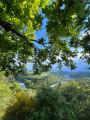
A demanding 40 km marathon trail around Lake Sûre (1350 m elevation gain/loss) in the heart of Luxembourg's wild landscapes. A technical and varied circular loop, highly recommended for trail shoes. Start and finish in Esch-sur-Sûre to enjoy a good meal or a well-deserved drink at the end of the course.
Option to complete the route in two days: see details in "Description".
Bettendorf, the Sure and its forest
12.44 mi
+1,522 ft
-1,496 ft
7h 05
Moyenne
Départ à Bettendorf (Luxembourg) (Luxembourg (Country))
A lovely hike along the Sure river offering numerous viewpoints. Around 40% of the route is through forest, making it particularly suitable in spring and autumn.
I completed the hike in 5½ hours with a 50-minute break.
Wiltz Castle and its surroundings
 8.19 mi
+1,175 ft
-1,165 ft
4h 45
Moyenne
Départ à Wiltz (Luxembourg (Country))
8.19 mi
+1,175 ft
-1,165 ft
4h 45
Moyenne
Départ à Wiltz (Luxembourg (Country))
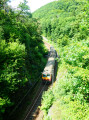
Wiltz, the capital of the Luxembourg Ardennes, has a beautiful Renaissance-style castle and is an ideal starting point for hiking.Numerous marked trails (circular or not) allow you to explore the region in complete safety.
Nommerlayen
 2.92 mi
+446 ft
-466 ft
1h 45
Facile
Départ à Larochette (Luxembourg (Country))
2.92 mi
+446 ft
-466 ft
1h 45
Facile
Départ à Larochette (Luxembourg (Country))
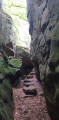
A leisurely walk through the rock fissures of Nommern with a gentle return via wide forest paths.
Clervaux and the Irbich Valley
 6.25 mi
+1,060 ft
-1,050 ft
3h 50
Moyenne
Départ à Clervaux (Luxembourg (Country))
6.25 mi
+1,060 ft
-1,050 ft
3h 50
Moyenne
Départ à Clervaux (Luxembourg (Country))
A climb from Clervaux to a superb view of the abbey bell tower and the valley, then a route mainly through forest, finally returning along the Irbich river on country roads or dirt tracks.
You can shorten the walk by continuing from (6) to Drauffelt station (6 km in total) and returning by train (free on the GDL).
Mullerthal Trail ExtraTour A
 13.95 mi
+1,837 ft
-1,841 ft
8h 00
Difficile
Départ à Larochette (Luxembourg (Country))
13.95 mi
+1,837 ft
-1,841 ft
8h 00
Difficile
Départ à Larochette (Luxembourg (Country))
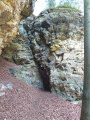
From Larochette, you cross the forest towards Meysembourg Castle. The path then leads through beautiful countryside of meadows and fields towards the rock formations at Nommerlayen, which are very well known in the region. From the village of Nommern, you pass through the Seitert Forest to Medernach, before returning to Larochette via a section of the Mullerthal Route 3.
More walks in Bourscheid (Luxembourg)
Select a point of interest below: