Country:

 City:
City:


The starting point is at the edge of the RD57 at the entrance to a wide path on the left, just after the Col du Fer à Cheval. It is possible to park (hunting car park) without obstructing traffic on the D57 or on this path.
GR®36 signposting
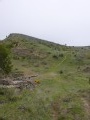
(S/E) Take the dirt and gravel path that remains level, then descends through heath and a few vineyards.
(1) Leave the main path descending towards Comigne and turn right to stay on the marked path. Climb this other path for 650 m to an altitude of about 300 m and a T-junction.
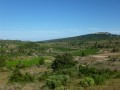
(2) Continue to the left. The carriageway (DFCI) climbs steadily through typical Mediterranean vegetation to an altitude of 450 metres. The slope then steepens until you reach the intersection with a track coming from the left.
(3) Stay on the main track and continue climbing at a gentler gradient.
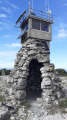
(4) Reach the DFCI watchtower by completing the climb with a semi-circle to the left after the signposts with the GR®36 on the right and the GR®77, which you should follow almost to the lookout (it branches off to the right 50 m before).
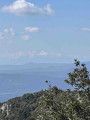
(5) Enjoy the 360° panorama: to the south, the Pyrenees mountain range (closest to Madrès and Canigou), the Corbières (including the Tuchan promontory and its wind turbines); to the north: Carroux, Montagne Noire; to the west: Alaric and the Carcassonne plain; and on the eastern horizon, the Mediterranean Sea. Head south down the stone path to rejoin the initial uphill track below.
(4) Follow it to the left for a few dozen metres to reach the crossroads.
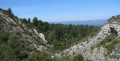
(6) Follow the very stony path on the right towards Lagrasse on a flat rocky plateau. When it ends, begin the descent with the Corbières and the Pyrenees in your sights. Be careful on the descent as the slope and the stones and pebbles on the path can cause you to slip and slide.
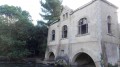
(7) When you reach a small flat area, make a quick detour to see the two walls of the ruined priory of Saint-Michel de Nahuze. Then pick up the GR®36 trail again. The path remains very stony, winding its way through boxwoods, holm oaks and other pines, and the slope becomes steeper and steeper as you descend (more than 20% on the last kilometre). The path does not have any vertiginous passages (I am very sensitive to this), but the view of the road 300 metres below can be impressive, especially as this is the point to reach. At the end of the steepest section, turn right. The stones on the path give way to earth: take care when the path is wet, even though the slope becomes gentler on this last part of the descent. The descent ends when you reach the RD114, where small signs remind you that the GR®36 links La Manche to the Pyrenees or vice versa, depending on the direction you are walking.
No markings
(8) Leave the GR®36 and turn right onto the RD114 to climb up the Gorges du Congoust. The road is winding but little used: nevertheless, take care .
(9) After 3.5 km on tarmac, and after crossing yet another dry valley, turn right onto a dirt track that runs alongside vineyards, then turn right and then left to go around another vineyard and join an unpaved communal track.
(10) Continue left on this road until you reach a T-junction 350 m further on.
(11) Continue right onto a communal road that crosses vineyards. Cross a shallow ford (the road is well above the stream) and arrive at a fork 400 m after the start of this section.
(12) Turn left onto another local road, still in the heart of the vineyards. At the foot of the hill, the road turns left, then left again to run alongside an intermittent stream. It finally joins another road at a Y-junction.
(13) Take the hairpin bend to the right to climb up through the vineyard. At the end, the path veers left and joins the RD67.
(14) Turn right carefully onto the uphill road and, after 1,200 metres, you will return to the car park (S/E).

 Visorando Member
 Easy
Easy