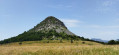
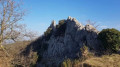
Baume-Cornillane loop, the keep, the Grotte de la Dame

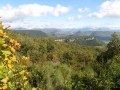
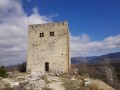
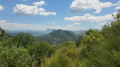
From the centre of the world (Pangaea) before continental drift, to the Middle Ages, via local legends about the cave that gave the village its name (Baume = cave in Provençal), this is a varied family walk starting from the charming village of La Baume-Cornillane: old stones, hidden paths, stunning landscapes, a stream and a petrifying waterfall (sometimes so petrified that it is dry!) and a remarkable cave.

Details

83433173
Creation:
Last update:
Last review:
  • Walking
    Activity: Walking
  • ↔
    Distance: 3.91 km
  • ◔
    Average duration: 1h 35 
  • ▲
    Difficulty: Easy

  • ⚐
    Back to start: Yes
  • ↗
    Ascent: + 153 m
  • ↘
    Descent: - 150 m

  • ▲
    Highest point: 401 m
  • ▼
    Lowest point: 316 m

Photos

Description of the walk

Park in the car park opposite the town hall in La Baume-Cornillane. See Practical Information.

Partial yellow-red signage

(S/E) With your back to the town hall, go to the signpost opposite the town hall, above the information board, on the right. Follow this small tarmac road, also GRP® "Tour des Monts du Matin", which climbs towards the feudal village. After about a hundred metres, the tarmac gives way to dirt and then arrives higher up at two houses.
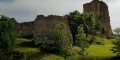
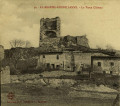
Turn right and then immediately left to follow the path that passes between the two houses. The trail enters a wood, leave a path on the left and continue climbing to reach a flat area. Turn right and then right again to climb up to the ruins ofthe 12th-century castle, including its remarkable keep, which offers beautiful views of the plain.

(1) Descend and head to the ridge where you will find an information panel about the centre of Pangaea. Turn left onto a path that runs along a line of rocks (you can choose between the path or the ridge, but it is safe either way). After about 100 metres, ignore a path that descends to the left and follow the path that slopes to the right, passing between the rocks. You will reach the Réservoir marker.

(2) Leave the path on the left at the fork and continue right towards Serre Perrier on the descending path. Pass a barrier and reach the road.
Turn left onto this road, heading south and descending. Just after the Rif farm on the left, you will reach a crossroads.
Turn left onto Chemin de la Grotte, cross the Rif Bridge and reach the junction with a road on the left.
Follow this road uphill and immediately turn left onto a path that leads into the forest to reach the bed of the Rif stream.

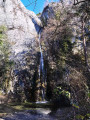
(3) Continue along this discovery trail, which runs alongside the Rif (dry in summer) and features information panels. Pass the clearing with the picnic tables. You will reach the petrifying waterfall or tufa formation (also dry in summer) and its pool.
Climb the path on the right, still in the forest, with a few rough earth steps, until you reach the metal staircase leading up to the Grotte de la Dame.

(4) After about thirty steps, you will reach the entrance porch and the cave's single chamber.
Return to the forest via the same path (or take a narrower path branching off to the left of the climb; the two paths meet at the waterfall). Retrace your steps to the previous crossroads.

(3) Continue to the Y-junction near the Rif farm. Take a different path from the one you took on the way there, turning left onto the road leading to the village centre. About 60 metres after the crossroads, you will see several paths on the right leading up to the hill of the old village.

(5) To avoid a long stretch of road, turn right onto the wide path that winds horizontally above the road (without going back up to the castle). Reach the village centre and the car park (S/E).

Waypoints

  1. S/E : km 0 - alt. 318 m - Car park opposite the town hall
  2. 1 : km 0.63 - alt. 396 m - Ruines du Château féodal de la Baume-Cornillane (Vieux Village)
  3. 2 : km 0.98 - alt. 396 m - Fork - Take the right fork
  4. 3 : km 2.18 - alt. 324 m - Junction - Turn left
  5. 4 : km 2.58 - alt. 358 m - Grotte de la Dame
  6. 5 : km 3.21 - alt. 321 m - Junction - Turn right and then left
  7. S/E : km 3.91 - alt. 318 m - Parking at the Marcel Maisonnat hall

Notes

The description is based on a family summer hike in mid-August 2025.

Parking at the start
In the centre of the village, below the Salle Marcel Maisonnat, there are around twenty parking spaces; this is an official car park, marked on road maps and village signage. It is free of charge.

Quality of trail maintenance
In August 2025, all the trails are perfectly maintained. Access to the ruins of the Old Village is greatly facilitated by perfect mowing. The ruins themselves have been made safe, and there is no danger in walking through the old streets and abandoned houses.

Time indicated
We completed this route in about 3 hours without rushing, including photo breaks.

Difficulty
Hike classified as Easy, Visorando rating.
The IBP Index is 32 HKG, which corresponds to an Easy difficulty route for a hiker with average physical fitness.

Variation

  • On the way back, at WP (5), you can climb up to the ruins of the feudal village by following a steep path northwards, then descend via the path between (1) and (S/E).
  • There are numerous paths on the mound of the feudal village ruins.

Water points
There are no drinking water points along the route, except in the village centre (cast iron fountain near the Town Hall). Bring at least 0.5 litres per person and/or a filter or purification tablets.

Shelter
There is no other shelter on the route except for the Grotte de la Dame (4).

Equipment
In summer, bring the usual equipment for hiking in the lowlands, light hiking or sports shoes, suitable clothing, possibly rainwear, sunglasses, hat, sun cream, UV-protective lip balm, etc.

Traffic
The trail was completely deserted in the middle of summer. Whatever the season, don't forget to tell your friends and family your exact route and inform them of any changes by text message or phone.

Check the weather forecast.

Maps
If you notice any errors in the signposting or place names on your route or on the map you are using, you can become a contributor and report them:
- marking errors, safety issues, usage conflicts, environment: click here.
- mapping errors, place names: click here.

Worth a visit

(4) Grotte de la Dame
In August 2025, a municipal decree dating from November 2022 prohibited the use of the staircase (deemed dangerous) and therefore access to the cave. It can only be admired from the foot of the staircase. The Mayor has indicated that it will be made safe by the end of 2025.

In 1562, Catherine de Cornillane, known as "La Dame", joined the Protestant Reformation. During the Wars of Religion from 1562 to 1598, the cave remained a refuge for Protestants until the Edict of Stream was issued on 13 April 1598 under Henry IV.

Protestant cemeteries
The revocation of the Edict of Stream in 1685 prohibited Protestant worship: excluded from public office and their temples, Protestants were also excluded from their cemeteries. The instructions from the King's council were clear: "His Majesty does not want there to be a designated place for the burials of those of the said religion, and everyone may bury them wherever they see fit." Royal ordinances further required that they be buried at night and without gathering. During the long years of the "Desert", Protestants who refused to convert buried their dead clandestinely, "in the land", in a field belonging to the family of the deceased (which only confirmed the Catholics' disgust for this "deformed religion").
Thus was born the tradition of family cemeteries: a few graves in a garden, a meadow, an uncultivated area, enclosed or not by walls. Cemeteries in open fields far from houses seem to have been enclosed from the outset, while those close to dwellings were more often open. Regions with a high Protestant population are literally dotted with such cemeteries, with cypress trees marking the graves near the houses.

The village remained attached to Protestantism and regained its place of worship in 1826.

Source: Le Jardin Le Clos Fleuri

(S/E) The village of La Baume-Cornillane

The village was established in the Middle Ages around an early Christian church, which became a Cluniac priory of Marcigny under the patronage of Saint Stephen and was fortified in the 11th century. The village adopted the Protestant religion in the 16th century.

(S/E) The Protestant temple of La Baume-Cornillane
It is remarkable to see a French village with only one place of worship, which is a Protestant temple rather than a Catholic church; this is linked to the history of the village. You will probably need to visit during service times to see it open, or during the Town Hall's opening hours to ask for the keys.

(S/E) La Baume-Cornillane, centre of the world? Pangaea?
We owe to the reflections of Dr Monod, from Crest, a geology enthusiast, the observation that, before "Laurasia" broke up and separated from "Gondwana", the centre of Pangaea, as it appears on Wegener's maps, could be located in the canton of Chabeuil. His friend Charles Regimbeau, a very active administrator at the Chabeuil Tourist Office, found the idea fascinating. All that remained was to materialise this centre of the original continent, dating back 2.45 million years, in the landscape.
After much deliberation, it became apparent that the largest, most vertical rock on the coast, in the Coquillon district (a place name referring to the Miocene marine fossils below the rock), could be a beautiful embodiment of Thierry Monod's idea.
With the owner's consent obtained and the municipality having accepted the principle, La Baume thus became symbolically the "centre of the world" or, at the very least, a place that evokes the genesis of the continents. And regardless of geographers' mistrust of any notion of a "centre", could there be a more beautiful recognition of the local tectonics: tilted and straightened, aren't the 30-million-year-old lacustrine "chatiens" limestones of the Côte a perfect illustration of the compression of the "Adriatic plate" against the "French plate" that led to the formation of the Alps?

Source: Municipal Bulletin, July 2021

Placenames
The word Baume means cave in Provençal. It comes from the Latin
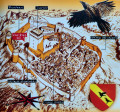
balma. Cornillane comes from Cornillans or Cornilhans, referring to crows, the emblems of the village's former lords.

Reviews and comments

4.5 / 5
Based on 2 reviews

Reliability of the description
5 / 5
Ease of following the route
4 / 5
Route interest
4.5 / 5
vb31
vb31

Overall rating : 4.3 / 5

Date of your route : Oct 13, 2025
Reliability of the description : ★★★★★ Very good
Ease of following the route : ★★★★☆ Good
Route interest : ★★★★☆ Good
Very busy route : Yes

short walk with a steep climb at the start and another near the cave.
to avoid the road, take the path heading south that descends from the castle ruins.

Machine-translated

MCTOUL
MCTOUL

Thank you, Julia, my pleasure 🤗
Same here, this summer there was no water at the waterfall...🥲
Kind regards

Machine-translated

JuliaM
JuliaM
• Edited:

Overall rating : 4.7 / 5

Date of your route : Sep 13, 2025
Reliability of the description : ★★★★★ Very good
Ease of following the route : ★★★★☆ Good
Route interest : ★★★★★ Very good
Very busy route : No

A beautiful hike, short but enjoyable, with magnificent views to the west (Ardèche, Crussol, Gerbier de Joncs, Mézenc, etc.), over the plains of Drome and Valence, and the foothills of Vercors.
The old feudal village is magnificent, and the pleasant path alternates between open views and woodland.
Access to the Grotte de la Dame is closed. The path to get there is a little steep and requires caution on the descent.
The tuff waterfall is superb but there is no water, sniff.
Thank you for your very detailed description. I highly recommend it!

Machine-translated

Other walks in the area

For more walks, use our search engine .

The GPS track and description are the property of this route's author. Please do not copy them without permission.