Circular Chamblanc, via Pagny-la-Ville, the banks of the Saône and the plain

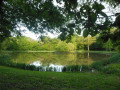
Fellow walkers, this walk starting from the village of Chamblanc will take you through the villages of Lechâtelet and then Pagny-la-Ville along the banks of the Saône. The return route follows the flatlands back to Chamblanc. Avoid this walk in hot weather as there is little shade along the route.

Details

85427787
Creation:
Last update:
Last review:
  • Walking
    Activity: Walking
  • ↔
    Distance: 20.43 km
  • ◔
    Average duration: 5h 40 
  • ▲
    Difficulty: Moderate

  • ⚐
    Back to start: Yes
  • ↗
    Ascent: + 6 m
  • ↘
    Descent: - 6 m

  • ▲
    Highest point: 188 m
  • ▼
    Lowest point: 177 m

Photos

Description of the walk

Head to the village of Chamblanc, located north of the town of Seurre. Park in the village on Rue Anne-Marie Javouhey.

(S/E) Head south to the junction of Rue Anne-Marie Javouhey with Rue des Bois and Rue des Prés. Turn right onto Rue des Prés to leave the village via the D34. Cross the bridge over the Saône Diversion Canal and continue for about 300 m.

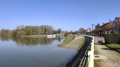
(1) Leave the D34 and take the path on the left to reach the canal bank. Follow the canal, turn right as you leave it, pass under the power lines and arrive at a stone bridge on the banks of the Saône.

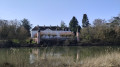
(2) Continue along the riverbank. As you go, note the Château de Pouilly-sur-Saône on your left.

(3) Pass under the A36 motorway, continue straight on along the Saône on the grassy path. Stay along the river as it meanders and arrive at an altitude of 177 at a place called l’Épenoi.

(4) Leave the banks of the Saône, turn right and head towards the houses. Join a tarmac road running alongside the river. Follow it to the right until you reach the village of Lechâtelet.

(5) At the green-coloured maintenance shed, keep left and continue along the grassy path. Pass by the campsite (a possible picnic spot) and continue to the water-skiing centre.

(6) At the Île de Barboura bridge, turn right onto Rue de l'Issue, then continue along Rue de la Grande Cour. Leave the village of Lechâtelet and head towards Pagny-la-Ville via the greenway.

(7) At the entrance to the village, take a stony path on the right, Rue du Pré d'Héé. At the next junction, turn left into Ruelle du Pré d'Héé. At the end of this lane, at Rue Truchot, turn right.

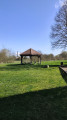
(8) At the stop sign on Rue Truchot, head left onto Rue de l'Église, pass the town hall, and at the junction with Grande Rue, continue straight on towards the church. At the church, turn left onto Rue de l'Abreuvoir and head for the picnic area behind the church. Shelter available.

(9) Continue round the church and head towards Ruelle du Sous-Préfet. Turn right towards Rue de la Place and continue onto Grande Rue. At the junction, first turn left then right and continue along Rue de la Croix de Mission to leave the village.

(10) On leaving the village, at the first crossroads with a wayside cross on the left, take the grassy path on the left towards the Bois du Pont des Vèvres. This grassy path turns into a white, carriageable track. Continue straight on until you reach a road just past the hamlet of La Marosse.

(11) Turn left, cross the bridge over the diversion canal and arrive at a roundabout.

(12) At the stop sign, turn right to rejoin a dirt track running alongside the diversion canal. Follow this track until you reach the A36 motorway.

(13) Go under the motorway and continue on to Chamblanc. In the village, take the first street on the right, Rue Mauchamps, to reach theRomanesque Churchof the Nativity of the Virgin, which is worth a visit if it is open.

(14) Continue along Rue de l’Église and turn left into Ruelle de l’Église. At the end, turn right into Rue Anne-Marie Javouhey to reach the car park (S/E).

Waypoints

  1. S/E : km 0 - alt. 182 m - Parking on Rue Anne-Marie Javouhey
  2. 1 : km 1.15 - alt. 181 m - Junction on the path to the left
  3. 2 : km 2.9 - alt. 178 m - Stone bridge. - La Saône
  4. 3 : km 4.62 - alt. 178 m - Passage under the A36 motorway
  5. 4 : km 8.36 - alt. 177 m - Fork in the road
  6. 5 : km 9.81 - alt. 179 m - Lechâtelet
  7. 6 : km 11.05 - alt. 182 m - Sailing boat
  8. 7 : km 13.05 - alt. 180 m - Fork in the road
  9. 8 : km 13.4 - alt. 183 m - Stop
  10. 9 : km 13.75 - alt. 180 m - Picnic area
  11. 10 : km 14.42 - alt. 180 m - Calvary
  12. 11 : km 16.48 - alt. 181 m - Road junction
  13. 12 : km 17.31 - alt. 183 m - Roundabout.
  14. 13 : km 18.57 - alt. 180 m - Passage under the A36 motorway
  15. 14 : km 20.09 - alt. 180 m - Church of Chamblanc
  16. S/E : km 20.43 - alt. 182 m - Parking on Rue Anne-Marie Javouhey

Worth a visit

Chamblanc is a charming village situated on the left bank of the Saône near Seurre. The village had a complex history in the 13th century, when it was divided into four seigneuries. The last lord was Nicolas Jannon.

The Romanesque Church of the Nativity of the Virgin, built of stone and brick, is considered one of the oldest in the Côte-d’Or. It is dominated by a curious, slender bell tower. It was built in the 12th–13th centuries and altered in the 17th, 18th and 19th centuries. Inside, two large columns from the gallery frame the entrance, whilst one is surprised to see a basket-handle vault. Among the stained-glass windows, a series depicts scenes from the life of Anne-Marie Javouhey. ) Taken from the book *Un curieux en balade*by André Beuchot.

Anne-Marie Javouhey, born on 10 November 1779 in Jallanges, Burgundy, and died on 15 July 1851 in Paris, was the founder of the Congregation of the Sisters of Saint Joseph of Cluny.

Anne-Marie Javouhey was born into a family that would eventually have ten children (four of whom died young). In the midst of the French Revolution, she consecrated herself to God during a clandestine mass. As a teenager, she taught the poor children of her village, Chamblancet, and the surrounding area. She also gave catechism lessons and prayed at length before the family oratory located in the garden.

After seeking her calling within various religious congregations, she was encouraged by the Bishop of Autun to draw up, in 1804, the rules for a new pious union bringing together a few young women, as well as her three sisters, who took their vows together at the Church of Saint-Pierre in Chalon-sur-Saône in 1807. This marked the birth of a new congregation, under the patronage of Saint Joseph, dedicated to caring for poor children

Chamblanc is home to one of the three ‘Forests of Remembrance’ in the south-east, near a small pond, comprising 150 trees planted in Chamblanc, Jallanges and Seurre, in tribute to the first 150 Guyanese slaves freed by Anne-Marie Javouhey in 1838, ten years before the abolition of slavery. Each tree bears the name of a slave.

Other walks in the area

For more walks, use our search engine .

The GPS track and description are the property of this route's author. Please do not copy them without permission.