Circular starting from Lachapelle-sous-Rougemont

Discover a splendid circular hiking loop starting from Lachapelle-sous-Rougemont in the Belfort gap, on the border with Alsace, 15 kilometres north-east of Belfort.

You will admire landscapes of cultivated fields, meadows and magnificent forests, not to mention the stork nests at Petitefontaine.

You can stop for refreshments at Lac de la Seigneurie.

Enjoy exceptional views of the Southern Vosges mountain range and the Swiss Jura.

Ideal for walking enthusiasts keen to discover the region's natural and cultural heritage.

The route is signposted.

Details

89284239
Creation:
Last update:
Last review:
  • Walking
    Activity: Walking
  • ↔
    Distance: 10.20 km
  • ◔
    Average duration: 3h 00 
  • ▲
    Difficulty: Moderate

  • ⚐
    Back to start: Yes
  • ↗
    Ascent: + 35 m
  • ↘
    Descent: - 35 m

  • ▲
    Highest point: 415 m
  • ▼
    Lowest point: 380 m

Description of the walk

Departure from the stadium in Lachapelle-sous-Rougemont.

The route is marked with a red ring.

(S/E) From the stadium car park, head towards the stadium, pass to the right of the hut near the children's playground, and enter the forest. Cross the Canal du Moulin on a beautiful footbridge.

(1) Turn right onto a wide path, passing a farm where you can see goats and sheep. There are several information boards describing the fauna, flora and agriculture in the department.

(2) Turn right when you reach the tarmac road. Turn left when you reach the D11. Be careful of traffic.

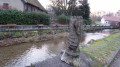
(3) Follow this road along the Saint-Nicolas River, pass the town hall, and look for the decorations and information boards just before the bridge. Admire the beautiful waterfall.

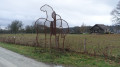
(4) Cross the bridge and turn left. Follow the D15 towards Rougemont-le-Château. Look for the old farming tools on display near the river.

(5) Turn right onto the path just before the pumping station. Turn right again and follow the path to a small wood.

(6) Then leave the path on the left and continue right on the path that crosses a beautiful meadow. Walk along the Étang Bouchon pond and continue into the forest. In wet weather, the path may be muddy. Continue straight ahead until you reach the road (D14 BII).

(7) Cross it and turn right, walking carefully as cars drive fast on this stretch. Leave the road by turning left near a large sign describing the hikes. Continue along the path, turn right when you reach the high-voltage power line, then further on to the left. Keep an eye on the markings, which are very useful. The route arrives in Alsace. Look out for the old blockhouses dating from the 1914-1918 war on the right. Be careful, you have to look closely as they are protected by piles of earth.

(8) Turn right at the first crossroads after the blockhouses. Continue along the wide path, ignore the path on the left and continue straight ahead. At the next crossroads, turn right and cross a small stream. The route returns to the Belfort area and leaves the forest.

(9) After leaving the forest, turn left at the crossroads and follow the hedge. Enter the Bois Denier and, at the next crossroads, continue straight ahead. The path is winding. It turns right, then left. Don't forget to enjoy the view of the Vosges mountains and the Swiss Jura massif.

(10) At the crossroads, turn right, at the next one continue straight ahead and further on, turn left and continue towards Lachapelle-sous-Rougemont.

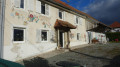
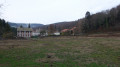
(11) Turn right at the crossroads just before you reach the village. Admire the beautiful view of the village and the church.

(12) At the crossroads, turn left onto a small path. Keep an eye on the markings. Cross the Rivière Saint-Nicolas, walk along the meadow, cross the D11 carefully , and continue along Rue du Stade to arrive at the starting point (S/E).

Waypoints

  1. S/E : km 0 - alt. 380 m - Stade, Allée du Stade in Lachapelle-sous-Rougemont
  2. 1 : km 0.24 - alt. 389 m - Wide gravel path
  3. 2 : km 0.78 - alt. 393 m - Route Rue du Bois Devantn D11
  4. 3 : km 1.25 - alt. 386 m - D11
  5. 4 : km 1.53 - alt. 389 m - Bridge over the - Saint-Nicolas (rivière) - Affluent de la Bourbeuse
  6. 5 : km 2.03 - alt. 393 m - Path to the pumping station
  7. 6 : km 2.68 - alt. 394 m - Bois
  8. 7 : km 4.59 - alt. 414 m - Route D14 BII
  9. 8 : km 5.43 - alt. 414 m - Crossroads after the blockhouse
  10. 9 : km 6.75 - alt. 411 m - Crossroads after leaving the forest
  11. 10 : km 8.27 - alt. 400 m - Crossroads in the middle of the fields
  12. 11 : km 9.67 - alt. 382 m - Crossroads on arrival at the houses
  13. 12 : km 9.98 - alt. 387 m - Crossroads along the pastures - Saint-Nicolas (rivière) - Affluent de la Bourbeuse
  14. S/E : km 10.2 - alt. 380 m - Stade, Allée du Stade in Lachapelle-sous-Rougemont

Notes

Departure from the stadium in Lachapelle-sous-Rougemont in the Territoire de Belfort.

It is possible to start the route at Lac de la Seigneurie. In this case, start at (7) or Petitefontaine at (4).

In wet weather, the path can be muddy, particularly between (4) and (7).

After the point (7), there is a campsite and a café-restaurant at Lac de la Seigneurie.

This route was developed by the services of the Territoire de Belfort department in partnership with the Community of Communes of the Southern Vosges (CCVS). It was marked out in 2025.


Visorando was informed by Mr Chevalley, a volunteer member of Balisage90.

Worth a visit

The Saint-Nicolas rises at an altitude of 800 m near the Ballon de Saint-Nicolas. It is 30 km long and passes through thirteen villages. It joins the Madeleine at Autrechêne to form the Bourbeuse.

Petitefontaine. Toponymy : Brun (1576), Dz dorff Brun (1628), Petite Fontaine (1793), Petite-Fontaine (1801), Petitefontaine (1962). In German: Klein-Brunn.
The name of the village was first mentioned in 1388. At that time, it was probably already attached to the parish of Angeot and was part of the seigneury of Rougemont. After the war of 1871 and the implementation of the Treaty of Frankfurt, Petitefontaine was detached from the canton of Masevaux along with the other communes of Rougemont, Leval and Romagny. Source: Wikipedia.

Petitefontaine is beautifully decorated. You can see many old farming tools and a wooden seahorse sculpture. The area around the bridge over the Saint-Nicolas is beautifully presented. Well done to the volunteers.

Storks: with its many ponds and marshes, the region is ideal for observing storks. In 2024, there were 80 pairs in the Territoire de Belfort. There are many nests in Petitefontaine.

Lachapelle-sous-Rougemont. Toponymy : Capella (1214), Ecclesiam de villa que Capella nuncupatur (1234). À la Chapelle vers Roigemont (1295), Capel (1576), Capplen (1579). In German: Welschen Kappelen.
Its inhabitants are called Chapelons.
The name of the village Capella is mentioned as early as the end of the11th century. At that time, it was part of the seigneury of Rougemont. Lachapelle was a post house and a popular stopover lodge. During the Restoration, a minor seminary was established in 1818, which operated until the war of 1870. It became a free college in 1873 and, in 1882, welcomed around 300 Alsatian pupils who came to study in French to escape the Germanisation of their province. It was undoubtedly the consumption of beer by travellers in the many inns in the locality that prompted the Grisez family to build a brewery at the entrance to the village from Belfort in 1835. From 1893 to 1961, a forging workshop, Établissements Woerlin, manufactured shuttle tips for looms.
In 1914, Lachapelle was connected to Belfort by a branch of the local metre-gauge railway line via Les Errues. At the start of the war, the line was extended by military engineers to the Alsatian village of Sentheim. The trains were pulled by electric locomotives, which were quieter than steam engines and would have been immediately spotted by the nearby enemy.
Source: Wikipedia.

Other walks in the area

For more walks, use our search engine .

The GPS track and description are the property of this route's author. Please do not copy them without permission.