Country:
 City:
City:


(S/E) At the port, at the Tourist Office hut, head south-west towards the village. Pass the bike rental shops (Le Cycle Porquerollais).
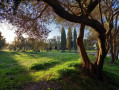
(1) Turn right onto Rue de la Ferme. This road runs alongside Place d'Armes, a large dirt field lined with eucalyptus trees, at the end of which you can see the church.
Follow the signs for "Le Phare". The road slopes gently southwards, passes the primary school and, after the last shops, becomes Route du Phare-Ché du Cap d'Armes, passing rows of old farm workers' houses on both sides, now converted into homes.
Very quickly, it becomes more of a track than a road. It runs alongside the Garonne, which has been channelled for about a hundred metres.
It then passes between vineyards and olive groves. Continue straight ahead at the Carrefour des Oliviers.
Less than 1.5 km after passing the Place d'Armes, you will see the sewage treatment plant's lagoon basins on your right, lined with reeds.
You can just see the top of the lighthouse rising above the treetops on your left.
(2) At the crossroads at the end of the last basin, turn left through the forest, slightly uphill. Continue along this road.
This climbs in hairpin bends towards the Cap d'Armes lighthouse. Leave the buildings of a former holiday camp (or garrison?) on your right and immediately afterwards continue along the Route du Phare, turning 90° to the left.
(3) You will reach the Porquerolles lighthouse.
Although the lighthouse platform has been inaccessible for several years, you can still go to the entrance gate of the small fort and lighthouse tower.
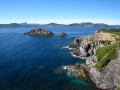
You can admire the landscape of Cap d'Armes a little below the last access road to the lighthouse.
NB: contrary to other comments on certain published walks, the Porquerolles Lighthouse is a must-see for anyone who wants to soak up the island atmosphere of Porquerolles, imagine the warships of all ages rounding this point and trusting the light of the sailors, or coming to anchor in the nearby creeks to shelter from bad weather! And you can't visit an island without seeing its lighthouse!
Then retrace your steps a few hundred metres to the water treatment plant basin.
(2) Then turn sharply left onto the Gorges du Loup trail (well signposted).
The path narrows through the Mediterranean scrub and eventually opens onto a clear esplanade facing the sea.
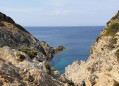
(4) Continue to the end of the esplanade until you see the bottom of the Gorges du Loup.
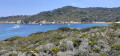
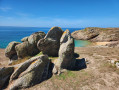
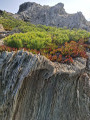
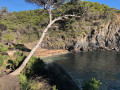
This is a long, narrow fault in the schist rock. Don't hesitate to climb down to the bottom of the gorges, at the edge of the sea, where the water is shallow. Several fairly flat rocks provide a place to sit and sunbathe.
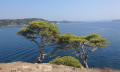
After your break, take the path heading east. This is the "Sentier des Falaises" (Cliff Path), which was built in the 18th century. It offers remarkable views of the sea, the cliffs and the creeks.
Just follow the signs for "Vigie" and "Le Langoustier".
(5) You will reach the highest point of Mont de Tiélo at an altitude of 107 metres, before descending via several hairpin bends to the Calanque du Brégançonnet.
(6) Leave the clear path on your right that leads to the Brégançonnet farm and continue by entering the scrubland again, slightly to the right and then immediately to the left.
Continue to follow "Le Langoustier". Cross the stream bed (usually dry) that flows into the Calanque du Brégançonnet.
Leave the cistern and the path that leads to the Pointe du Brégançonnet and its 44-metre peak on your left. A few metres further on, at a three-way junction, leave the wider path that continues to the right towards Argent beach, and turn left towards Mont d'Esterly and Le Langoustier, following the cliff path.
(7) Go around Mont d'Esterly (87 m) to the north, making sure to stay on the cliff path and not take any of the numerous paths (in varying states of repair) that lead inland.
Head towards Mont Sarat (72 m).
(8) Continue to the Pointe des Carrières.
The trail then disappears from the map, but not from the terrain.
Walk about 250 m west along the cliffs, then about 450 m north in a southerly direction.
This will take you to the entrance of Mas du Langoustier.
(9) You will arrive in front of the entrance to the farmhouse. Turn right onto the access road/track (Circuit du Couchant according to OpenStreetMap randonnée Monde) and go through the gate to exit onto the road.
In the 18th century, there was a soda factory here.
Continue east on this road.
(10) You will soon reach the Col du Langoustier (not mentioned on maps).
You can either head straight to Plage d'Argent or even the village, or take the ridge road, which only adds a few hundred metres and offers breathtaking views of the harbours of Porquerolles and Hyères. The latter route is described here.
At the pass, immediately head towards Plage des Maures on the left as you climb. Then, in the hairpin bends, do not head towards Plage du Grand Langoustier (western tip of the island), but go around the 79-metre-high hill to the west for a few dozen metres, heading due north.
(11) Just before the cistern (which you leave on your left), turn sharply right, heading east.
(12) The path passes at an altitude of 74 m (called "Le Parapluie", site of an old landmark built in 1899), then descends gently towards Plage d'Argent.
At the junction with the track that runs from the village of Porquerolles to Grand Langoustier (Chemin du Langoustier), cross it and take the path opposite.
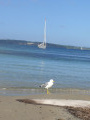
(13) The trail leads to Plage d'Argent, opening onto the stretch of sea between Porquerolles and the mainland, called Rade d'Hyères, the scene of famous regattas.
There, a network of more or less well-maintained paths in the sand runs parallel to the beach, avoiding the track and its dust for about a hundred metres.
Go behind the beach restaurant, then cross the wooden bridge, leave the transformer ("Tf." on the IGN map) on your left and turn right to join the Chemin du Langoustier track.
Follow the signs to return to the village via the same track, skirting the southern side of the Porquerolles harbour cove.
(S/E) This will take you back to the starting point of the hike.


 Visorando Member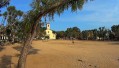

 Difficult