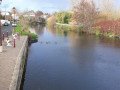
A walk along the banks of the Mère

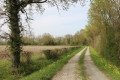
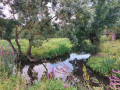
A pleasant walk through a marshy area to the east of Épannes. It appears that the Marquis de Cugnac developed the Mère and the Courance. He also donated several marshes, which were then used as communal pasture or cultivated marshes. This route allows you to discover all these developments and the state of this area, which varies greatly between marshes, woods and bocage.

Details

3176868
Creation:
Last update:
Last review:
  • Walking
    Activity: Walking
  • ↔
    Distance: 7.06 mi
  • ◔
    Average duration: 3h 15 
  • ▲
    Difficulty: Moderate

  • ⚐
    Back to start: Yes
  • ↗
    Ascent: + 20 ft
  • ↘
    Descent: - 20 ft

  • ▲
    Highest point: 85 ft
  • ▼
    Lowest point: 56 ft

Photos

Description of the walk

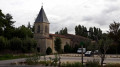
Set off from the car park at Place de l’Église, alongside the cemetery.

(S/E) Leave the car park by heading north of Sainte-Madeleine Church and taking the Allée du Château eastwards. Turn onto the first road on the right behind the church’s apse. A little further on, the road passes a tennis court on the left-hand side. Continue to a junction with a farm track just after the pumping station. Turn left and continue to a four-way junction nearby.

(1) Turn left onto the farm track heading north-west alongside an intermittent stream on your left. Pass through a barrier preventing motor vehicles from passing near a body of water and follow the Courance after the track has made a right-angle bend.

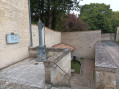
“On the left-hand side of the track, via a very ‘homespun’ bridge made of two fibre-cement posts, you’ll come across La Pelle
à Cugnac, named after the local lord. It is a weir built to divert the Mère towards Épannes.
It is a upper-leat, with the weir raising the river’s level. On its left bank, the river flowed down to power the village’s old mill, with a 2-metre drop providing the driving force to make it
, whilst on its right bank it resumes its normal course.” (extract from the walking guide “A Walk along the Mère” published by the Deux-Sèvres Departmental Hiking Committee)''.

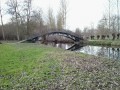
Further on, the path takes another right-angle bend to the right and follows the Courance or the Mère. This leads towards the Grand Marais area on the left-hand side. Continue to a further right-angle bend to the right.

The waterways are lined with pollarded ash trees, whose ‘crowns’ are cut every 6–7 years to provide firewood. The roots, which form a dense, deep network, stabilise the banks. There are also numerous poplars.

(2) Turn right and continue straight on along the path, which winds its way to the first forest track on the left, just before the Leat du Lac. Turn left onto this track, which runs alongside the Leat du Lac before veering away from it further on. The track then forms a sort of ‘S’ shape – first turn right then left – before turning at a right angle to the right, then winds through the Rivière area before reaching the Route de Vallans (D118).

(3) Turn left and follow the D118 carefully towards Fougerit. Cross La Fenée, then leat, and immediately turn right onto Rue du Chasserat. Pass through the village of Fougerit, see the old mill and continue towards the hamlet of Chasserat to the east of the village.

(4) As you approach Chasserat, the road bends to the right, crosses the leat and passes through the hamlet. It then crosses the Courance or the Mère, before winding its way south-east. Continue to the junction with a road, known as Rue de l’Huilerie, on the right.

(5) Turn right onto Rue de l’Huilerie, which heads south-west towards the Bois des Touches. Cross the Bois des Touches and continue to the hamlet known as Les Touches. Walk through the hamlet along Rue de l’Huilerie. Continue straight on until you reach a T-junction. Carry on straight ahead, still heading south-west along Rue du Leat du Lac, until you reach a junction of three roads and a farm track nearby (about 150 m away).

(6) Turn right onto the farm track known as Chemin des Pierres Rouges. Further on, cross the D118 with care and continue straight ahead towards the hamlet of La Barrière along Rue du Marais. Pass La Barrière on your left and continue to the next junction.

(7) Turn right onto Rue du Marais and, at a Y-junction with a farm track in front of the hamlet known as La Grève, take the left-hand track which winds its way before running alongside the Leat du Lac heading westwards. Continue to a junction of canals, including the Leat du Lac.

(8) The track turns left at a right angle and heads south. Pass between the Marais area on your right and the Chiron Danié area on your left. Further on, the track turns right at a right angle and rejoins the junction you passed on the way out.

(1) Return to the starting point via the same route, but in the opposite direction. Turn left at the fork and, at the next junction, opposite the pumping station, turn right onto the farm track/road leading towards Épannes and its castle. Follow the track until you can turn left onto the Allée du Château and reach the Place de l’Église on the left, near the cemetery (S/E).

Waypoints

  1. S/E : mi 0 - alt. 66 ft - Church car park
  2. 1 : mi 0.6 - alt. 62 ft - Junction of farm tracks. Towards the - Courance (rivière) - Affkuent du Bief de la Blaizé
  3. 2 : mi 1.84 - alt. 62 ft - Bend in the forest track
  4. 3 : mi 2.85 - alt. 72 ft - Junction of the farm track and the D118 road
  5. 4 : mi 3.49 - alt. 82 ft - Junction of road and footpath near Chasserat
  6. 5 : mi 3.89 - alt. 82 ft - Crossroads
  7. 6 : mi 4.68 - alt. 85 ft - X-shaped crossroads after Les Touches
  8. 7 : mi 5.21 - alt. 75 ft - Junction of Rue du Marais and Rue des Terres Rouges
  9. 8 : mi 6.06 - alt. 59 ft - Leat Crossroads
  10. S/E : mi 7.06 - alt. 66 ft - Church car park

Notes

This walk, which takes place over varied terrain, requires sturdy footwear.

This route is signposted as it follows the ‘Balade au bord de la Mère’ route published by the Deux-Sèvres Departmental Hiking Committee. It is signposted in yellow. Nevertheless, it is advisable to follow the instructions in this description and on the map, whilst also paying attention to the surrounding landscape. Distance markers from the starting point, and even the GPS coordinates of waypoints (including the start), can also help hikers find their way.

Hike completed by the author on 28 March 2022

Worth a visit

Épannes
Situated on the ancient Roman road from Saintes to Angers, the village of Épannes is thought to have been founded by barbarians (possibly Spanish armed bands) between the 3rd and 5th centuries, during the late Roman Empire.
Ruled successively by the Franks, the Carolingians and then the Capetians, Épannes came under English rule around 1150, before returning to the Kingdom of France in 1225.
The commune is home to fiefdoms such as ‘La Chapelle’ (suggesting the existence of a religious building?) and ‘La Martellerie’ (a name thought to derive from the passage of Charles Martel?).

From Hyspania to … Épannes:
The name of Épannes has undergone numerous changes. Known as Hyspania in 1243, then Espania in 1245, the village was subsequently called Hyspanice, Panes, Espanes (1425) and Les Panes (1493). Cassini’s maps (1800) refer to the village as Épannes.

Historic sites and heritage:
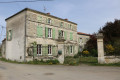
The church, dedicated to Saint Mary Magdalene, dates from the 14th and 15th centuries.
The Hosanna cross, situated in the present-day cemetery, was erected in 1603.
The washhouse, built in 1912, was renovated during major works in 1994.

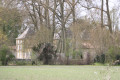
The seigneury of Épannes has been known since the 12th century; its owner was the Lord of Béchillon. The present castle was built in the 18th century using stones from a neighbouring castle that disappeared after the Revolution, the Château d’Aitz. Only the outbuildings and a dovecote with 1,062 nesting boxes predate it. After passing through the hands of various owners, it came into the possession of the Cugnac family in the mid-19th century.
Source: the town’s official website.

Situated on the old Poitiers–La Rochelle royal road, the commune of Épannes lies on the route of a Roman road linking Poitiers to Saintes. It is situated in the Courance Valley. For a long time, life was
centred on the river and its power.
In Poitou, the term ‘courances’ is used to refer to streams that are heavily dependent on rainwater. Along the Courance, several leats supply the neighbouring villages, and the river takes on other names such as La Mère, Le Vivier and La Petite Ronde.
Source: walking guide ‘A stroll along the banks of La Mère’ published by the Deux-Sèvres Departmental Committee for Hiking.

Reviews and comments

4.5 / 5
Based on 4 reviews

Reliability of the description
4.5 / 5
Ease of following the route
4.8 / 5
Route interest
4.3 / 5
PAQUITO 85
PAQUITO 85

Overall rating : 4.3 / 5

Date of your route : Jun 22, 2026
Reliability of the description : ★★★★☆ Good
Ease of following the route : ★★★★★ Very good
Route interest : ★★★★☆ Good
Very busy route : Yes

A very pleasant first section, in the shade and running alongside La Mère. As the route starts by the lake, you can plan to have your picnic either before or after the walk.
We came across several groups of cyclists, but this didn’t cause any problems.
The second section, starting from point 3, is less interesting, with tarmac roads.
Please note: just before point 8, the route requires you to go straight on rather than taking the slight detour.

Machine-translated

kartavan
kartavan

Overall rating : 4.3 / 5

Date of your route : Sep 14, 2024
Reliability of the description : ★★★★☆ Good
Ease of following the route : ★★★★★ Very good
Route interest : ★★★★☆ Good
Very busy route : No

A lovely walk through woods, forest and marshes in glorious sunshine.
A great way to start our week’s holiday.

Machine-translated

randonnée79270
randonnée79270

Overall rating : 4.3 / 5

Date of your route : Oct 14, 2022
Reliability of the description : ★★★★★ Very good
Ease of following the route : ★★★★☆ Good
Route interest : ★★★★☆ Good
Very busy route : No

A superb hike in glorious weather. I’d recommend it

Machine-translated

Falbala
Falbala

Overall rating : 5 / 5

Date of your route : Oct 08, 2022
Reliability of the description : ★★★★★ Very good
Ease of following the route : ★★★★★ Very good
Route interest : ★★★★★ Very good
Very busy route : No

The walk is very pleasant, particularly through the marshland and along the course of the River La Mère. What a joy it was to arrive straight away at the picnic area by the Epannes lake. We followed this route as a continuation of the “Le Bois des Touches” route in the commune of Vallans. As a result, we were walking the route in the opposite direction to that which was signposted and recommended. We rejoined the Vallans route at point 6, south of Les Touches.

Machine-translated

Other walks in the area

For more walks, use our search engine .

The GPS track and description are the property of this route's author. Please do not copy them without permission.