Cléville
- Before arriving at the Calvary and the Virgin Mary statue, notice the old nail-studded tiles that are very typical of old walls, protecting them from moisture.
- In the village, note the very old half-timbered houses, some of which are over 300 years old, particularly near the church, which was the heart of the village.
Héritot
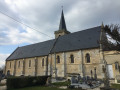
You can admire the small church of Héritot, which has been recently restored. Nearby, you will see the château, a pleasant private summer residence with classic 18th-century architecture, and its farm with its typical buildings.
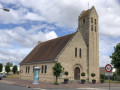
Notre-Dame d'Héritot Church
The hamlet of Héritot was attached to Saint-Ouen-du-Mesnil-Oger from 1833 onwards. The origin of the village's name comes from the eponymous saint (Saint Ouen), the Late Latin word "mansionile" (estate), and the anthroponym Oger.
Saint Ouen, or Dadon, was born in 609 in Sancy, in what is now the department of Aisne, and died at the age of 77 in Clichy-la-Garenne, which took his name to become Saint-Ouen (north of Paris). At an early age, Saint Ouen and his brothers decided to devote themselves to religion, and he received a pious education that enabled him to enter the court of Clotaire II and then DagobertI, whose chancellor he became. Ordained a priest in 634, he was elected bishop of Rouen five years later. In 686, he fell ill and died within the year. He was buried in Rouen.
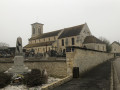
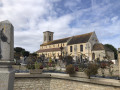
The church was built in the 14th or 15th century but was extensively remodelled in the 18th century, when the walls were covered with plaster. Above the western portal, in a small niche surmounted by a scallop shell, is a statue of Christ with a lamb on his shoulders. On either side of the entrance door, two niches were intended to hold statues that have since disappeared. The bell tower rises above the first bay of the nave. The choir extends the nave with a slight offset.
The high altar probably dates from the early 14th century. The subtle overall composition allows the eye to move from the lower part of the altar, through successive transitions, to the cross at the top, surrounded by two globes. The central part of the altarpiece (probably that of the parish church of Saint-Ouen-du-Mesnil-Oger) no longer features any artwork, but sources indicate that it once depicted the Descent from the Cross. Nevertheless, the frame has been preserved. On either side, fluted Tuscan columns support an entablature surmounted by a cross. The chromatic effect of the altarpiece is based on the contrast between the faux red marble of the columns and the faux white marble of the background, while the decorative effects are provided by the cherub heads arranged on either side of the tabernacle-pavilion decorated with three statuettes in niches separated by twisted columns. Depicted beneath the cherub heads, from left to right, are Saint Ouen, Christ and Saint Peter. The altar is decorated in the centre with a lamb lying on a cross and on the Book of the Seven Seals of the Apocalypse.
On the south wall of the nave is an altarpiece with a wooden statue of the Virgin and Child. On either side of the central niche is a faux marble Corinthian column supporting an entablature above which rises a cross. Two side altarpieces, located at the junction of the choir and the nave, no longer have altars. The one on the north side is very different from what it must have been originally, as the Virgin and Child that was there has now been replaced by a reproduction of a detail from a work by Rembrandt: The Return of the Prodigal Son (circa 1669, Saint Petersburg, Hermitage Museum). To the south, a saint receiving a crown probably dates from the 18th century. The saint, in the centre, opens his arms in a sign of acceptance while an angel places a crown on his head and two cherubs watch the scene. The structure of the two altarpieces is the same: the painting is in the centre of a curved frame surmounted by a cross and ending, on the sides, with a vegetal volute.
On the north wall of the nave, a painting depicts Saint Sebastian. The structure of the work and its frame could lead us to believe that this is the altarpiece of a third side altar. It is likely that some of this furniture comes from the former parish church of Saint-Ouen-du-Mesnil-Oger, which is no longer in use today.
On the west wall of the nave, two 18th-century paintings probably come from an altarpiece. The first shows Saint Ouen in episcopal robes, holding a crosier in his right hand and making a sign of blessing with his left hand. The second depicts Saint Michael slaying the dragon with his spear. Unfortunately, the paintings are in poor condition. They are both set in wooden frames decorated with plant and geometric motifs.
On the north wall of the nave, there is a 17th-century polychrome wooden statue of Saint Ouen, depicted in bishop's robes (chasuble, mitre) and making a sign of blessing with his right hand. It comes from the commune's former parish church. On the same wall, another statue depicts Our Lady of Good Counsel. Made of polychrome wood, it appears to date from the 17th century. The last statue worth noting in the church is the one on the south wall of the nave, a Virgin and Child dating from the 17th or 18th century. In her right hand, she probably held an object, such as a lily, which can no longer be discerned today.
The church has ten stained glass windows, four of which in the choir are historical. On the north wall are the Annunciation and Joan of Arc, while on the south wall are Saint Ouen and Saint Andrew. All of the stained glass windows date from the 20th century, but it is likely that those on the north wall, signed with the intertwined letters A and B, were made earlier than those on the south wall.
On the north wall of the nave, a funerary plaque pays tribute to a parish priest who died on 2 December 1539. The inscription is placed on a plaque framed by two pilasters and surmounted by a coat of arms featuring a griffin and an eagle supporting a fleur-de-lis. The coat of arms, with its fleur-de-lis, lion and bird, is presented by two angels, all under an ogee arch
A. Caumont.
Contribution: Association Le Pays d'Auge - https://www.lepaysdauge.org/
La Cour
La Cour, whose manor house was built by Toussaint Hélie in 1633, was home to the Hélie family until 1934 and now houses the prestigious stud farm of the Viel family. It is a private breeding and training estate for trotters, whose horses compete in the biggest races in this style of racing, which originated in Normandy. This stud farm is one of the most prestigious trotter stables in France and has distinguished itself several times in the Prix d'Amérique with "Mon Tourbillon", "Catharina" and "Abo Volo", winner in 1997. You can see the extensive facilities: stables, indoor arena, paddocks, training tracks... This establishment breeds, raises and trains horses that race all year round, in Vincennes in winter and in the provinces in summer, particularly in Cabourg and Dozulé.
The Château du Bois Roger
The Château du Bois Roger belonged to the d'Argences family, and a certain Roger had a chapel built there in the 12th century. An ornithological centre was created there by Jacques Perrin during the making of the film "Le Peuple Migrateur" (The Travelling Birds), released in 2001. Since then, these birds, geese and storks, are not uncommon in the region.



 Country:
 City:
City:



 Visorando Member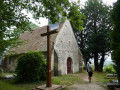

 Moderate