Around the Combe d'Orvaz

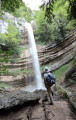
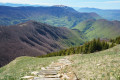
This is a fairly challenging circular trail around the Combe d'Orvaz: the main points of interest are the banks of the Sémine river and its waterfalls, the plateau around the Combe d'Évuaz, and then the Roches d'Orvaz and its cirque.

Details

420800
Creation:
Last update:
Last review:
  • Walking
    Activity: Walking
  • ↔
    Distance: 11.57 km
  • ◔
    Average duration: 5h 05 
  • ▲
    Difficulty: Very difficult

  • ⚐
    Back to start: Yes
  • ↗
    Ascent: + 629 m
  • ↘
    Descent: - 629 m

  • ▲
    Highest point: 1,201 m
  • ▼
    Lowest point: 722 m

Photos

Description of the walk

Park before the entrance to the hamlet of Orvaz at a road junction (there are a few recycling bins).

Updated on 25/05/2024:
Overall, the obstacles previously observed in the Combe d'Evuaz area are no longer a problem.
In addition, I noted two things:
- the path starting on the left just before the (6) has been repaired (marked in purple on the IGN map).
- access to the meadow overlooking the Combe, which was used by the route, is now fenced off.

The starting point of the alternative route indicated by BMAN (many thanks to him), leading from the forest path to the waterfall, has been identified. It is visible just after a short climb up the path and before its final section in a widened area. Two cairns mark the access point.

In view of these findings, the route has been modified.

Other difficulties remain on this challenging hike:
- the two fords at (2) and (7) may not be very obvious depending on the water level.
- in the Combe Bandit area, the route is off-trail (alternating orange and blue markings).
- the steep climb after (2).

For these reasons, I prefer to change the classification of the route as described: from today, it is classified as "Very difficult".
For those who are not sure-footed, I always recommend doing the route in reverse to Roches d'Orvaz (10), or even to Cascade de la Sémine (7), then returning by the same route.

(S/E) Follow the road uphill for about 700 m.

(1) When you reach the hamlet, continue straight ahead. At the exit, follow the gentle slope that leads to the Sémine river (follow the yellow markings). Along the way, you will pass two waterfalls on your left (small footbridges prevent you from getting your feet wet if the water level is a little high). At the end of the path, you will reach the river, where you will encounter some difficulties.

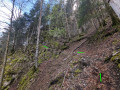
(2) Ford the river (be careful as the water level can be high depending on the season), then take a fairly steep path (be careful as the start is not very obvious and it looks more like a forest track).
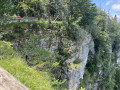
The route then continues along gentler slopes at the foot of cliffs overlooking the gorges.
There is asecond section with a fairly steep slope, then you will come to a clearly visible cave (not marked on the map).
Blue and orange markings along the way help you find your way.

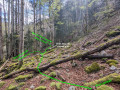
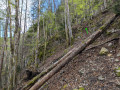
(3) Turn left to climb a small hill. The terrain becomes easier in the undergrowth, with a moderately visible path marked with orange and blue markings. Shortly before arriving at a replanted area (Combe Bandit), turn left downhill at the edge of the forest, staying close to a cliff: be careful, this is off-trail and some sections are cluttered with wood.
NB: the route of this last section was changed on 21/07/2017 (the original route currently crosses fields of nettles).
When you reach the top of the Cascade du Saut à l'Âne waterfall, wade across the river (trying to stay away from the waterfall). Be careful as the water level can be high depending on the season.

(4) Continue left on a moderately sloping path, then turn right and head uphill. Not far ahead, where the trail seems to disappear, head left, then very quickly turn right onto a visible path uphill (an old yellow marker confirms you are going in the right direction). Not far ahead, the path disappears and you should continue left, following another path that appears shortly afterwards.

(5) You will reach a forest path, close to its end, and follow it to the right for about 700 m. Look out for a path starting on the left (to be followed immediately afterwards), and a few metres further on you will find another on the right.

(6) Look for a cairn on the right and take the path downhill.

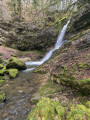
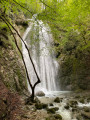
(7) You will soon reach the Cascade de la Sémine waterfall. Then return to the forest track by retracing your steps.

(6) Continue to the left for about ten metres, then take the path on the right that you spotted earlier going uphill: you will soon turn to the right and, after a steep climb, you will reach a more open area.

(8) Pass a signpost and continue straight ahead. Not far away, turn left onto a moderately visible path and you will soon find the direction quite obvious. The slope is a little steep atfirst, then much more moderate afterwards on a path that you follow for quite a while. After avoiding various paths and tracks on the right and left, you reach a tarmac road at Le Montelet.

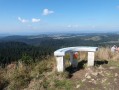
(9) Continue on the left for about 200 metres and turn left onto a path that quickly returns to the road. Shortly afterwards, you will see a sign on the left indicating the direction of "Les Roches d'Orvaz", which you should follow. You will arrive at a remarkable viewpoint.

(10) Continue along the path overlooking the cliffs for a few minutes. Once you have passed a cross on a hillock, you will arrive at a farm. At the intersection, turn left into the meadow, following the edge of the forest.

(11) Turn left onto a path towards Orvaz. Just before you reach a pasture, walk along its left side and take a path on the left that enters the forest (called Sentier du Facteur). Descend a few steep slopes (yellow markings) and further down, join a carriage road, Chemin du Soufflet.

(12) Take it to the right and then, at thefirst intersection, turn left, following the markings. The path descends gently, then more steeply after crossing a small stream. After a while, you will reach a pasture and then, fairly quickly, arrive in the vicinity of the hamlet of Orvaz. Turn right onto the small road.

(1) Continue to the right, then return to the starting point by retracing your steps (S/E).

Waypoints

  1. S/E : km 0 - alt. 723 m - Orvaz Road - Intersection
  2. 1 : km 0.69 - alt. 761 m - Orvaz
  3. 2 : km 1.71 - alt. 786 m - Sémine Waterfall Trail
  4. 3 : km 2.73 - alt. 1,016 m - Cave
  5. 4 : km 3.16 - alt. 972 m - Saut à l'Âne
  6. 5 : km 3.41 - alt. 1,015 m - Final section on forest road
  7. 6 : km 4.14 - alt. 1,040 m - Path on the right, small cairn present
  8. 7 : km 4.3 - alt. 1,002 m - Cascade de la Semine
  9. 8 : km 4.69 - alt. 1,085 m - La Bourbonache
  10. 9 : km 6.94 - alt. 1,201 m - Le Montelet
  11. 10 : km 7.45 - alt. 1,192 m - Roches d'Orvaz
  12. 11 : km 8.3 - alt. 1,166 m - Intersection towards Orvaz
  13. 12 : km 9.04 - alt. 987 m - Chemin du Soufflet
  14. S/E : km 11.57 - alt. 723 m - Orvaz Road - Intersection

Notes

Parking from the hamlet of Orvaz seems complicated to me.

The passage over Combe Bandit is a little tricky (not "comfortable" to be precise): I suggest an alternative route, which can be seen here.
I recommend this route if you have difficulty finding your way.

I also suggest another shorter route that avoids the Combe d'Evuaz area: click here

After the (2), I do not recommend accessing the waterfalls located upstream, as there are some perilous and dangerous sections: contrary to what the IGN map might suggest, the route ends in a dead end

The route has been classified as Very Difficult due to steep slopes and moderately visible passages, particularly between the2 and the forest road after the4.

There are two fords to cross (be careful as the water level can be high depending on the season).
Avoid in wet weather

Good hiking boots are strongly recommended.

Below is a difficulty rating for each section (a route is not uniform):
- green: fairly easy going with no significant elevation changes or difficulties.
- blue: steeper slopes and/or gradients on a well-marked route.
- orange: route presenting some technical difficulties and/or poor route viability (markings or visibility of the path).
- red: difficult route due to significant elevation changes that may require some climbing, in an environment with some hazards.
- black: trails that are quite difficult and/or involve contiguous hazards.
- white: route in very difficult technical environments requiring certain equipment.

From (S/E) to (2): Green difficulty.
The route is fairly easy on this section.
Yellow markings

From (2) to (3): Red difficulty
Crossing the river can be difficult if the water level is high.
There is a steep climb on a steeply sloping path. The gradient is then flat to moderate, but some passages overlooking ravines require caution. There is a second steep climb before arriving gently at the cave.
Markings alternate between orange and blue. These are helpful on some sections where orientation is difficult.

From (2) to (3): Orange difficulty.
Just after passing the cave, there is a short climb that may require the use of your hands, but after that, the route is fairly straightforward.
Shortly before Combe Bandit, orientation can be problematic on an off-trail section: first, you must be careful to turn left early enough towards the cliff (hidden by vegetation) where there are no markings to indicate it. After that, the markings are clearly visible along a path cluttered with a few trees.
Markings alternate between orange and blue.

From (4) to (5): Orange difficulty.
Depending on the water level, crossing above the waterfall can be more or less difficult.
Continue along a well-maintained path, then after a right-hand bend, the path virtually disappears and you will need to follow a moderately easy route to reach the forest road.
This section is not marked.

From (5) to (6): Green difficulty.
The route is easy to follow on a forest track.
Unmarked section

From (6) to (7): Blue difficulty.
Follow a small path that has been redeveloped, but remain vigilant, especially if the ground is wet.

From (6) to (8): Blue difficulty
The path is fairly easy at first, but then the slope becomes significantly steeper before reaching an open area.
Unmarked section

From (8) to (9):
Blue difficulty
The start of the trail is moderately visible, but the path itself is easy to follow. The slope is a little steep at first, but becomes much more moderate for the rest of the section.
Yellow markings

From (9) to (10):
Blue difficulty.
Take a small tarmac road and then a path, which is easy to follow.
Yellow markings

From (10) to (11): Blue difficulty
The route follows the heights of the Orvaz cliffs and is easy to follow: at most, you need to be careful near the cliffs.

From (11) to (12): Blue difficulty
Follow a pleasant path alternating between short ascents and descents. The difficulties encountered are minimal.
Yellow markings

From (12) to (12): Blue difficulty
Follow a trail with a few steep slopes that may be slippery when wet.
Yellow markings

From (12) to (S/E): Blue difficulty
Follow a forest path which is fairly easy going at first, but after crossing a small stream the slope becomes steeper, though not excessively so. After heavy rainfall, the lower part of this section can be quite muddy (particularly from around elevation 816 to the meadow overlooking Orvaz).
Yellow markings.

This route passes through a protected area, which may be subject to special regulations:

Worth a visit

Read here the little anecdote about the Saut à l'Âne, which has changed location.

Reviews and comments

4.1 / 5
Based on 18 reviews

Reliability of the description
4.1 / 5
Ease of following the route
3.7 / 5
Route interest
4.5 / 5
BMAN
BMAN

Hello,

That's it, I've done the left bank (last April) from the top, having parked at the mini car park where the path leading down to Combe Bandit leaves the D48a. I was able to get to the foot of the big waterfall. It's quite possible for a good hiker, and I found it even easier than the part of the path between the gorges and the Combe Bandit.
The Combe Bandit is always well marked in blue and there are plenty of fallen trees to go over and under or around. After making the round trip to the large Saut à l'Âne waterfall and also the lower waterfall, I continued along and down the gorges on the path but didn't go all the way to the bottom. So I still have to discover the lower part of the left bank.
But my aim was to get to the foot of the Grand Saut à l'Âne, and that's done: in the direction of the topo, in the long, steep straight that follows the end of the flat part that runs alongside the gorges, about halfway down, there's a small flat spot (rare in this area) on the left of the path. Head in this direction, and after a steady but safe descent of twenty metres or so, and after crossing some fallen trees, you come to a wider level where there are some large boulders, one of which is flat.
To get to the big waterfall, you have to cross these boulders and more or less find a path after them, then continue across keeping about the same altitude with the river quite far away, after 100m you cross a ridge (this is the level of the lower waterfall), then continue across for at least 200m and little by little, between the trees and a few rocks, the river comes closer as does the waterfall where you reach it without difficulty. The least obvious part is about 100m before the waterfall where the slope to be crossed with the river a little further away is a little steeper with a rock in the way, but nothing too serious, I went along the bottom of the rock. The fallen trees and small fir trees to cross at the end are sometimes more problematic.
It's quite easy to climb up and admire the waterfall on the cliff to the right (by looking at it).
On the way back, after crossing the slightly steep crossing section, you can easily get closer to the river by passing to the left of a large boulder, and you arrive at the top of the lower Saut à l'Âne waterfall (which is not on the maps).
You can also go to the foot of the waterfall (which I did, but with at least 60m more ascent) from the level where there are several boulders. A small river with lots of rocks flows down from the boulders to near the waterfall, but it's easier to go through the wood to the left. It's a little steep but easier to reach the waterfall just below the one you can see, and all that's left is to walk along the river, which you can see for a few metres, until you reach the waterfall. To really get to the foot of the waterfall, you have to negotiate a small, usually wet, step, which requires some care.

I've added photos of the fairly technical part of the gorges at Combe Bandit (between points 2 and 3).
There are occasional crossings of a couloir plunging into the not very visible gorges, including one (with beautiful cliffs on the right) where the leaves completely covered the tiny path. The steep slope ends in a not very reassuring gorge corridor on the left (photo attached).
Otherwise, the long, steep, straight slope separating the ridge above the gorges from the Saut à l'Âne rise is also partly difficult: fallen trees and a steep corridor that is a little slippery but not exposed.
There is also a key passage, the chimney that allows you to cross the sheer drop above the Grotte at point 3: with the leaves and the damp, you need to be careful because at the top, you overlook the sheer drop.
I spotted the path leading down to the upper Saut à l'Âne, but didn't go there. It is in fact below the young trees, which are a bit of a hindrance to getting into the real Combe Bandit meadow, where the wide path appears (or ends), crosses it and goes up to the D48a road. If the river crossing at Saut à l'Âne (above) poses a problem, this carriage road to P1032 above the Sémine waterfall (point 7) is longer but quieter.

Enjoy the hike.

Machine-translated

zbh0170
zbh0170
• Edited:

Hello,

Thank you for your detailed review.
I think I have identified the locations you mention:
- i had the opportunity to walk the route between marker P1154 and the point (5) once, and it is indeed not very obvious
- i went down to the bottom of the Grande Cascade waterfall, but I couldn't find the path leading to the top that would allow me to walk back up the river as you did
- regarding access between the bottom of the upper Saut à l'Âne and its top (point (4)): some time ago, I spotted a not very obvious passage on the left bank (to be checked to see if it is still passable). I did it from the top and the access was more visible in that direction.
- for the return to Orvaz, the direction is not necessarily obvious after the spring, and it is important not to miss the orange markings, which are very helpful (see also my other track)

Best regards

Machine-translated

4810MB
4810MB
• Edited:

Overall rating : 4.3 / 5

Date of your route : Feb 15, 2025
Reliability of the description : ★★★★☆ Good
Ease of following the route : ★★★★☆ Good
Route interest : ★★★★★ Very good
Very busy route : No

Here I am again. This time, I went back, starting with the Roches d'Orvaz first, so in the opposite direction, hoping to then cross the Semine and finally discover this left bank trail (between points 2 and 4). But in the end, I only did a variation of the circular that I'll describe in detail, although I did make a little more progress towards these secret gorges and waterfalls.

So first, in this direction, the climb to the Roches d'Orvaz has two little pitfalls:
- the start of the hamlet of Orvaz: the meadow you enter has no path, so you wonder if you're in the right place. You have to head towards Les Roches and then you'll see a path branching off to the left, making a hairpin bend to pass an orientation table (photo I added).
- Passage at point 12: there is no (or no longer) sign to leave the wide path that crosses the combe and take the steep final path. Only a yellow mark on a small rock on the ground and a few pebbles. I noticed this at P1004 and turned back.
Then, along the pleasant rocks, although a decree asks you not to get too close to them, and indeed large crevasses are widening.
Then came the plateau forest with wide paths that were not always easy to follow, but generally to the right.
As for me, I wanted to cut across and discover the path that starts at P1154 in the part overlooking the gorges. There is indeed a cairn and the path leads steeply towards Orvaz, arriving at a viewpoint at the top of the rocks/cliffs overlooking the gorges. From here, the path leading to the Saut à l'Âne starts discreetly but is not obvious, and is narrow for a small ledge that requires caution.
Otherwise, the path towards Orvaz is more marked, which is why it remains on the detailed IGN map, whereas the one I am going to take is no longer there. So, once you have crossed the ledge, this is the part where the path is least obvious, but you must continue to cross under the upper rocks. Crossing a couloir requires caution (walking stick recommended), then you cross a small scree slope, then a small slab. After that, it is more marked and easier, and you eventually arrive at point 5, but the tree cuttings are a bit of a hindrance and have made the path connecting to the large flat area disappear.
Then descend to Saut de l'Âne (upper). Always go into the lower woods (SE then turn right SW, sometimes old yellow markings) to overlook the gorges from a ledge. On the left, the path is blocked by a fallen tree (go around it) to reach point 4, the top of the upper waterfall. But once again, the flow is not huge but sufficient to make it impossible to cross the Semine safely, both towards the waterfall and upstream towards a small meadow.
I then set off in search of the Grande Cascade, still on the right bank. I retrace my steps. Shortly after the fallen tree, you can see the top of the Grande Cascade. I continue along the cliff face and after less than 100 metres, it levels out and we can descend (photo) to the lower part, where there is a more or less visible path. This time I head left, heading back east, this time along the bottom of the rocky cliff face. A path across the cliff face is slightly visible. The large waterfall on the right is getting closer, but with a steep slope ending in a large cliff. When you reach the waterfall, the slope becomes difficult to cross. It is best to head towards the waterfall, which is quite close on the slope. It is steep, but with a walking stick it is manageable. You are now above the first cliff, but it is difficult to see the large waterfall, even when you are very close.
However, upstream, you can see the upper Saut à l'Âne in the distance. A large fallen tree upstream can be crossed using its roots, then after crossing other smaller trees, I was able to cross the Semine to easily reach the rocks at the foot of the upper waterfall (photos). But on the left bank, at first glance, there is no feasible climb to reach a path.
After flying my drone around to admire the large waterfall, I decided to return to point 5 given the time rather than go back down to inspect the right bank again (particularly the access at the bottom of the Grande Cascade). So I climbed back up the same path to P1154, with its slight difficulties at the end, to descend to Orvaz.
This last trail is fairly easy, with a few trees to climb over during the long traverse. You pass above the mini cirque of the Résurgence (which you can climb to the top of if you're careful), then cross a scree slope/couloir, before finally coming across several large trees where the path disappears. In fact, you are not far from the source on the map. So you have to head more towards the slope, which has become much gentler, and you can see reddish marks on the trees, which is the right landmark. You will finally follow the hollow of a rather dry mini river, heading straight towards Orvaz. You will arrive at a meadow with a well/spring, and a wide path branches off to the left, which will take you to the Orvaz wash house.

That's it, the next stage is the bottom of the Grande Cascade, still exploring the left bank. I've found that winter is much better for visibility and off-trail hiking for the waterfalls on this hike.

Machine-translated

Arthur_43
Arthur_43

Overall rating : 4 / 5

Date of your route : Oct 26, 2024
Reliability of the description : ★★★★☆ Good
Ease of following the route : ★★★☆☆ Average
Route interest : ★★★★★ Very good
Very busy route : No

It's not easy to follow the route, but in the end you'll find your way! I can confirm that if you stay on the same bank from A to Z, you won't be able to reach the bottom, but you can access a few additional waterfalls, although the access points are exposed (be careful!).
Other than that, it's a beautiful hike, with a fairly steep incline but nothing impossible

Machine-translated

BMAN
BMAN

Hello,

Well, while exploring online (via canyoning), I just realised that the highest waterfall in the Sémine is located above the one I found below (which I called the 'Saut à l'Âne inférieur' waterfall in my description). This means that there is another waterfall that is not on the Géoportail map.
In fact, this high waterfall, which is nearly 30 metres high according to canyoning experts (which you found yourself above, starting from point 3), would be almost at the location of the 'Saut à l'Âne' on the map (very slightly upstream according to the altitudes given) with a large cirque. And it is "my" waterfall, about 15 metres high, which I discovered off the trail and which is not on the map. It is a little further downstream from the 'main Saut à l'Âne', so to speak.
I have posted photos of the 'lower' and 'upper' Saut à l'Âne waterfalls. All that remains is to explore to find the 'main' Saut à l'Âne, probably via the left bank, or perhaps by following the first drop I crossed during my descent, which would take me above the lower Saut à l'Âne.

As for the waterfall downstream, the fourth from point 1, your explanation confirms that it is not easy to access. I have posted a photo of the narrow corridor that probably leads to this waterfall. It was from this point (the start of the corridor) that I was able to access the north slope, joining the path below Montelet despite the fallen trees.

I will probably return there in the coming weeks or months to hopefully see this 30-metre waterfall up close.

Machine-translated

zbh0170
zbh0170
• Edited:

Hello,

Thank you for this detailed description and these beautiful photos. The waterfalls are stunning after the recent rains!

The area is not at all easy to navigate and you have to be very careful, especially if it is slippery (as you have seen). The slopes are steep and rockfalls can be a risk.
Like you, from the point (1), I had the opportunity to climb up the stream on the right-hand side on a path that is quite exposed to the void and where you have to be precise. From memory (my last visits were not recent), the large boulder to climb rings a bell: I remember it being one of the difficulties. I don't know if it's the same one you're referring to. I then continued on to reach a mini gorge between two large boulders where it's not possible to continue without getting wet (so it was almost a dead end).
From the Saut à l'Âne (point (3)), I didn't know the access you mentioned via the right bank. For my part, from the top of the waterfall on the left bank, I took a small, discreet path that required caution (especially on the descent) on a short section. Once at the bottom, I had "pushed on with the exploration" downwards (without difficulty) until I reached the overhang of another waterfall of considerable height, where access seemed very difficult to me. I didn't go any further.

Best regards

Machine-translated

BMAN
BMAN
• Edited:

Overall rating : 3.7 / 5

Date of your route : May 13, 2024
Reliability of the description : ★★★★☆ Good
Ease of following the route : ★★☆☆☆ Disappointing
Route interest : ★★★★★ Very good
Very busy route : No

Hello,
I wanted to see these gorges with their many waterfalls, and after the good rains of the last few months, I set off from Orvaz on this long Ascension weekend
It started well because the first springs before point 1 already gave me two unmarked waterfalls: the one before P762, which flows over the path via a mini footbridge, and then the Résurgence, which I recommend getting close to because after an easy 30 metres, you can see the mini cirque with several waterfalls flowing out of it.
Then, when I reached point 1, the end of the markings, a yellow mark on the tree clearly indicated a U-turn, followed by a cross further on. What a shame. In fact, another fallen tree was blocking the path along the right bank of the river, and this path was now narrow and overhanging the river. Nothing to see anymore. The Sémine was quite full and I couldn't see the dotted path opposite or where to join it.
My goal being the waterfalls, I continue, carefully climbing over the tree, continuing on the right bank despite the slightly wet ground, which is sometimes slippery but not dangerous. After two passable trees, we saw the first waterfall on the map. The narrow path continued to cross a few steep metres, even a drop, above the river, up to the upper level of the waterfall. From there, we could see the second small waterfall (about 3 metres high) with its pool.
We continue across, but the height above the river increases, and as we see the third waterfall, a delicate crossing requires caution as the 'path' crosses a mini corridor (1 metre wide) plunging steeply into the river. Before the waterfall, you cross a steep, leafy gully to reach a rock just to the left of the nearby waterfall. For me, this is where I failed. The 'path' goes through here, but it is at least 2 metres high with unstable ground sloping steeply down to the foot of the waterfall. The rock has a step, but it is quite high and mossy. The real problem is that there is nothing solid or easy to hold on to with your hands.
I then tried to climb up the steep valley (fortunately with a good walking stick) to try to cross this rocky ridge, but it wasn't easy to get down the other side without a rope. I perhaps regret not having descended it, even if it was narrow at the point where I couldn't get across.
I therefore attempted to climb back up the valley, hoping to find a passage to reach the upper path that runs along the gorges below Montelet, but despite this journey, with impressive cliffs on the right and a long rocky ridge on the left (I attempted a steep ledge but the rest was still uncertain among the rocks), with stones that once started rolling down didn't stop, and no path in sight. Only two chamois came down the slope at full speed, causing several rocks to fall, which I avoided. I returned to the top of the Resurgence, which I could barely see, and was able to descend the slopes and ridge on its left, which were steep but less so and well wooded, phew.
A little disappointed, I returned two days later, starting from point 6: a small cairn on the wide forest path indicating the place to descend to the Sémine waterfall. The marked path is a little steep, but descends fairly easily to the river and then the waterfall.
Then, we take the wide path again and I confirm that, due to the felling of trees, the start of the path leading north to Montelet has disappeared. Instead, there is a rather steep path that climbs up to the last 't' of Montelet on the map in the direction of Montelet.
I spotted two cairns located before a forest car park, which are indeed at the location of the dotted line descending on the map. Descend to the left via a barely visible path, on a flat area of young trees, then turn right to approach the steep slopes of the gorges. You can still see a few yellow marks on the trees, but a tree blocks the way. You can get around it on the left and join the fairly easy path that descends upstream of the river and takes you to the top of the upper Saut à l'Âne. It's a large waterfall, but it's difficult to see the bottom of the gorges. You can also see the path opposite leading to Combe Bandit, but it's not easy to cross without getting your feet wet. A fallen tree upstream of the waterfall is also an obstacle.
Then I returned to the flat area to follow the steep slopes, still on the right bank, in order to find access to the lower Saut à l'Âne. After about 100m overlooking the cliffs on the left, you can find an accessible slope heading west, leaving a cliff on your left. After descending a moderate slope, you come to another ledge which, if you look carefully (still in the downstream direction of the river), has an easy ledge (trail) to descend into mossy boulders (good landmark). The slope here, although steep, is manageable, and there is sometimes a trail. As you descend, the ledges on the right again lead you upstream towards the river. The last 5 metres gave me pause for thought: there was no path upstream (towards the waterfall) and a slab to cross with a tree in the way to try to follow the river. This second solution was the right one despite the tree. We were able to walk along the right bank of the river, despite having to step over some rocks in the water, and after 30 metres we came to a cave on the left. We then walked along the walls between leaves and fallen trees, finally going around a tree to find ourselves at the foot of the lower Saut à l'Âne waterfall.
Back at the foot of the climb, leaving the river, I noticed that this was the start of a narrow gorge where you could see the beginning of a waterfall at the bottom, probably the last one to see, the one in the middle.
However, after walking along the cliffs, still on the right bank, for at least 200 metres, there is no obvious way to get down. Given the steepness and the time, I contented myself with taking out my drone, which was difficult to get out between the trees, to see this last waterfall, which has about three drops as it emerges from the narrow gorge.
End of the journey, a good climb that I had spotted.
Perhaps a tricky descent downstream from the last waterfall was feasible, but it was really very steep and I was starting to see the cliffs I had walked along two days earlier. But the waterfalls were flowing well and were very beautiful. Not a soul in sight on Ascension weekend!
So I didn't tackle the left bank of the gorges, maybe another time.

Good luck to everyone for this beautiful place, which might deserve a little development, as it's rare to find so many waterfalls along such a long stretch.

Machine-translated

Squale01
Squale01
• Edited:

Overall rating : 4.7 / 5

Date of your route : May 23, 2021
Reliability of the description : ★★★★★ Very good
Ease of following the route : ★★★★☆ Good
Route interest : ★★★★★ Very good
Very busy route : No

Hello.
Hike completed on Sunday, 23 May 2021.
The three of us set off from point 6 and finished at the two waterfalls.
The difficulty is clearly stated, so no complaints on that front; hikers set off knowing what to expect...
Thank you for this superb route, but it is indeed very difficult in zones 1 and 2. We had a lot of trouble because the trail is difficult to find. Fortunately, we had GPS guidance (which doesn't do everything!), but it is very complicated to reach the top of the rocky ridge; a lot of effort was required at this point.
This hike is demanding in places and requires you to stay on the trail in sections 1 and 2. To reach the "saut à l'âne" (donkey jump), you tend to follow the yellow markings, when you should actually keep to the left and follow the blue markings. We also made this mistake and had to turn back to find the right path.
The route in this direction on the rocky ridge around the cirque is superb and impressive (great height).
A good hike, but one that is still aimed at experienced walkers looking for thrills in the critical zone 1-2 with a complex ascent and tangles to overcome (especially after very wet weather)...
It's true that in the opposite direction, the paths to the two waterfalls, "Semine" and "Saut à l'Âne", are less easy to find, even though they are signposted at the start of the forest path. I film waterfalls in the Ain region, and sometimes you have to find the access points yourself...
Thank you for this adrenaline-filled journey!
Drone Altitude
https://www.youtube.com/playlist?list=PL...

Machine-translated

zbh0170
zbh0170
• Edited:

Hello piccolopripri,

I also did the route from Roches d'Orvaz to Roche Fauconnière, passing through Combe d'Evuaz, either by road or by paths running almost parallel to it.

However, I haven't had the opportunity to do the route from Combe Bandit to La Grive, so I can't be of much help. From memory, I can say that the Combe Bandit section wasn't the most difficult.

I wish you a pleasant hike in advance.

Machine-translated

piccolopripri
piccolopripri

Overall rating : 5 / 5

Date of your route : Apr 28, 2021
Reliability of the description : Not used / Not applicable
Ease of following the route : Not used / Not applicable
Route interest : ★★★★★ Very good
Very busy route : No

Hello, I did the Roches d'Orvaz-Roche Fauconnière route a long time ago. Do you know if the path that starts just before Combe Bandit when coming from Orvaz and goes up towards La Grive (marked on the IGN map) is still passable?
Thank you for the information about the difficulties encountered in March-April. Not very encouraging!

Machine-translated

zbh0170
zbh0170
• Edited:

Hello,

I completed the route today in order to revalidate it as described. A few difficulties were noted:
- the watercourses had a good flow, making some fords difficult to cross,
- and many trees had fallen due to bad weather.
No significant forestry work was observed that could hinder progress.

In view of these facts, I currently recommend only making a return trip to Les Roches d'Orvaz (or even La Combe d'Evuaz) by taking the route in reverse to the description.

Machine-translated

zbh0170
zbh0170
• Edited:

For my part, additions have been made to the description (in particular, raising awareness of the preference for hiking in the direction indicated).

Taking a step back, it seems a shame that access to the Saut de l'Âne has not been promoted for some time (there is only a signpost (which is a bit old) pointing towards the Combe d'Evuaz farm).
In addition, I recommend reading a short article in the Journal du Progrès newspaper (read here).

NB: I also suggest an alternative, slightly easier route (avoiding the Saut de l'Âne); read it here.

Machine-translated

zbh0170
zbh0170

Hello Xavier,

I am very sorry that this hike was such a "nightmare" for you.

I can confirm that the route in the opposite direction is much less straightforward, particularly the access to the Saut de l'Ane, due to forestry work (still evident last autumn).

I wish your friend a very speedy recovery.

Machine-translated

grandin
grandin ★

xavier Pagnier

i am sorry to hear about this unfortunate incident. I will add a warning to the description

i wish your friend a speedy recovery

Machine-translated

xavier Pagnier
xavier Pagnier

Overall rating : 3.3 / 5

Date of your route : Mar 04, 2021
Reliability of the description : ★★★★☆ Good
Ease of following the route : ★☆☆☆☆ Very disappointing
Route interest : ★★★★★ Very good
Very busy route : No

We started the hike in the opposite direction to the one recommended, which was undoubtedly a mistake. The signposting in this direction is really poor. We always managed to find our way without too much difficulty until we reached the Saut à l'Ane, which we never managed to reach. The reality of the terrain is very different from the map. The forest path ends abruptly in a no man's land littered with fallen trees. According to the map, we should turn left along a large curve and descend to reach the Saut de l'Ane. We found no path or any markings. So we continued on, following a small black dotted line on the map... which led nowhere. So we plunged straight through the woods down a very steep slope towards the Semine... A disastrous decision! My partner, weighed down by her snowshoes attached to her rucksack, slipped on the leaves and got her foot stuck between some large rocks... The result: a badly sprained ankle and fainting... a real nightmare.
It was difficult for her to climb back up to where we had come from. We decided to continue down to the bottom of the ravine where the Semine flows, with the aim of reaching the Saut de l'Ane ford. Very bad idea. We found ourselves blocked by a 20-metre-high waterfall upstream and a very narrow canyon and waterfall downstream. After trying to find a way around these obstacles, we decided to climb back up the forest path that we knew was 200 metres higher up. Watch out for the cliffs! It was nearly 5.30 p.m... no network and not much battery left on my iPhone. We decided that I would go alone to seek help for my partner, who was in agony. She decided to try to climb up using her arms and one foot. As a pharmacist, she had some anti-inflammatory arnica cream and an energy booster (Sportedine) in her bag.
Just before my iPhone dies, I manage to call 15, who are able to geolocate me. The Ain fire brigade is alerted, contacts me and informs me that they are on their way. I turned back and went to join my partner, who had managed to climb up to the forest path. We made our way up this path, which was littered with fallen trees. We finally reached a small road near a farm. The fire brigade picked us up there. End of the adventure.
This hike is very beautiful, magnificent even... its difficulty lies mainly in its poor signage, especially if you do it backwards... next time I'll read the comments before setting off. I take full responsibility for our misadventure.
We will return in the summer, because I want to understand why we were unable to reach the Saut de l'Ane.

Machine-translated

Other walks in the area

For more walks, use our search engine .

The GPS track and description are the property of this route's author. Please do not copy them without permission.