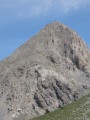
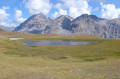
Aiguille Rouge and Lac Bellety

A magnificent circular hike that avoids a mundane return trip to the Aiguille Rouge. This hike ventures off the marked trails on a few occasions, but civilisation is always in sight, so it’s impossible to get lost.

After the superb viewpoint at the Aiguille Rouge, the route takes in two lakes as well as a multitude of fairy chimneys in the Combe des Thures.

Details

4208858
Creation:
Last update:
Last review:
  • Walking
    Activity: Walking
  • ↔
    Distance: 10.34 mi
  • ◔
    Average duration: 7h 55 
  • ▲
    Difficulty: Difficult

  • ⚐
    Back to start: Yes
  • ↗
    Ascent: + 3,589 ft
  • ↘
    Descent: - 3,589 ft

  • ▲
    Highest point: 8,320 ft
  • ▼
    Lowest point: 4,997 ft

Photos

Description of the walk

Warning:
Information on how to reach the starting point, as well as details regarding difficulty, alternative routes and precautions to take, is summarised in the ‘Practical Information’ and ‘During the Hike’ sections. All hikes require preparation, and this hike requires knowledge of the cardinal directions.

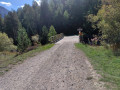
(S/E) From the hairpin bend at Notre-Dame de Bon Rencontre, take the GR® 57 which heads north-west then north. Forestry machinery has recently (2020) devastated the path, making it difficult to follow: stay in the micro-depression until you emerge from the debris of branches. Continue along the path, generally heading north, to reach, after a few hairpin bends, a flat clearing containing a ruined dwelling.

(1) A sign names the spot Bois de Saint-Hippolyte and points to the Chalet des Thures on the left. Continue in this direction, still on theGR®, heading north-north-west. The rock becomes more prominent and the path crosses some scree before winding through several bends. When the path reaches a flat area and heads west into a clearing, take a short detour (optional) southwards and back to walk alongside the ruins of Tête Noire on the right (as you head south) and reach a small promontory offering a view of the valley (see track).

Return to the main path, which leaves the wooded area after a circular route to the east and continues northwards. After two ruins on the right, it reaches a junction.

There are no yellow markings apart from a few cairns.

(2) At the ‘Ruines de Tête Noire’ sign, leave theGR®® and head towards the Aiguille Rouge, generally northwards, along a ridge.

(3) Pass the cairns on the left and continue northwards on the path, which straightens out. A series of hairpin bends marked by cairns leads to the summit of the Aiguille Rouge.

(4) From the summit, retrace your steps to reach the flat section of the ridge at the cairn seen earlier.

(3) Turn right to descend straight down the west-facing slope, then head north-north-west along the first path leading down through the scree of La Scia towards the Col des Thures. Lac Chavillon soon comes into view.

(5) Once north of Lac Chavillon, leave the path and follow a track up to the west-south-west, alongside the Riou des Thures. A few cairns mark the route. This leads to a flat area from which several boundary markers are visible to the south. These are the old boundaries between Savoie and Dauphiné. Head south towards these markers to reach Lac Bellety.

(6) Walk round the lake along one of its shores, still heading south, then take one of the many livestock tracks to descend south-east beneath the Serre des Creuzots. Cross a ravined stream above the Cabane des Thures, clearly visible below, and reach the ravined edge of the ochre-coloured Thures valley. Descend the ridge of this valley, to the east, to pass near the hut and join theGR®® below.

(7) A sign on theGR®® indicates the direction of Névache: be careful not to head back up towards the ruins of Tête Noire; take the right-hand branch of the path. It runs alongside the Combe des Thures on the right and reaches a series of switchbacks that plunge into the wooded slope, generally heading south-south-west.

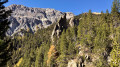
(8) Just before crossing a ravine, with a fairy chimney in view (see reference photo), a sign indicates a secondary path leading to Névache via the “left bank”. Follow this path, which descends due south. The detours in my route allow you to observe a few other fairy chimneys and tuff formations that have given their name to the Combe des Thures.

The path runs alongside the Torrent de Roubion and emerges from the larch trees at Cros de Roubion. Cross the meadows dotted with mounds of stones piled up by farmers to clear the fields and turn left (east) onto a track that joins the D1t road.

(9) Cross the D1t and head down towards the edge of the trees, to the south-east, to cross the D994g at Glutier de Roubion. A track runs alongside the Clarée and climbs back up to the road at a narrowing. Shortly after this, in the middle of the straight stretch of road, a path branches off to the left (car park spaces).

(10) Take this path north-west to climb up a ravine to the north, then cross it and, after a few hairpin bends, arrive at the Notre-Dame de Bon Rencontre wayside shrine (S/E).


Waypoints

  1. S/E : mi 0 - alt. 5,577 ft - Notre Dame de Bon Rencontre
  2. 1 : mi 0.6 - alt. 6,079 ft - Signpost at Bois de St Hippolyte
  3. 2 : mi 2 - alt. 7,274 ft - Signpost for the ruins of Tête Noire
  4. 3 : mi 2.59 - alt. 7,697 ft - Cairns
  5. 4 : mi 3.02 - alt. 8,317 ft - Summit - Aiguille Rouge
  6. 5 : mi 4.63 - alt. 7,185 ft - Lac Chavillon
  7. 6 : mi 5.15 - alt. 7,507 ft - Lac Bellety
  8. 7 : mi 6.45 - alt. 6,818 ft - Sign for the Chalets des Thures
  9. 8 : mi 7.14 - alt. 6,247 ft - Signpost for Névache on the left bank
  10. 9 : mi 8.94 - alt. 5,272 ft - D1t junction
  11. 10 : mi 9.76 - alt. 5,000 ft - Notre Dame Trail - Clarée (rivière)
  12. S/E : mi 10.34 - alt. 5,581 ft - Notre Dame de Bon Rencontre

Notes

?️ You can start from two locations:
- From the hairpin bend (S) at Notre Dame de Bon Rencontre N 45.021425º, E 6.653717º on the D1t if you wish to reach the alpine zone quickly at sunrise,
- From the path (10) starting above the Pont de Fanager N 45.015657º, E 6.653957º on the D994g if you prefer not to climb back up at the end of the circular route.

The links above take you to Waze. The route is described starting from Notre-Dame de Bon Rencontre (S).

? Water is scarce, as is often the case in Les Cerces, so make sure you bring enough with you.

? Dogs are allowed in the Cerces. It is best to keep your dog on a lead so as not to disturb the wildlife and livestock.

The small Lac Chavillon at the Col des Thures, below the Sommet Rond.?♀️ The difficulty of this hike lies on the borderline between ‘moderate’ and ‘difficult’, the only challenge being the off-trail section between Lac Bellety (5) and the junction with theGR®® 5 at :7::. The clear route makes it lean towards a ‘moderate’ rating, but the elevation gain forces me to classify it as difficult.

? Best undertaken in good weather to ensure easy navigation.

? The hike is too short to be suitable for camping.

? Standard hiking kit is sufficient.

⏰ To catch the sunrise over the Aiguille Rouge, you need to set off at dawn (one hour before sunrise) from (S/E) or 20 minutes earlier from the Pont de Fanager (10).

? Finding your way is easy in good weather, but a GPS — or of course the Visorando app — is recommended. Naturally, you need to be able to tell north from south.
- The right and left banks are always defined in the orographic sense, i.e. relative to the direction of the water’s flow.
- A tributary is a stream or watercourse feeding into a lake (the opposite is an outlet).
- Upstream is the direction towards the top (the mountain), downstream is the direction towards the bottom (the valley).
- The sun-facing slope is the side that receives the sun; the north-facing slope is its opposite.

? There is only one emergency number in France: 112. Other numbers (15, 17, or direct numbers…) have no priority on mobile networks, do not switch to other operators’ networks when there is no signal, and in the event of an overload of calls, ongoing calls are cut off to prioritise 112. So forget about them as soon as possible; they are dangerous and no longer serve any purpose (contrary to what some outdated training materials claim). If you cannot speak or hear, use 114 to communicate via text message. 112 works on any mobile phone (and landlines, of course), including on a locked phone and even if the SIM is blocked (however, since 2004, France has been in breach of European recommendations and blocks calls to 112 when there is no SIM in the phone. This blocking has required special investment, as the GSM standard naturally allows calls without a SIM card. Taxpayers will appreciate this particularly clever use of public funds).

⚠️ Please note: if your call is cut off, it is up to you to call the emergency services again: they have no way of contacting you or locating you. Remember to note down your GPS coordinates before calling, as the French government has still not deigned to equip mountain rescue centres with AML (Advanced Mobile Location) technology, despite this having been made mandatory by the EU since 2018.

? In the mountains, switch your phone to 2G: the range of this technology is 4 to 8 times greater than that of newer technologies, and it uses significantly less power. Remember to switch off your Wi-Fi, which drains the battery quickly and serves no purpose outside homes and offices. ? Bear in mind that your phone’s GPS tracking works even in flight mode (GPS has nothing to do with mobile phone signals).

?Checklist
☑︎ essential in addition to standard hiking kit
☑︎ 1.5 L water bottle

optional
☐ telescopic or non-telescopic poles

Not required
☒ any mountaineering equipment, unless following the route described by Pascal Sombardier.

⚠️ As a general rule, treat IGN topographic maps with a degree of scepticism, as they may contain inaccuracies. Some of the IGN topographic maps date back more than 25 years and have not been updated since (!). The free OpenStreetMap, updated by volunteers, is usually much more up to date; it is best to consult its OpenTopoMap version, which is easier to read.

Worth a visit

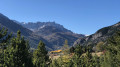
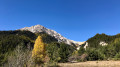
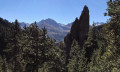
This album gives an idea of the landscapes.

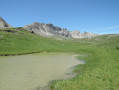
Lake Chavillon and the AiguilleRougeThe Aiguille Rouge is reflected in Lake Bellety.? Alpine wildlife is present, particularly marmots, chamois and ibex. However, theGR®® 57 is far too busy for this wildlife to be seen regularly.

? Lakes Chavillon and Bellety appear as superb mirrors in which the peaks are reflected.

The spherical view from Lake Bellety corresponds to these peaks identified by PeakFinder.

The Aiguille Rouge atdawn. A close-up of the Crête des Rois Mages, with Rocca Pompea and Roche Bernaude in the background. The Aiguille Rouge offers a superb (interactive) panorama of the Italian and French peaks. These are easy to spot thanks to Peakfinder.

The interactive spherical view from the foot of the Aiguille Rouge corresponds to these peaks.

This public album contains the highest-resolution photos from the trip.

? Several route options are available. The first involves starting from the Pont de Fanager (10) to avoid the climb at the end of the circular route. However, this has the drawback of delaying the emergence from the vegetation and is therefore not recommended for sunrise enthusiasts.

The second involves shortening the walk (9) and heading back up via the D1t to the starting point (S/E).

The most interesting alternative is the one described by Pascal Sombardier via the via corda starting at the Mauvais Pas, below the Col de l’Échelle. This more challenging alternative (Visorando rating: ‘extremely difficult’) requires standard mountaineering safety equipment (rope, harness, quickdraws, helmet). Once at the summit (4), follow the route to (7) then head back up to theGR®® at (2) and descend to the Mauvais Pas via the path that heads first east, then north-east, and returns south onto the road.

? Explanation of some terms:

  • a cairn is a pile of stones used as a landmark along a route. You can add cairns if you are sure of the route, and it is useful to replace stones that have fallen from a cairn.
  • a combe is a relatively wide valley or the hollow of a fold in the terrain.
  • Chavillon is a diminutive of the Occitan word chave, meaning hollow; Lake Chavillon is therefore situated in a hollow, unlike Lake Bellety, which lies at a higher elevation (on the slopes of the Bel beneath the Roche Pertuse).
  • Thures is the dialectal term for tuf limestone, a soft rock composed of cargneules and gypsum that forms the fairy chimneys in the eponymous combe.

Always be cautious and plan ahead when you're outdoors. Visorando and the author of this route cannot be held responsible for any accidents occurring on this route.

The GR® and PR® markings are the intellectual property of the Fédération Française de Randonnée Pédestre.

Reviews and comments

4.8 / 5
Based on 3 reviews

Reliability of the description
5 / 5
Ease of following the route
4.7 / 5
Route interest
4.7 / 5
eric_jrdn2
eric_jrdn2

Overall rating : 4.3 / 5

Date of your route : Aug 22, 2025
Reliability of the description : ★★★★★ Very good
Ease of following the route : ★★★★☆ Good
Route interest : ★★★★☆ Good
Very busy route : No

I find it problematic to disturb wildlife by going off-trail after Lake Chavillon. The trails are there, so we might as well use them. Going off-trail adds nothing. No pleasure, no different view.

As I'm afraid of heights, I hesitated for a long time before climbing the Aiguille Rouge. The wind died down at that point, so I followed the other hikers. The peak is impressive, but it's not that difficult. People climb it with their dogs.

For me, the difficulty lies on the Aiguille Rouge; the rest is no problem.

The scenery in the second part of the hike is magnificent.

Machine-translated

TITI 13 OVS
TITI 13 OVS

Overall rating : 5 / 5

Date of your route : Aug 05, 2024
Reliability of the description : ★★★★★ Very good
Ease of following the route : ★★★★★ Very good
Route interest : ★★★★★ Very good
Very busy route : Yes

A superb and very enjoyable walking route

Machine-translated

RPodor
RPodor

Overall rating : 5 / 5

Date of your route : Jul 01, 2024
Reliability of the description : ★★★★★ Very good
Ease of following the route : ★★★★★ Very good
Route interest : ★★★★★ Very good
Very busy route : No

A truly beautiful hike that requires a fair bit of effort to reach the summit of the Aiguille Rouge. After that, it’s a real feast for the eyes!

Machine-translated

Other walks in the area

For more walks, use our search engine .

The GPS track and description are the property of this route's author. Please do not copy them without permission.