Discovering Fermanville: land, sea and Mange-Cailloux

A walk that allows you to discover most of the points of interest around Fermanville. The figure-of-eight route comprises a long circular loop (15.5 km) and a short one (7.5 km).

Details

607604
Creation:
Last update:
Last review:
  • Walking
    Activity: Walking
  • ↔
    Distance: 20.86 km
  • ◔
    Average duration: 6h 45 
  • ▲
    Difficulty: Difficult

  • ⚐
    Back to start: Yes
  • ↗
    Ascent: + 284 m
  • ↘
    Descent: - 283 m

  • ▲
    Highest point: 137 m
  • ▼
    Lowest point: 1 m

Photos

Description of the walk

Start from the Vallée des Moulins car park, near the church and cemetery in Fermanville.

Long circular loop

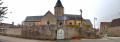
(S/E) From the car park, head towards the church (official start of the trail). Go round the church to the left, skirting the cemetery. Turn right, take the steps, follow the Chemin de l’Église and leave the bell tower (separate from the church) on your right. Cross the Chemin de la Cloche and continue straight ahead up the path.

(1) Cross the main Tue-Vaques path, continue along the Chemin de l’Église, skirting the cemetery and passing to the left of a beautiful oak tree. Cross a small road with care and continue along the path opposite. At the next road (marker 61), first turn left then right and follow a small road to the village of La Judée.

(2) In the village, head up to your left. At the next junction, turn slightly right (leaving the Chasse de la Noire Vallée on your left).

(3) At the crossroads, turn left (Chemin des Valmiers). Head south, ignoring the two turnings on the right. After a wooded climb and a reservoir, you’ll reach a T-junction (on the left, note a well-camouflaged bunker buried underground).

(4) Turn right. Then take thefirst path on the left. You’ll come out onto a wide path.

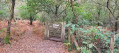
(5) Cross the path and go through the gate (just push it open) to enter the protected nature reserve (extensive grazing area). Follow a very pleasant but unmarked path. After leaving the grazing area, just before entering a wood, go through the exit gate and continue along the path.

(6) At the T-junction, turn right. The path (unmarked) descends through the middle of the Bois de Maupertus.

(7) At a fork, take the path on the right (not shown on the map). Join the Ruisseau du Vivier and follow it on your left without crossing it. Further on, cross the Ruisseau du Nid du Corps and keep the stream on your left. After a few steps to the left, you’ll come out at a car park.

(8) Leave the car park via the dirt track leading to it. Just before reaching the main road (D116), take a short, steep 5–10 m climb to the right to reach a wide path with a cattle grid. Follow this path to the right and head uphill. Ignore a turn-off on the left and continue uphill.

(9) At the top, when the wide path turns right, take a small track on the left. Note a few buried bunkers forming the French Bruley battery (or Brulay... or Brulé; the last bunker, the largest and most colourful, served as an observation post). Head down towards the sea along paths worn by animals grazing on the moor. Cross the D116 with care, turn right and walk carefully alongside the road for about ten metres. Then step over the safety barrier to take a barely visible path leading to the coastal path.

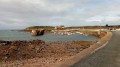
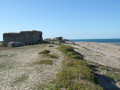
(10) Take the customs officers’ path to the right (red and white markings ofthe GR®223), stay as close to the shore as possible and ignore all turn-offs to the right. Walk along Anse du Pied Sablon and reach Port du Cap Lévi.

(11) Follow the quay to the left. Ignore a path branching off to the left and, at the next junction (marker 10), take the coastal path on the left. This will take you to Fort du Cap Lévi (formerly Fort Amiot; viewpoint).

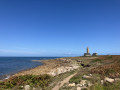
(12) Continue along the customs officers’ path, ignore all turnings on the right and reach the Cap Lévi Lighthouse.

(13) Continue along the customs officers’ path. At the small car park at the end of the road (marker 6), follow the road for a few metres and turn left immediately afterwards to rejoin the customs officers’ path.

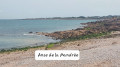
(14) Continue along the road past Port Pignot, then climb up to the left towards Castel de la Mondrée to enjoy the view. Head back down the path, which offers a lovely view of the beach, and follow the beach to the next small car park. Then leave theGR® and take the road on the right for about a hundred metres.

(15) Turn right onto the Chemin de la Heugue au Rey (a tree-lined path). Follow it and admire the sea view from under a pine tree. After ignoring a path on the left, turn left to climb up to the D116. Cross the road carefully and follow the Chemin du Gibert.

(16) You’ll come out onto a small road; follow it to the right, passing a riding school on your left. Ignore a path on the left, then cross the D116 again. Ignore a turn-off on the left and head downhill. Cross the River Le No and climb back up on the other side.

(17) At the end of a dirt track, before returning to the tarmac, turn left. Further on, join the D116. Follow the road to the left along a path protected by a railing (narrow track). This will take you to the access point for the starting car park, located on the right.

Short circular loop: in search of the Mange-Cailloux

(S/E) Continue along the D116 and ignore the turn-off to the right for the hamlet of Le Moulin. Pass the hamlet of La Bergerie and immediately turn right onto the Chasse du Crève-Cœur. You’ll come to a stream; follow it on your right, ignoring all side paths.

(18) Just after a slight bend to the right, turn left. Follow a path for about 150 m to admire the Mange-Cailloux. Retrace your steps.

(18) Take the Chasse des Houvetteries on the left and head uphill. Go straight on, southwards, ignoring the paths branching off to the sides. At the T-junction, turn right onto the Chemin des Argillières (clay extraction). Ignore a path on the right.

(19) At the fork, almost on a hillock, take the path on the left. Immediately ignore a path branching off to the right, turn left with the path and head southwards. Turn right with the path and, at the next junction, turn left at a sharp angle to reach the hamlet of Le Moulin.

(20) Turn right twice, follow the Chemin de la Vallée des Moulins and keep the Le Poult stream on your left.

(21) Go under a viaduct and continue along a small road. Ignore the side paths and head for the Vallée des Moulins car park (S/E).

Waypoints

  1. S/E : km 0 - alt. 9 m - Vallée des Moulins car park - Église Saint-Martin (Fermanville)
  2. 1 : km 0.58 - alt. 51 m - Chemin de L'Église x Chemin du Tue-Vaques
  3. 2 : km 1.35 - alt. 60 m - La Judée
  4. 3 : km 1.71 - alt. 75 m - Crossroads
  5. 4 : km 2.7 - alt. 129 m - T-junction
  6. 5 : km 3.21 - alt. 133 m - Protected natural site
  7. 6 : km 4.16 - alt. 127 m - T-junction
  8. 7 : km 4.64 - alt. 124 m - Fork
  9. 8 : km 6.21 - alt. 17 m - Car park
  10. 9 : km 6.93 - alt. 67 m - Path through the Bruley moor
  11. 10 : km 7.81 - alt. 11 m - Pointe du Brulé
  12. 11 : km 9.35 - alt. 5 m - Entrance to the Port of Cap Lévi
  13. 12 : km 10 - alt. 17 m - Fort du Cap Lévi
  14. 13 : km 10.93 - alt. 7 m - Phare du Cap Lévi
  15. 14 : km 11.84 - alt. 6 m - Port Pignot
  16. 15 : km 13.6 - alt. 9 m - Start of a small tree-lined path
  17. 16 : km 14.34 - alt. 34 m - Junction
  18. 17 : km 15.08 - alt. 14 m - Chemin des Vauches / Petit Moulin
  19. 18 : km 17.02 - alt. 32 m - Access to Mange-Cailloux
  20. 19 : km 18.49 - alt. 85 m - Fork
  21. 20 : km 19.1 - alt. 51 m - Moulin hamlet
  22. 21 : km 19.95 - alt. 33 m - Viaduct
  23. S/E : km 20.86 - alt. 9 m - Vallée des Moulins car park - Église Saint-Martin (Fermanville)

Notes

Just before (7), if your phone and/or GPS allows you to change the base map (sometimes called a ‘layer’), select the base map called ‘Open Topo’ or ‘OpenCycle Map’ – the only ones, to my knowledge, that show this specific path, which, on the ground, is actually the only one used: there is no risk of confusing it with another.

In (8): a short, steep climb saves you from having to follow the main road. It is by no means essential: if you cannot see it, follow the main road for 5 metres and take the climb on the right, which will take you over the cattle grid: go through the small gate if you want to avoid walking on the rollers.

Worth a visit

In front of Fermanville Lighthouse (Cap Lévi Lighthouse), in the car park, there is a memorial stone commemorating the sinking of the Fidèle.

The bell tower of Saint-Martin Church (S/E) is unusual as it consists of a bell tower completely separate from the church itself, situated on the hill so that the bells can be heard further afield.

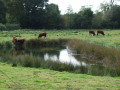
In the nature reserve (5), with a bit of luck, you might come across horses, donkeys, ponies, goats or sheep.

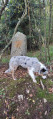
Shortly after leaving the nature reserve and turning right at (7), keep an eye on your left: you might be lucky enough to spot a small menhir behind a bush, offering a chance for an unusual break.

The last bunker (the largest) after (9) is called the Ancien Observatoire and offers a view of the main harbour, or Port du Cap Lévi, and the Cap Lévi Lighthouse.

Afterwards, enjoy the view of the fort (formerly known as “Fort Amiot”, named after its owner, the President of Chantiers Amiot). Picnics are possible inside the fort.

At (13), at the foot of the lighthouse, in the car park, you will see a memorial to an accident involving the barge known as “La Fidèle” (an accident that remains in the memories of many people!).

Admire the beauty of the little port of Pignot (14), sheltered by a rocky barrier, just behind Anse des Longs Camps. A pink granite quarry backs onto this little port!

The Mange-Cailloux is a beech tree that has grown over this low wall, ‘swallowing’ a few stones along the way. Look how gracefully one of these trunks, leaning over, catches hold of one of the other trunks with a horizontal branch and wraps itself around it!

On the descent leading to the Hameau du Moulin, shortly after leaving the Chemin des Argillières, you will pass a sheepfold on your left (organic cheese tasting on Sundays).

Always be cautious and plan ahead when you're outdoors. Visorando and the author of this route cannot be held responsible for any accidents occurring on this route.

The GR® and PR® markings are the intellectual property of the Fédération Française de Randonnée Pédestre.

Reviews and comments

4.9 / 5
Based on 4 reviews

Reliability of the description
5 / 5
Ease of following the route
5 / 5
Route interest
4.8 / 5
User 1344736

Overall rating : 5 / 5

Date of your route : Apr 04, 2026
Reliability of the description : ★★★★★ Very good
Ease of following the route : ★★★★★ Very good
Route interest : ★★★★★ Very good
Very busy route : No

Very well. Thanks to Viso Randonneur

Machine-translated

rAoule66
rAoule66

Great 🤩

Machine-translated

ArouG
ArouG
• Edited:

Visorando is an excellent website, but the "public sharing of tracks" feature is rather... limited. This is absolutely essential for minimising risks!
I suggest you take a look at this site: https://aroug.eu/trassage/

Machine-translated

rAoule66
rAoule66

😅
I realise I’ve been following a lot of your hikes and I love it 😊

Machine-translated

ArouG
ArouG

"I’ll have explored them all"
Er... there are loads of them! And I do sometimes come across new (short) sections...
And I’ve been skipping the sections that have been off-limits for the past seven years!
But... thank you again for sharing your experiences.

Machine-translated

rAoule66
rAoule66

Overall rating : 5 / 5

Date of your route : Oct 31, 2024
Reliability of the description : ★★★★★ Very good
Ease of following the route : ★★★★★ Very good
Route interest : ★★★★★ Very good
Very busy route : No

Another route around Fermanville.
I’ll have done them all 😅.
A magnificent, varied hike.
It didn’t seem difficult to me.
The second circular loop was lovely too.
I must say, I love the sea just as much as the woodland!
Thank you for a lovely day ☺️

Machine-translated

ChTitom
ChTitom

Overall rating : 4.7 / 5

Date of your route : Oct 15, 2024
Reliability of the description : ★★★★★ Very good
Ease of following the route : ★★★★★ Very good
Route interest : ★★★★☆ Good
Very busy route : No

A lovely, magnificent and very varied circular walk on the first loop; the second, shorter circular loop is less interesting but is worth it for the sight of this beautiful stone-swallowing tree and the viaduct.

Machine-translated

benoitrando
benoitrando

Overall rating : 5 / 5

Date of your route : Apr 26, 2024
Reliability of the description : ★★★★★ Very good
Ease of following the route : ★★★★★ Very good
Route interest : ★★★★★ Very good
Very busy route : No

A rather pleasant route

Machine-translated

Other walks in the area

For more walks, use our search engine .

The GPS track and description are the property of this route's author. Please do not copy them without permission.