Country:
 City:
City:


(S/E). Leave the car park and turn right onto Rue du Château (road D237). Follow this road downhill to the junction with Rue du Pont (road D227). At the junction, you will see the town hall/school building.
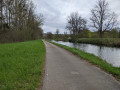
Take Rue du Pont to the right, which descends to the bridge over the Cure. As soon as you cross the river, turn right onto the path that runs alongside the Cure on your right. The path leads to Rue du Gué at an electricity pylon on your right.
(1) Turn left onto Rue du Gué and walk for about 20 metres before turning right onto Rue de la Haie Vive. Follow this road until you reach the junction with Rue de la Croix Benoit on your left. At this point, continue straight ahead into a narrow street that heads east and joins the RN6 national road. As you pass, you will see a fine example of traditional architecture.
When you reach the end of the lane, turn left and carefully cross the RN6 at the pedestrian crossing. Then continue straight ahead along Rue de la Gare, which leads towards the railway line and turns right. Pass in front of the station and continue south-east along the path that runs alongside the railway line on your left.
(2) At the T-junction, take the path on the left. Carefully cross the railway line at the gate (level crossing) and continue straight ahead on the uphill path to a crossroads where there is a calvary. There, turn right onto the path that climbs slightly along the Cure stream on the hillside.
The path arrives at Vallée Tarceau on the left and, shortly afterwards, on the other side of the valley, take the left-hand path uphill into the Bois de Chauvotte, which leads to the plateau where it arrives at a junction with theGRP® du Tour de l'Aveyronnais on the left.
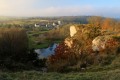
(3) At the T-junction, take the path on the right heading south-west. The path crosses the plateau (ignore the paths on the right that lead to caves and the Chêne de Saint-Moré oak tree). Leave the path at a post and climb up to the right. Climb to the top of the cliff and enjoy the superb panorama. To leave the plateau, take a small path (on the right, with your back to the cliff) to return to the original route. The path eventually descends the hillside west of the Malpierre spur towards the village of Nailly.
At the bottom of the descent, the path leads to Rue de Nailly, about 50 metres from the D606 road.
(4) Continue straight ahead on Rue de Nailly heading south. Cross the entire village lengthwise.
When you reach the D606 road south of Nailly, follow it carefully for about seventy metres, staying on the left-hand side (pavement) before crossing the D606 at a pedestrian crossing and turning right onto the C2 road towards Saint-Moré. Cross the Cure via the bridge and follow the road known as Rue du Pont to reach the hamlet of Crot. On the way, see the Château de Crot on the left and its outbuildings.
(5) At the junction with a road on the right at an acute angle, turn right heading north. The route then follows theGR®13-GR®654, which is one of the Chemins de Compostelle (Sens-Cravant-Vezelay route). Follow this road, which runs alongside a campsite on the right and is soon enclosed between the railway line on the left and the Cure on the right. The road then moves away from the railway line and follows the river. A little further on, the small road passes under the railway line.
(6) Immediately after passing under the railway line, turn left onto a farm track that runs alongside the railway line on the left before turning away from it to the right.
The uphill path crosses a small wood and then runs alongside a wooded area on the right and a cultivated area on the left, including a plot of vines. The path turns left in a wide curve with trees on either side.
(7) Take the right-hand path at a triangular crossroads. Continue straight ahead on the slightly uphill path, along the edge of the woods on your right. The path soon enters the woods and curves in an S-shape before heading west. It runs along the hillside above La Cure.
If you wish, you can leave the path on your right. After 10 metres, there is a beautiful view of the meanders of the Yonne. Back on the original path, a little further on, after the cross, you can take a path that descends to the right to reach La Roche Taillée (a Merovingian sarcophagus quarry) 200 metres away. Go back up the same path and resume the original route downhill into the Bois de la Côte Nailly.
A little further on, the path leaves the woods and crosses a cultivated area to reach a crossroads where there is a small calvary.
(8) Turn right to follow the white path, a wide stony road. Continue straight on along the spur known as Les Terres du Vallot before descending towards Val Sainte-Marie and the Manoir de Chastenay above the hamlet.
At the corner of the large field on your right, the path crosses Rue des Monts d'Arcy coming from Val Sainte-Marie on the left through a wooded area.
(9). Continue on the main path, which turns right on the flat, then descends again to the top of the Côte Coffin. The path joins a small road called Grande Rue on the left-hand side. At this point, turn right onto the stony path lined with power and telephone lines, which heads towards the edge of the plateau before descending the hillside towards the Grottes d'Arcy-sur-Cure (yellow markings) (see section "During the hike").
(10) Return to the small road known as Grande Rue. Follow it, turning left and walking along Côte Coffin in a north-westerly direction, then cross the hamlet of Val Sainte-Marie.
(11) On the left, you will come to a crossroads with Rue des Monts d'Arcy, which can be taken from point 9 by those who do not wish to go to the caves (see practical information - alternative route).
Continue along Grande Rue, passing the pretty Manoir de Chastenay on your left with its large round tower overlooking the street.
When Grande Rue turns left, take the small downhill lane on the right that joins Rue du Château. This short steep lane is opposite the ruins of Château de la Cobarde.
Turn right onto the path that soon runs alongside the castle's surrounding wall. The path leads to Rue du Château (road D237) with the car park on the left (S/E).




 Visorando Member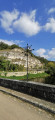

 Easy
Easy  Difficult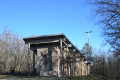
 Local authority