Country:

 City:
City:


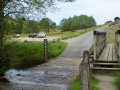
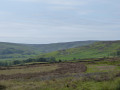
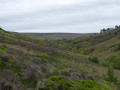
Park at the Hob Hole parking/picnic spot NZ652074. There is parking for about 20 sensibly parked cars, no camping and overnight camper vans.
(S/E) Please take care with this section as it is on the road. Walk in single file along the left side of the road, where you can step off onto the verge if cars pass. From the parking turn right onto the road, walk to the ford/bridge and use either to cross over. Follow the road which ascends steeply at first, but the gradient eases off as it bends to the right. Now look out for a junction with a minor road on the right. At the junction, turn right and follow the minor road southwards to a metal gate. From here, look out for Esk Valley Walk marker signs:- a round disk with a salmon and the words 'Esk Valley Walk'.
(1) As you pass through the gate the road becomes a farm track. Follow this track to Hawthorn House Farm, passing through wooden gates as necessary. The track passes to the right of the farm to another wooden gate. Go through and follow the track across the short pasture. The track descends and then splits. If the next pasture has no livestock, then take the right-hand split and cross the pasture to a gate on the far side. If there is livestock, then it is better to take the left-hand split and walk with the stone wall on your left around the edge of the field and to the gate.
(2) Pass through the gate and walk with the stone wall on your left. Pass through another wooden gate and onto a junction with a rough stone track. Turn left and descend gently, then follow the track passing a junction with a minor road on the left (ignore and go straight on). The track takes you to New House Farm. Just before the farm, look out for a signpost on the left.
(3) At the signpost, turn left and go through a gate into a field. Walk across to another wooden gate and marker next to a tree, and go through into the next field. Now aim for a prominent pole; there is another sign to its left with a wooden stile leading onto a bridge. After the bridge, cross the next field to pass through an obvious small wooden gate. Now walk with a wire fence on your left and aim for a stone step stile about 10m to the left of a pole. Cross over the stone stile and then follow the line of poles across the field to walk over a track and to a small wooden gate. Follow the path over the next field towards Wood End Farm and another small wooden gate.
(4) Go through and take the path to the right of the farm (with a wooden fence for the farmhouse garden on your left). You will see a stone stile in the bottom left corner; cross the stile and stream and follow the path, which crosses a farm track, to a wooden stile which leads onto a bridge. After the bridge the path is narrow and leads to a junction with a farm track.
(5) At the track, turn left and walk to a bridge/ford and signpost. Go over the bridge/ford and look out for a signpost and track on the right. Turn right and follow the track. You are now walking across the edge of fields, and the track becomes a path. As a rule of thumb, the small gates are found at the right-hand end of the stone walls, and there are marker posts to help you. Walk across three fields and descend into a small stream bed with wooden planks in the bottom, followed by a small wooden gate.
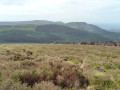
(6) Go through the gate, you are now entering moorland, and the path is narrow and sometimes wet underfoot. The boggy parts can be avoided by small detours, and in some of the worst places, there are duckboards. There is a stream down and to your right, after about 1 km the path descends via some stone slab steps to a bridge.
(7) Cross the bridge and on the far side go immediately up the far bank to a wire fence, sign and obvious gate on the far side of a short plank bridge. Go through and follow the path (crossing more duckboards) to a junction with a track. Turn left to a large metal gate and go through it to follow the rough stone track to a large wooden gate. Go through this and walk to a junction with another track. Now turn right at the junction and follow the track uphill to a large metal gate, pass through this and continue on an easier gradient to a junction with the old ironstone railway and a signpost. This is the end of the markers for the Esk Valley Walk.
(8) Turn right and walk along the bed of the old ironstone railway with views down Farndale on your left. The track curves left and right to follow the heads of the valleys. On the right is a grouse moor, you will see white painted names for the different shooting areas and ignore any gamekeepers' tracks on the right, instead keep to the bed of the old railway and walk for about 4 km to a large metal gate, after which is the Bloworth Crossing, signpost and information board.
(9) At the Bloworth Crossing, turn right and follow the track to the stump and remains of an old cross with another stone behind it.
(10) From here, keep following the track for 300 m, and you will see a pair of tracks on the left, which lead to Incline Top.
Option: If you have time, follow them to the top on Ingleby Incline and the information boards about the funicular winch, which was used for hauling wagons up and down the incline. Then walk back to the track.
Now follow the track for about 600 m, looking out on the right, for a pair of metal posts with a chain hanging between them.
(11) Turn right and cross the chain to follow another track, walk up to the stone pillar on the top of Burton How or follow the track around it. The track now heads northeast across Middle Head Top for just over 1 km, where it descends to join another track.
(12) Turn left and follow this track northwards, ignoring any tracks leading off on the left. On your right is the forested top of Baysdale, with a lot of young trees. The track starts to gently descend Middle Head, and just after 2 km you will arrive at a wooden gate leading into an older wood.
(13) Take the track down through the wood and go through a second wooden gate. Now walk downhill to a metal gate between a wall and a fence, go through this and diagonally across the pasture to a wooden gate on the left of the large farmhouse. (Baysdale Abbey, now holiday homes.)
(14) Go through and walk leftwards down into the farm yard and around the barn on your right. Keep following the farm track for 1 km, passing through 5 gates (which are usually left open) to a fingerpost.
(15) At the post, turn left off the farm track and onto a path. Go through a wooden gate and then cross a bridge. Follow the path up towards a stone barn.
You now have two choices:
A) The bridleway shown on the OS map goes up beside the barn and crosses a wall at the top of the field to then turn right and take a path to arrive at (16).
B) The following is an alternative which we took and is shown on open-source mapping. Before you reach the barn, look out for a metal gate (open) in the wall on the right. Go through the gate and walk straight over the next field to a gap between the stone walls. Walk across the next field to a gap in the wall just left of a tree. Now walk up to where there is a rabbit warren next to a stone wall and walk with the wall on your right. This takes you to a gate in front of a stone barn. Go through the gate where the ground may be wet, but a stone pillar has been laid down to allow dry passage. Turn left and walk uphill to an open gate on the left of a ruined barn. You will see a fingerpost behind the barn. Go through the gate and turn right to find the fingerpost.
(16) From the post, walk eastwards along the track/path with the wall on your right. This is straightforward to navigate. Walk all the way to a junction with a road,
(17) Please take care on this next short section and look out for cars. At the road junction, turn right and walk (single file) downhill on the left side of the road, where it is easy to use the verge and avoid vehicles. This will take you back to the parking. (S/E)
 Visorando Member
 Moderate
 Easy
Easy