Country:
 City:
City:


Start: The tour begins at the Volksfestplatz on Arkau (which is usually available as a large car park) or at one of the many smaller car parks or multi-storey car parks in Bad Mergentheim.
(S/E) From the car park, we walk a short distance straight ahead (northwards) and, at the row of trees, come to a footpath and cycle path, where we keep to the right. We follow the ‘Bad Mergentheimer Weg’ signpost, passing the mini-golf course, the tennis hall and the sports ground, continuing straight on. Soon, the well-maintained path takes us out of Bad Mergentheim across the fields, with the railway line on the left and the River Tauber on the right.
Before long, the first houses of Igersheim come into view on the left. After passing under the B19, we come to Herrenwiesenstraße, with a furniture shop on the corner. Here, we continue straight on (followingthe ‘Bad Mergentheimer Weg’ sign) along the railway tracks.
(1) We then reach the Heckenwirt restaurant and beer garden on the left-hand side. Behind the restaurant, we come to Bad Mergentheimer Straße.
Side trip
It’s worth taking a short detour of about 200 metres to the left to the Bamberger bakery and café (straight ahead over the railway tracks, Bad Mergentheimer Str. 13).
Otherwise, carry on to the right along Bad Mergentheimer Straße. Here, the signposting briefly switches to the Igersheim 50 circular walk. We cross the River Tauber and, at the next junction, turn left onto the street Am Kitzberg.
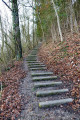
(2) Just past the first house, a narrow (somewhat hidden) path branches off to the right (signposted ‘Fußweg Burg Neuhaus’). This leads us along a somewhat bumpy path, over makeshift steps through the woods, up the hillside to the castle. Once at the top of the access road, follow it to the left. It leads us slightly uphill after a right-hand bend towards the castle.
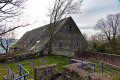
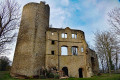
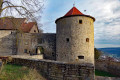
(3) Cross a bridge to reach the entrance gate. Neuhaus Castle was built in the 13th century and was owned by the Lords of Hohenlohe-Brauneck. It later passed to the Diocese of Würzburg. In the 18th century, following its reconstruction after being destroyed in the Peasants’ War, the bailiff of the Teutonic Order resided there, before the Order’s headquarters were moved to Igersheim. When Napoleon abolished the Order, the castle served partly as a prison and was also notorious as a so-called ‘torture castle ’. Today, the property is leased out. The famous Trakehner horses are bred in the outer bailey, but the inner bailey is open to the public. Events such as medieval markets are also frequently held here.
After the tour, we head back across the bridge, but this time – unlike on the way there – we do not turn left down the hill, but carry on straight ahead. After a short distance, we come across the sign for the Igersheim Circular Walk 50 again, but we leave this at the next fork by turning right and take the right-hand path again at the following fork.
(4) This path takes us through the Neuhaus Nature Reserve. We continue straight ahead across the fields and, after about 1.5 km, arrive at the edge of a small copse, through which we walk straight on. At the end of the copse, on the left-hand side, there is a small car park directly on the B290. We continue straight ahead, keeping to the right on the tarmac path alongside the B290. After a few metres, the path curves to the right and leads to the first houses on the outskirts of Bad Mergentheim (the cemetery is on the right-hand side). There, it continues as the Alemannenweg towards the town centre. We follow the road until we reach Maurus-Weber-Straße.
(5) We turn left and walk past the Old Cemetery of Bad Mergentheim to Kaiserstraße, where we keep to the right. At the end of the cemetery grounds, we come to Würzburger Straße. Here we turn left and then immediately right into Wachbacher Straße. This takes us straight to the market square.
(6) We walk past the Old Town Hall, which now houses the tourist information centre.
(7) We then walk past the famous twin houses on the right, across the Ledermarkt. On the left is St John’s Cathedral; behind it is the small St Martin’s Chapel – both are well worth a visit.
(8) At the next junction, we turn right and look straight into the inner courtyard of the Johanniterhof, which today houses a care home and a restaurant. The building complex is one of the oldest in Bad Mergentheim; the Franconian count’s estate was probably built in the 12th century by the House of Hohenlohe, who soon donated it to the Order of St John. In front of the Johanniterhof, we keep to the right through the Pfarrgang.
(9) At the end of the Pfarrgang, we look directly at the historic walls of Mergentheim Residential Palace. For centuries, the palace – built in the Baroque and Renaissance styles – was the residence of the Grand Masters of the Teutonic Order. This complex, which remains fascinating to this day, now houses a museum.
To enter the complex, we first turn right along Münzgasse and then immediately cross the bridge through the gateway. To reach the actual palace courtyard, we turn right and then right again straight away. The entrance to the museum is located in the inner courtyard. It is also worth taking a look inside the palace church.
We return along the same route, keeping to the left after the passageway, then turning right. The former farm buildings stand all around. At the far end of the complex, we go through the passageway and find ourselves in the castle park and Bad Mergentheim’s spa gardens. We take the second path on the right (signposted ‘Panoramaweg Taubertal’).
(10) We then walk past the pavilion – the ‘Halbmondhäuschen’ – on the right.
(11) After the right-hand bend, we turn left and then right before the castle pond.
On the opposite side, the Panoramaweg Taubertal leads us further to the right. We follow the path to a T-junction and keep to the right there.
(12) It’s worth taking a short detour here to the Schellenhäuschen, which was built in the style of a Chinese tea house. We head back and keep to the right. At the junction, we turn left.
(13) Behind the Japanese stele, we keep slightly to the right before crossing the bridge to the other side of the Tauber. At the fork, we turn right, then right again and immediately left. After the lavender field on the left, we continue to the right and keep to the left to cross the railway tracks.
(14) On the left is Café Amadeus; behind it lies the Fountain Temple with its healing waters and the promenade hall of the spa gardens. Immediately after the railway tracks, at the next opportunity (level with the café), we turn right and continue straight ahead. At a pavilion, we turn left and, on the other side, take the path to the right and then right again.
Before the rose garden, where the Karlsquelle spring is located, we keep to the left, walk round the garden keeping to the right, and come to a road (Erlenbachweg).
Here we turn right, cross the railway tracks and turn right at the next opportunity. At the T-junction, we continue to the left (signposted ‘Panoramaweg Taubertal’). In the right-hand bend, we turn left and pass under Schwimmbadstraße.
(15) We then reach the second spring on our route, the Paulsquelle.
(S/E) To the left of the Paulsquelle, we reach the large car park at the Volksfestplatz (Arkau) once again.
 Tourism professional
 Easy
Easy