When visiting Florence, you’ll be literally left speechless by the sight of the main monuments in the historic centre – a UNESCO World Heritage Site.
(S/E) Florence’s main railway station is of great historical and architectural significance. Designed by Giovanni Michelucci – and opened on 30 October 1935 – it has always engaged with the surrounding urban fabric, particularly with the church of Santa Maria Novella, to which it ‘contrasts’ through the horizontal nature of its form.
(1) Walking through the San Lorenzo district, bustling with numerous shops and restaurants, you arrive at the famous Covered Market, housed in a unique Art Nouveau structure of iron and glass. Losing yourself amongst the scents and flavours of this place is one of the finest gastronomic experiences one can have in Florence: on the ground floor, a large market offers fruit, vegetables, fresh pasta and typical Tuscan specialities – such as lampredotto and tripe – whilst on the upper floor, you can sample dishes prepared by the ‘artisans of taste’ right there on the spot.
(2) Piazza del Duomo: the Cathedral of Santa Maria del Fiore, Brunelleschi’s majestic dome – the symbol of Florence –, Giotto’s imposing bell tower and the ancient Baptistery of St John the Baptist, a jewel of Romanesque art, adorned with bronze doors by Ghiberti and Andrea Pisano.
Via dei Calzaiuoli: the street linking Piazza del Duomo (ecclesiastical power) to Piazza della Signoria and its Palazzo Vecchio (political power).
Today, it is one of the most elegant and busiest streets in the city centre, where, in addition to numerous shops, one can admire the splendid church and museum of Orsanmichele, whose external pillars feature copies of the fourteen statues of the patron saints, sculpted by Donatello, Verrocchio, Ghiberti, Giambologna and Nanni di Banco – the original sculptures have been moved to the Orsanmichele Museum, on the upper floors of the building.
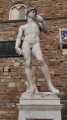
(3) Piazza della Signoria has been the beating heart of the city’s political life since the Middle Ages; indeed, it remains the main seat of Florence City Council to this day. The square is home to some of Florence’s most famous buildings: the Palazzo Vecchio with its distinctive tower – designed by Arnolfo di Cambio (a native of Colle di Val d’Elsa) – and the Loggia dei Lanzi, an open-air sculpture museum featuring masterpieces such as Benvenuto Cellini’s Perseus and Giambologna’s Rape of the Sabine Women.
Next to the square stands one of the city’s most important and famous museums: the Uffizi Gallery. A visit to the museum is well worth a whole day as it houses masterpieces found nowhere else in the world, but it is just as interesting to explore the palace that houses the gallery – built by Giorgio Vasari in 1560 on the orders of Cosimo I de’ Medici – and the Vasari Corridor, the extraordinary elevated passageway linking the Palazzo Vecchio to the Palazzo Pitti, on the other side of the Arno, passing over the Ponte Vecchio and through the Boboli Gardens.
(4) Ponte Vecchio: the oldest bridge over the Arno, which in the15th century housed the shops of fishmongers, butchers and tanners: in 1593, however, on the orders of Ferdinand I – who could not stand the unpleasant odours beneath the windows of the Corridoio Vasariano, where he passed every day – the spaces were taken over by goldsmiths and jewellers.
Even today, there are only goldsmiths’ shops on the bridge, making the Ponte Vecchio the ideal destination for a day of authentic Florentine shopping.
(5) Palazzo Pitti: the palace of the lords of Florence and Tuscany, where the Medici lived, followed by the Lorraines and, after the unification of Italy, the House of Savoy, during the years when Florence was the capital.
Today, the Palazzo Pitti is one of the city’s most important museums: it houses the Palatine Gallery, a rich art collection comprising a remarkable selection of Renaissance paintings – including works by Raphael, Caravaggio and Titian – as well as the royal apartments, furnished with16th-century furniture. The Gallery of Modern Art, also located within the palace, displays works of art from the late18th century to the early decades of the20th century.
A short detour down the narrow street ‘Via Sguazza’ takes you past the house where Lisa Gherardini (future wife of Francesco del Giocondo) was born; she is universally recognised as the model for Leonardo da Vinci’s Mona Lisa. The house is marked by a small plaque and a bas-relief.
(6) Piazza Santo Spirito: one of the city’s most beautiful and lively squares. It is dominated by the façade of the basilica designed by Brunelleschi. Picturesque, with its artisans’ workshops and artists’ studios, its restaurants and clubs open day and night, it is one of the symbols of the Oltrarno district and a favourite meeting place for locals and tourists alike. It is the ideal spot to take a break in one of the many cafés that bring the square to life.
The Basilica houses Michelangelo’s wooden crucifix and precious works by Filippino Lippi, Sansovino, Orcagna and Giuliano da San Gallo: it is well worth a visit, even if only for a very brief one.
Every morning – except Sundays and public holidays – the square hosts the local market, selling locally grown fruit and vegetables.
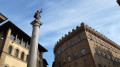
Piazza Santa Trinita: it is home to the ancient Basilica of Santa Trinita, rich in history and sacred art: it is one of Florence’s earliest religious buildings of Gothic origin and, over the centuries, has been embellished and enriched with works of sacred art such as Cimabue’s ‘Madonna in Majesty’ – now housed in the Uffizi – and adorned with frescoes by Buontalenti, a versatile Florentine artist and architect.
The square then opens onto Via de’ Tornabuoni, the street of luxury and the world’s leading fashion houses. It is dominated by the Palazzo Spini-Ferroni, which houses the Ferragamo Museum, the Palazzo Tornabuoni and the Renaissance-style Palazzo Strozzi, which hosts major temporary exhibitions.
Piazza Santa Maria Novella: here stands the basilica of the same name. The splendid façade of white and green marble is just a foretaste of what the church holds within: inside are masterpieces by Masaccio, Giotto, Ghirlandaio, Brunelleschi and Botticelli.
On the other hand, if you find yourself here at sunset, it’s lovely to spend a few moments in one of the square’s cafés, sipping a glass of fine wine in the tranquillity, whilst taking in the city from a different perspective.



 Country:
 City:
City: