

 Country:
 City:


Starting point and access: Poterne des Peupliers.
- Tram – Line T3a. Alight at the rear of the tram, regardless of the direction of travel.
- Bus – Route 184.
Head for Rue Gouthière: if arriving by tram, regardless of the direction of travel, this street is a few dozen metres behind the station (relative to the direction of travel); if arriving by bus, the stop is on the street.
(S/E) Follow Rue Gouthière south-west, i.e. towards the ring road and away from Boulevard Kellermann. Cross Avenue Caffieri and continue straight on into Rue de Sainte-Hélène. After about 150 metres, you will find the cemetery entrance on the right.
The route within the cemetery is a guide only and there are various alternative routes. In the description that follows, the names appearing on the graves may be highlighted for three different reasons:
1) Graves of notable figures, in which case a lower-case letter in brackets refers to a short entry in the ‘Places to see’ section, where the names are listed in the order in which they appear on the route.
2) Particularly original monuments.
3) Useful landmarks within the cemetery.
(1) Enter the cemetery and turn immediately right into the Allée des Deux Portes. Pass the Allée des Tilleuls on your left, go past the reception area on your right, and arrive at the Rond-Point de la Demi-Lune (on the left, a grave at the foot of which a banana tree has been planted). Then turn left onto the Allée du Vieux Cimetière. Just after a tree, on the left-hand side, you’ll find Claude Chéreau’s grave (a).
Shortly afterwards, at the foot of another tree, turn right onto a path at the corner of the Lauent-Barrault grave. Note the Dedouvre family grave (b) on the left, whose headstone has weathered with age. At the end, squeeze between two graves, emerge onto a tarmac path (Allée du Nord) and follow it to the left.
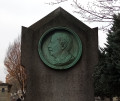
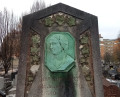
Take the first left, the Allée de la Pyramide. At the next junction, turn right onto the Allée du Vieux Cimetière. At the foot of a tree, turn right at the corner of the Duchassin-Thierrée grave. On the left-hand side, you will find the grave of Charles Bitte (c), adorned with a medallion. At the junction, turn left onto a grassy path. At the next junction, note the grave of Jules Amiot (c) on the right, adorned with a medallion, and continue straight ahead.
(2) At the T-junction that appears shortly afterwards, note the grave of Charles Calmus (e) opposite and turn left. At the end of the path, head right towards a signpost. You will emerge onto Allée des Sycomores; follow it to the left (the Muslim section is on the right). At the junction that appears immediately, turn right onto Allée des Ormeaux.
You will arrive at the foot of the grave of Simon Remoissonnet (f) and his son Marcel (g), whose very tall headstone is adorned with a mosaic. Then turn left and note, on the right-hand side, the grave of Léon Bouchez (h). At the next junction, turn right into Allée Principale. Note the bust of Paulin Mery (i) on the right-hand side and you will immediately reach a crossroads.
(3) Then turn right into the Allée du Sommet and walk past the Gentilly war memorial. Next, turn left at the corner of a small building and note, on the right-hand side, the medallion adorning the grave of Alphonse Truffaut. Then turn sharply left and return to the previous crossroads.
(3) Turn right into Allée du Sommet and you will immediately find, on the left, the grave of Auguste-Henri Jacob (j), whose bust has been removed (or stolen). Turn sharply right straight away into Allée de la Glacière. Note, on the left, the Nicoli-Wagner grave adorned with stained-glass windows. Take the first right, the Allée des Ifs, and follow it to the end: opposite, a bas-relief adorns the Féron memorial.
Retrace your steps and, after about twenty metres, turn right into a grassy path. Further on, cross a tarmac path and continue straight ahead along a grassy path. After two rows of graves, turn left until you reach the Canet grave on the right-hand side, where a hand is unrolling a (stone) plaque inscribed with the names of the deceased.
Retrace your steps and continue left along the grassy path. At the end, pass the Alloyer grave on your right, come out onto a tarmac path and follow it to the left until you reach a rotunda. Then turn right into the Allée de la Glacière. Note, on the right-hand side, the grave of Louis Millet (k) adorned with a medallion depicting him in action.
At the next junction, turn left into the Allée Nouvelle. At the end, turn left at the foot of a large tree. Pass between the Zapp and Sourzat graves and continue straight ahead along the Allée de l’Est. You will cross the Allée des Bastions on your left and, immediately afterwards, turn right into a wide paved area between the Niel and Javelle-Gousson graves.
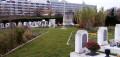
You will emerge onto Allée des Marronniers; follow it to the left. You will cross Allée du Centre on your right and reach a junction. On the right is a military plot paying tribute to those deported and members of the Resistance during the Second World War, including, right at the back behind the memorial stone, Robert Lynen (l).
(4) With your back to the military memorial, note the pink granite grave of Charles Frérot (m). Then turn right and you will immediately find, on the left-hand side, the communal grave of four members of the Resistance (n) who were shot in August 1944. Shortly afterwards, at the foot of a signpost, turn left onto a path, leaving the Faubert grave on your right.
After the third row of graves, turn left onto a path. On the left-hand side, you will find the grave of Carmen Leroux (o). At the end of the path, turn left and return to the crossroads. Note the grave of Hélène Édeline (p) on the right.
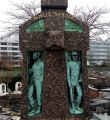
(4) Turn right into the Allée des Marronniers and, at the junction immediately ahead, turn left into the Allée du Sud. The tenth grave on the left is that of the Samour family, adorned with two statues representing soldiers who died in action in August 1914 and April 1915, respectively.
Retrace your steps and, at the junction, turn left into the Allée des Marronniers. The penultimate grave on the left-hand side, just before the next junction, is that of France Roche (q). Then turn right into the Allée des Acacias. At the next junction, turn right again, into the Allée des Sycomores.
At the end, rejoin the Allée du Sud and follow it to the left. On the left-hand side is the Konnert grave, adorned with a medallion depicting Jeanne, created by Michel. Still on the left-hand side, a medallion adorns the grave of Edmond Guion. You will reach a junction with the Allée de la Pyramide.
(5) Carry on straight ahead and note, on the left-hand side, the grave of Raoul Bertheau (r). The grave of Raymond Souplex (s) is also on the left. Retrace your steps to the previous junction.
(5) Then turn right onto the Allée de la Pyramide, lined with conifers. Take the first right, the Allée Principale, and walk alongside a row of chapels. At the next junction, turn right onto the Allée des Cyprès. Take the first left, the Allée des Amandiers, and pass the Allée des Platanes on your left.
The fourth grave on the left after this junction is that of Paulin Enfert (t). Two rows further on, still on the left-hand side, is the grave of Pierre Pène (u). Walk back a short way and turn right onto a paved path at the corner of the Gautreau-Roussel grave. At the end, turn right to reach the cemetery’s entrance/exit gate immediately.
(1) On leaving the cemetery, turn left. Continue straight on until you reach the Poterne des Peupliers (S/E).
 Visorando Member